
Why technology is autocracy’s perfect accomplice
There is a road near my house where the speed limit changes three times in two or three kilometres, for reasons known only to the municipal engineer who approved it, possibly in a previous birth. Every driver treats the signage the way we treat most Indian law: as a suggestion, an opening bid in a negotiation the state has neither the manpower nor the appetite to conduct. This is not lawlessness, irrespective of what the traffic police say on Twitter. It is the oldest democratic arrangement there is: the law announces itself, the citizen decides how much of it to obey, and somewhere between the two, a society finds its actual speed.
Since July 2024, every new car sold in the European Union must carry Intelligent Speed Assistance, a system that reads the signage so you don’t have to, and then nags, vibrates, or gently strangles the accelerator when you exceed the limit. For now, the driver can override it by pressing harder, a concession the regulation describes in the soothing vocabulary of assistance and empowerment. But anyone who has watched software evolve knows what an override is. It is a feature awaiting deprecation. The headphone jack was also an override once.

The American legal scholar Lawrence Lessig saw this coming in 1999 when he wrote that code is law. He meant it literally. A statute must be interpreted, enforced and argued over in courtrooms by lawyers in bad ties or bands in most of the Commonwealth. Code simply executes.
A speed limit on a signboard is a law you can break and then contest. A speed limit in the firmware is a law that precedes the offence. You cannot stand before a compiler and plead mitigating circumstances. The compiler was not elected, takes no petitions, and has never once adjourned for lunch.
So, who writes this law? Not your MP, who, on current evidence, may not be able to operate the settings on his own phone. The defaults that govern how a billion people drive, pay, speak, and are seen were written by product managers optimising for engagement in office parks in California and Bengaluru, reviewed by nobody you voted for, and shipped on a Tuesday. Democracy’s basic unit is the argument. Code’s basic unit is the default. Nobody has ever voted for a default.
Here you will be told, in the reasonable baritone reserved for telling citizens to calm down, that this is simply where technology is headed. The technology is coming, the technology is here to stay and you cannot stop progress. Notice the grammar. The sentence has no subject. Technology does not head anywhere; it is not a monsoon. It is designed, funded, lobbied for, and shipped by people with names, salaries, and quarterly targets. When a man tells you something is bound to happen, he is telling you that somebody wants it to happen and would rather you didn’t ask who. Inevitability is the passive voice of power. The speed limiter did not descend from heaven; it emerged from a decade of committee meetings in Brussels, and the surveillance camera on your street corner was a line item in a budget that a specific officer signed with a specific pen. “It was bound to happen” translates, in every language, as “it was budgeted for.”
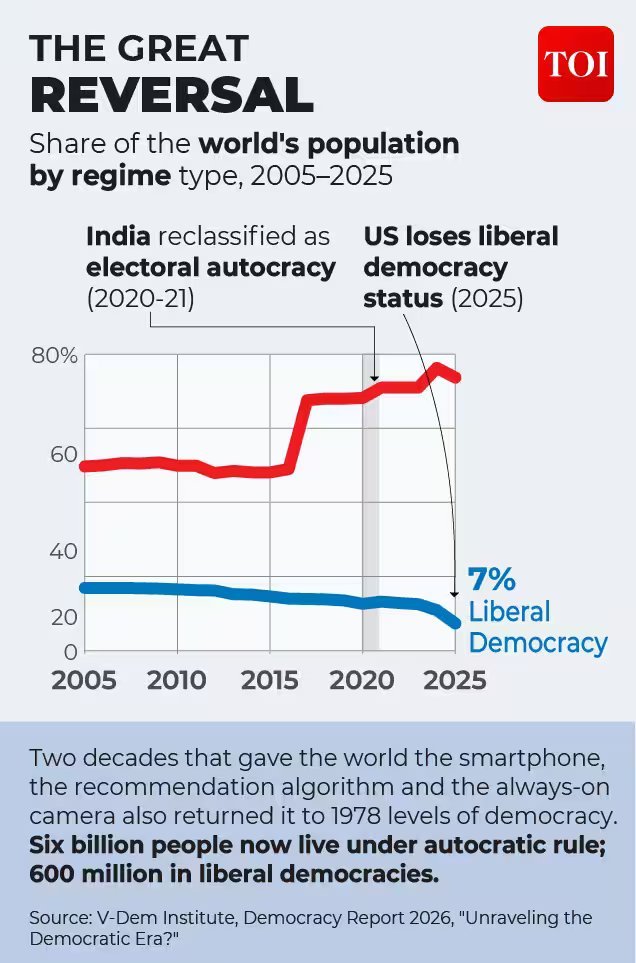
And once you refuse the grammar of inevitability, the graph starts to look less like weather and more like work. The V-Dem Institute’s 2026 report, the sort of document that measures democracy the way actuaries measure death, finds the world back at 1978 levels, 74 per cent of humanity under autocracies and the United States, in a sentence I did not expect to type in this lifetime, no longer a liberal democracy.
The third wave of democratisation, which began the year Portugal sacked its dictators, has been almost entirely reversed in the two decades that gave us the smartphone, the recommendation algorithm, and the camera that never blinks. Correlation is not causation, as every undergraduate learns and every columnist tends to forget. But when the same twenty years produce the greatest surveillance apparatus in human history and the deepest democratic recession on record, one is permitted to squint. Autocracy used to be labour-intensive. It needed informers, files, and a stamina for paperwork that even the Stasi (the East German secret police) found exhausting. Now it scales much more easily.
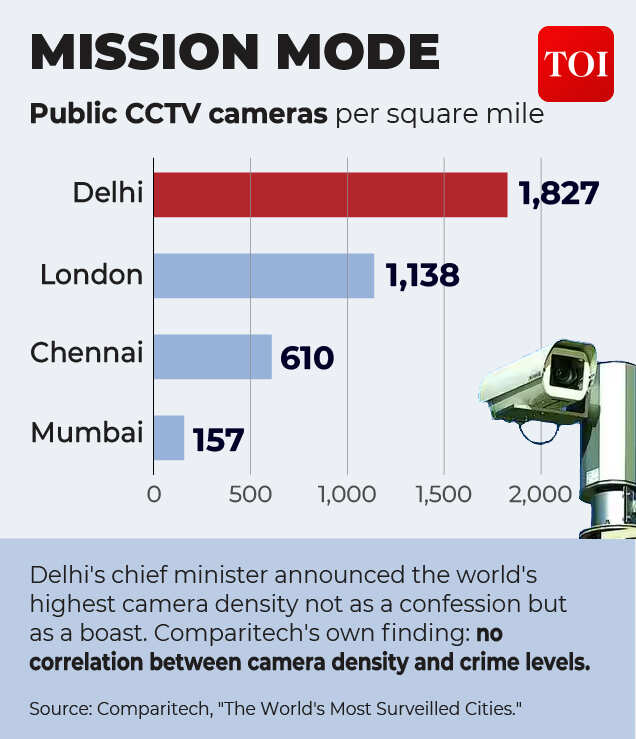

We need not squint very hard at home. At Guwahati’s railway stations, cameras now raise an alert if a person stands still for more than five seconds, which, in an Indian railway station, describes everyone who has ever waited for a train, a coolie, or clarity on Platform 4. In examination halls across Uttar Pradesh and Bihar, algorithms reportedly study the eye movements of teenagers for deceit. Orwell imagined the telescreen hunting Winston Smith for thoughtcrime; he did not imagine it invigilating a Class 12 board exam. Even dystopians have limits of imagination.
And here is what Orwell, bless his sooty English pessimism, got wrong. The boot does not stamp on the human face forever. The boot offers the face a shorter queue. Digi Yatra, our airport facial recognition scheme, is voluntary the way things are voluntary in India: the staff wave you toward the camera and the paperwork happens to your face. The Internet Freedom Foundation has documented the coercion, noted that the foundation running it is three-quarters privately owned and therefore sits outside the Right to Information Act, and asked, so far into the void, who audits the machine that knows what fifty million of us look like. Meanwhile, the middle class, my class, the class that once marched for things, taps its face against the scanner and feels the small triumph of beating the fellow still fumbling with a boarding pass. We were promised the panopticon would be imposed on us. Nobody warned us we would apply for it, upload a selfie and rate the experience four stars.
The Data Protection Act we finally passed exempts the government from most of its own rules, like a household where the rulebook binds the children and the staff but never the uncle who wrote it. That is the design. Surveillance here is not a bug in the system. It is the system, and the system is popular because it arrives dressed as convenience, as safety, as seamlessness. Seams are where garments can be altered; a seamless society has been stitched shut by a tailor who took your measurements while you slept.
None of this was bound to happen. All of it was designed, and what is designed can be redesigned, provided we stop treating engineers as weathermen. I think of that road near my house and the signboard everyone ignores, and I understand now that the signboard was never the point. The point was that ignoring it was possible. The freedoms a constitution grants you arrive with trumpets and lawyers. The freedoms a default removes leave quietly, in an update, while you sleep, and the release notes will say only that performance has been improved.
The Reading That Got Me Into This Mess
- V-Dem Institute, Democracy Report 2026: Unraveling the Democratic Era?, University of Gothenburg, March 2026 — democracy at 1978 levels; 74% of the world population under autocracy; US loses liberal democracy classification.
- Regulation (EU) 2019/2144, General Vehicle Safety Regulation — Intelligent Speed Assistance mandatory on all new vehicles sold in the EU from 7 July 2024; overridable by the driver. Explainer: European Transport Safety Council.
- Lawrence Lessig, Code and Other Laws of Cyberspace, Basic Books, 1999 (updated as Code: Version 2.0, 2006) — the “code is law” thesis.
- Comparitech, “The World’s Most Surveilled Cities” — Delhi: 1,826.6 CCTV cameras per square mile, the highest globally; London: 1,138; Chennai: 609.9; Mumbai: 157.4.
- Arvind Kejriwal’s “mission mode” statement on Delhi’s camera density, The Tribune, 26 August 2021.
- SFLC.in, “Artificial Intelligence and Surveillance in India: 2025 Roundup”, January 2026 — Guwahati railway cameras flagging persons stationary beyond five seconds; AI-enhanced CCTV at the Maha Kumbh; FRT in metro and railway stations.
- Internet Freedom Foundation, “Resist Surveillance Tech, Reject Digi Yatra” — coercion at airports; privacy, exclusion and accountability concerns.
- Global Voices Advox, “India’s race to adopt AI sparks a deeper question”, April 2026 — Digi Yatra Foundation ~75% privately held, outside the RTI Act; AI proctoring of board and competitive exams in UP, Bihar, and Karnataka.
- Digital Personal Data Protection Act, 2023, Section 17 — exemptions for the state and its instrumentalities.
Disclaimer
Views expressed above are the author’s own.