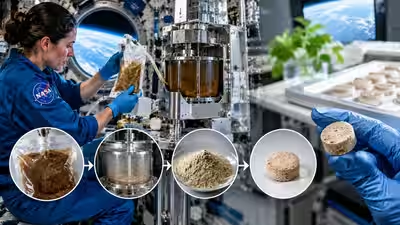
Nasa is testing a way to turn astronaut poop into a sterile, odour-free material that could be recycled |

Image: AI representation of a way to turn astronaut poop into a sterile, odour-free material that could be recycled For astronauts travelling far beyond Earth, even the most ordinary human waste becomes a serious engineering problem. On a long-duration mission, there is no convenient rubbish collection, unlimited storage space or easy way to send unwanted…

Read More

Scientists turned dog poop into fuel and found it could produce both hydrogen and methane |

Dog waste is usually treated as an unpleasant urban problem, something to be collected, bagged and thrown away. But researchers are investigating whether it could instead become a source of renewable energy. A new study has examined dog faeces as a feedstock for producing biohydrogen and methane through anaerobic biological processes. The research, published in…

Read More

Meet François Génier: The Canadian Museum of Nature scientist who used animal dung to uncover three new beetle species on a remote African island |

Image: ResearchGate/François Génier Deep in the rainforests of Bioko Island, Equatorial Guinea, a deceptively simple field technique helped reveal beetles that science had never formally recognised. Canadian entomologist François Génier, from the Beaty Centre for Species Discovery at the Canadian Museum of Nature, surveyed the island’s dung beetles using traps baited with animal dung. The…

Read More

In 2013, Czech researchers studied 70 dogs from 37 breeds and found they aligned north-south while defecating when Earth’s magnetic field was stable |

Dogs may be doing more than simply choosing a spot when they stop for a break. A 2013 study by Czech researchers found that dogs tended to align their bodies along Earth’s North-South magnetic axis while defecating, but only when the planet’s magnetic field was relatively stable. The research involved 70 dogs from 37 breeds,…

Read More

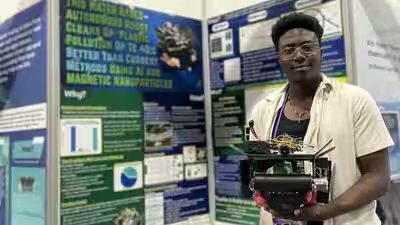
A 17-year-old Canadian student built an AI-powered water robot that uses magnetic liquid to find plastic without harming aquatic life |

Moroti Adegboyega. Image Credit: Jonas Borg / Stockholm Water Foundation A 17-year-old Canadian student has developed an AI-powered robot designed to tackle one of the most persistent forms of water pollution i.e plastic. The project, called ‘Ecoferroquatics,’ uses artificial intelligence, robotics and a magnetic liquid known as ‘ferrofluid’ to identify and remove plastic from water…

Read More

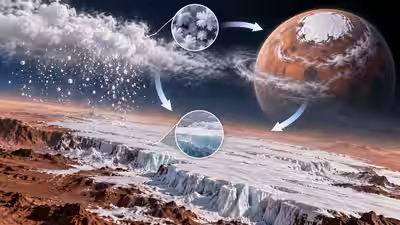
Mars winter turns carbon dioxide into snow and ice, cycling 25% of the atmosphere and changing circulation across the planet |

Winter on Mars is not simply a season of plunging temperatures and long polar nights. As the planet moves into winter, its atmosphere begins to change with it. Carbon dioxide, the dominant gas in the Martian atmosphere, can freeze directly onto the ground or fall as snow, building temporary polar caps that hold a substantial…

Read More

Meet Thorin Jonsson, the biologist who used 165-million-year-old insect wings to recreate the sounds of a Jurassic forest |

Millions of years ago, several species produced higher frequencies, just like the native leaf grasshopper. Image Credit: Thoris Jonsson/University of Graz Jurassic World was not silent. Around 165 million years ago, forests in present day Inner Mongolia were filled with the calls of insects communicating through sounds that ranged from low tones to frequencies beyond…

Read More

White storks vanished from Southern Sweden in the 1950s; a wetland revival now aims to support 100 breeding pairs |

A flock of White Storks. Image Credit: Society for Ecological Restoration(SER) White storks once formed a familiar part of the landscape in southern Sweden, but by 1954 the species had disappeared as a breeding bird from the country. Their decline was closely linked to dramatic changes in the countryside, where wetlands were drained and other…

Read More

In 2019, Buffalo scientists developed a low-cost urban cooling system to reduce AC loads; tests showed 6°C cooling by day and 11°C at night |

In 2019, scientists at the University at Buffalo developed an electricity-free cooling system that uses a thin aluminium film coated with the polymer polydimethylsiloxane, or PDMS, to send heat from its surroundings through the atmosphere and towards outer space. The approach, known as radiative cooling, was designed to overcome a key challenge: making passive cooling…

Read More