In 2019, Buffalo scientists developed a low-cost urban cooling system to reduce AC loads; tests showed 6°C cooling by day and 11°C at night |

In 2019, scientists at the University at Buffalo developed an electricity-free cooling system that uses a thin aluminium film coated with the polymer polydimethylsiloxane, or PDMS, to send heat from its surroundings through the atmosphere and towards outer space. The approach, known as radiative cooling, was designed to overcome a key challenge: making passive cooling…
Read More

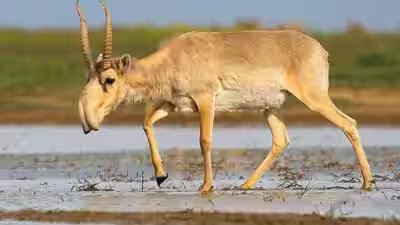
Kazakhstan lost 200,000 saigas in a devastating die-off in 2015; now the population has surged past 4.6 million creating tensions with the human population |

Wild saiga antelope. Image Credit: Andrey Giljov/Wikipedia In 2015, Kazakhstan’s vast grasslands became the scene of one of the most devastating wildlife losses in recent history. Around 200,000 saiga antelopes died within weeks, leaving a population already weakened by poaching and earlier declines facing another impossible setback. The disaster wiped out more than two thirds…

Read More

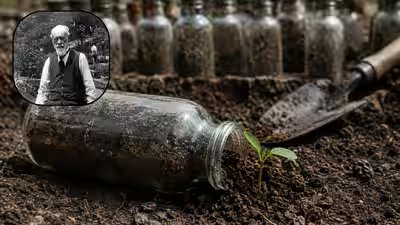
A Michigan scientist buried seeds in 20 glass bottles in 1879; 142 years later, some still grew, and the experiment is set to run until 2100

Michigan State University botanist William James Beal buried 20 glass bottles filled with seeds In 1879, Michigan State University botanist William James Beal buried 20 glass bottles filled with seeds and sand in an effort to answer a deceptively simple question: how long could seeds remain dormant in the soil and still grow when conditions…

Read More

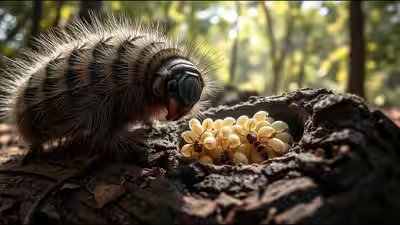
A parasitic wasp turns caterpillars into zombie bodyguards; they spend their final hours protecting the larvae eating them alive |

​Representative Image of a caterpillar guarding wasp larvae and aggressively swinging its head at approaching predators (AI-generated image) A species of parasitic wasp has evolved one of the strangest survival strategies in the insect world, turning its caterpillar host into a living bodyguard for its own young. The wasp, from the genus Glyptapanteles, lays as…

Read More

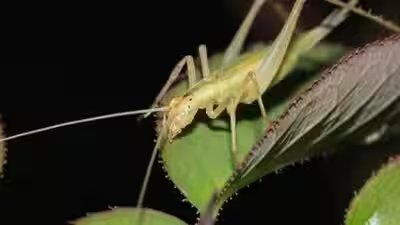
Scientists used fossil wings, lasers and AI to recreate the calls of insects from 165 million years ago; some Jurassic species were already communicating above human hearing

The research focused on nine extinct insect species related to modern crickets and katydids. For 165 million years, the sounds made by insects living alongside dinosaurs were lost to time. Scientists have now recreated some of those calls using fossilised wings, studies of living insects, computer modelling and artificial intelligence.According to Smithsonian Magazine, the research…

Read More

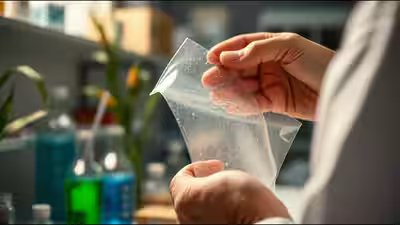
Meet Onndinadaho Rasilwela, the South African student who turned sugarcane and maize waste into biodegradable plastic |

​Representative Image of biodegradable plastic made from sugarcane and maize waste (AI-generated image) Onndinadaho Rasilwela, a chemical engineering graduate from South Africa, has won top honours at the 2026 Green Youth Indaba for developing a biodegradable plastic from agricultural waste. A member of the Tshwane University of Technology’s Student Women Economic Empowerment Programme, Rasilwela received…

Read More

A huge forested island appeared in a British Columbia reservoir, vanished, then resurfaced 30 km away 15 days later with trees, birds and other animals still aboard

British Columbia reservoirRepresentative image from Canva In the summer of 2026, workers and residents around the Williston Reservoir in northern British Columbia witnessed something that sounded like folklore: a large, forested island broke free from the shoreline, drifted across the lake, disappeared from view, and then turned up again about 30 kilometres away, still carrying…

Read More

Trees have their own version of muscles: Scientists discover how they sense a tilt and straighten themselves, a lesson in how nature finds its balance

To study proprioception alone, the researchers had to remove other cues that normally affect a tree’s growth. A tree might look like it’s stuck in place, quietly suffering whatever weather comes. But below that stillness is a remarkable system for sensing, responding and correcting its own posture. But new research suggests that trees can sense…

Read More

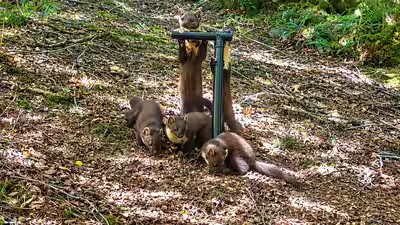
Pine martens vanished from England for a century; locals built den boxes and set up cameras to track their return, now four kits have been spotted |

Pine martens are making a remarkable return to south-west England after disappearing from Exmoor for more than a century, with conservationists capturing the first confirmed evidence that the reintroduced animals are breeding in the wild. A remote trail camera recorded a female pine marten with four kits on Exmoor, signalling that an ambitious effort to…

Read More

Quote of the day by Neil deGrasse Tyson: “If you want to assert a truth, first make sure it’s not just an opinion that you desperately want to be true” |

In an age when information moves faster than ever, distinguishing between what is true and what people simply want to believe has become increasingly important. People can form strong opinions about science, health, politics, technology and everyday events, sometimes accepting claims because they fit what they already believe. Astrophysicist and science communicator Neil deGrasse Tyson…

Read More