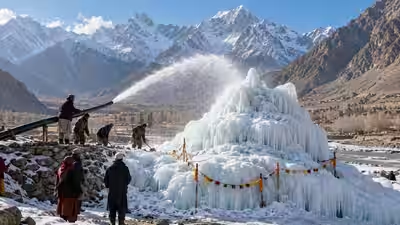
Communities marry glaciers in Gilgit-Baltistan to create artificial glaciers as climate change threatens water supplies |

High in the mountains of Gilgit-Baltistan, communities are reviving an age-old practice to answer a modern water crisis: they are ‘marrying’ glaciers. As natural glaciers shrink and meltwater becomes less reliable, local people are carrying pieces of ice from existing glaciers to carefully chosen sites, where male and female ice are brought together and buried…
Read More

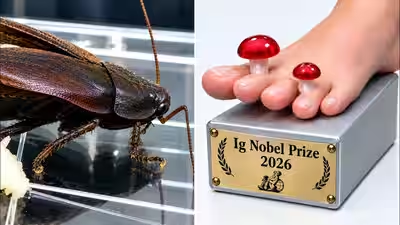
Scientists studied cockroach milk and won an Ig Nobel Prize for it; crystals inside contain a dense store of nutrients |

Image Credit: Left/The Wire/Right/CNN A cockroach producing something resembling milk sounds like an unlikely subject for serious scientific research. Yet one species has developed a remarkably unusual way of nourishing its young. The Pacific beetle cockroach, Diploptera punctata, gives birth to live offspring rather than laying eggs, and its developing young feed on a milk-like…

Read More

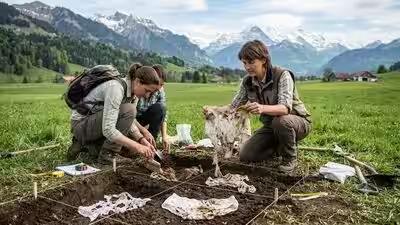
Scientists buried 2,000 pairs of cotton underwear across Switzerland; what they found revealed the health of the soil |

A pair of cotton pants is not usually considered scientific equipment. Yet across Switzerland, thousands of them spent weeks underground as part of an unusual experiment into the condition of the soil beneath people’s feet.More than 1,000 volunteers took part, burying underwear and teabags at sites ranging from private gardens and farmland to grasslands and…

Read More

Harvard neuroscientists kept human brain organoids alive for over five years, breaking the 694-day record and mimicking brain development |

Harvard neuroscientists have kept tiny clusters of human brain cells alive in laboratory dishes for more than five years, setting a new record that could change how researchers study the human brain. The peppercorn-sized brain organoids, each containing more than one million cells from the cerebral cortex, survived for roughly three times as long as…

Read More

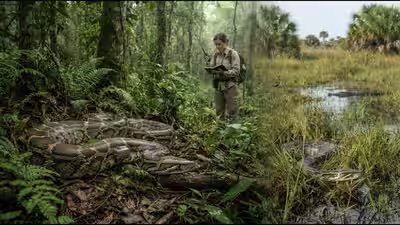
Florida hunts Burmese pythons, but Bangladesh is tracking them to save them; scientists are using radio tags to understand the threatened snake |

The Burmese python has become a symbol of two completely different conservation battles. In Florida, wildlife managers search for and remove the giant snake because its introduced population is threatening native wildlife in the Everglades. Thousands of kilometres away in Bangladesh, researchers are putting radio transmitters on the same species to understand where it moves,…

Read More

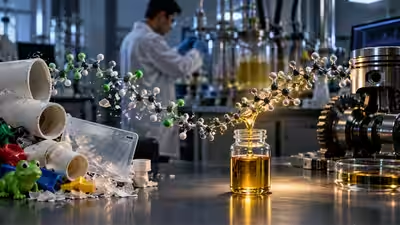
Scientists turn one of the world’s hardest-to-recycle plastics into high-performance engine lubricant, giving stubborn PVC waste a valuable second life |

One of the world’s most difficult plastics to recycle could soon have a far more valuable second life. Scientists at Virginia Tech have developed a chemical method that converts polyvinyl chloride, or PVC, into polyalphaolefin, an important material used in high-performance lubricants including engine oil. The approach tackles a longstanding problem with PVC, which is…

Read More

Why EOS-05 matters: Isro breaks Gisat jinx, returns to flight & gets 1st success of 2026

Gisat-1A is the programme’s second attempt, and its success finally gives India the capability that Gisat-1 was meant to establish. BENGALURU: When Isro’s GSLV-F17 lifted off from Sriharikota early Friday and successfully placed Gisat-1A or EOS-05 into its intended orbit, the mission did more than add another Earth observation satellite to India’s growing fleet.It ended…

Read More

In 1921, a young Canadian doctor experimented with starving dogs; one dog’s dramatic reaction helped lead to the discovery of insulin |

Representative Image of Frederick Banting and Charles Best conducting early diabetes research in a laboratory with dogs (AI-generated image) In May 1921, Frederick Banting arrived at the University of Toronto with an idea about diabetes and little laboratory experience. Professor John J.R. Macleod gave him space in the physiology department, several dogs and Charles Best,…

Read More

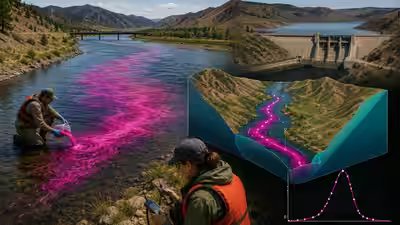
In 2010, US scientists released dye into Montana’s Missouri River and tracked it across 41.2 miles; one reservoir held the plume for 8.2 hours, helping predict chemical-spill timing

Representative Image (AI-generated) A river can carry a contaminant far beyond the point where it enters the water, but predicting exactly how quickly that material will travel is not always straightforward. In 2010, scientists with the U.S. Geological Survey (USGS), working with the Montana Department of Environmental Quality, conducted a dye-tracing experiment on a 41.2-mile…

Read More

He began studying the Amazon in the 1970s; 50 years later, Philip Fearnside’s research has calculated the costs of losing the Amazon on account of deforestation, dams and highways

Philip Fearnside’s research has calculated the costs of losing the Amazon on account of deforestation, dams and highways The Amazon rainforest has been described in terms of its enormous size, biodiversity and importance to the global climate. But for Philip Fearnside, understanding the forest has also meant asking a more practical question: what does it…

Read More