Move over, police, journalists have stories to tell
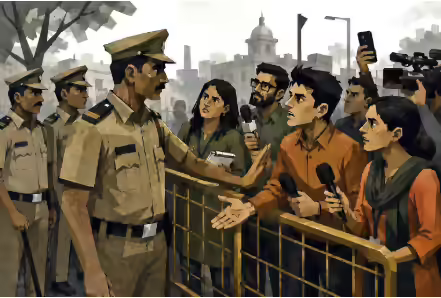
Police are entitled to question journalists. They are not entitled to make the questioning the punishment. Last week’s treatment of television anchor Vijayan raises uncomfortable questions not merely about one investigation, but about how the state understands press freedom.
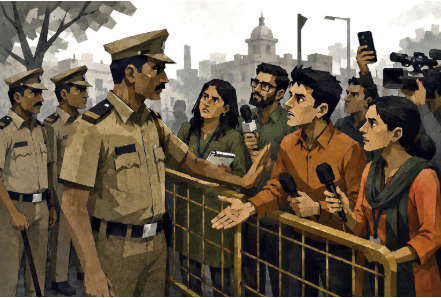

There is nothing wrong in calling a journalist for questioning, but the police procedure was intimidating. According to the channel’s editor, Vijayan was questioned till midnight, and after letting him go home, the investigating officer called him back and questioned him again till 2am. His mobile phone was seized. He was asked to come back at 11am. When he returned, the investigators made him wait till 7pm.
Equally uncalled for was an unsigned police statement implicating the journalist without apparent evidence in what they called ‘the Meghalaya programme’, saying he had exchanged some “objectionable message” with Thirunavukkarasu. Objectionable to whom? Journalists routinely exchange messages with police officers, politicians, bureaucrats, activists, whistleblowers — and sometimes criminals. That is part of reporting, not proof of wrongdoing.
Whether the journalist is ultimately found innocent or culpable is for the investigation to establish, but the process should be fair. Police rarely operate in a political vacuum. Their instincts are often shaped by the signals they receive from those in power. This govt appears more comfortable communicating directly through social media than engaging with the news media. If that is the govt’s preferred model of functioning, it could ask whether it still needs a department of information and public relations. Anyway, that is its choice. But the indifference becomes a problem when it spills over to the state’s treatment of journalists.
On July 10, when chief minister C Joseph Vijay visited Karur, reporters were given passes for the event but were shooed away by police at the entrance. Three days later, during the chief minister’s maiden visit to his constituency of Perambur, reporters were made to sit on a distant platform with virtually no visibility of the chief minister. Now, the mobile phone of a journalist not named in any FIR was taken away in the name of investigation. Tamil Nadu, despite having some spans of autocratic behaviour by the govt, has had a fairly free press. Now, such behaviour on the part of police doesn’t augur well for that image of the state.
Soon after being sworn in as the chief minister, Vijay had said he will be “the only power centre” of this govt. If that is true, he should tell Tamil Nadu police to follow procedures while subjecting journalists – or just anybody – to questioning with due respect and not cast aspersions on actions that are often inevitable while discharging one’s journalistic duties. If a govt concludes that mainstream journalism is dispensable, journalists should first ask whether they have made themselves dispensable. It shows that we journalists are not doing enough. It tells us to pull up our socks, hit the streets, find the stories that matter and hold up that old mirror to society.
While they are at it, khaki shouldn’t stand in the way. Some police officers have this tendency to be more loyal than the king. And when they decide to be ‘proactive’, journalists are often at the receiving end. This isn’t new to us; we are quite weatherbeaten by the waywardness of overenthusiastic investigators. Journalists worth their stories need no favour. Neither do they fear.
Disclaimer
Views expressed above are the author’s own.