The seven things I have learnt from people who have learnt seven things

There was a time when becoming a guru required inconvenience. You had to retreat to the mountains, renounce a reasonable quantity of worldly goods, sit under a tree for an unreasonable length of time, acquire disciples, develop some familiarity with the human condition, and then wait until somebody else began referring to you as wise. You could not appoint yourself. Gurudom was bestowed, usually after decades and occasionally after death, which made the whole enterprise admirably resistant to personal branding.
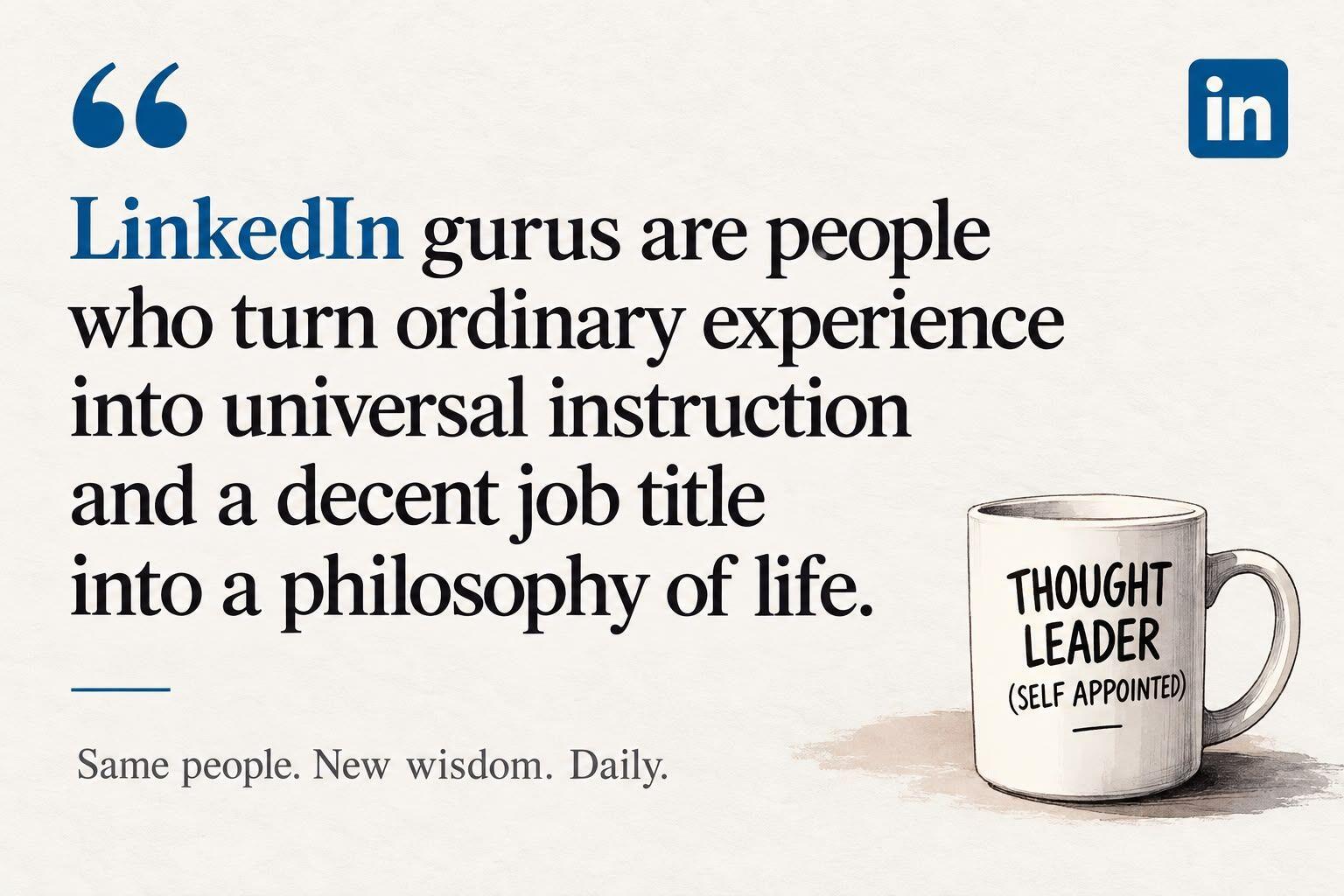
LinkedIn has fixed this inefficiency.


Enlightenment now requires a smartphone, a photograph from a conference in which you appear to be explaining something important to a microphone, and the confidence to announce that after twelve years in corporate life you have identified the seven things everybody in their twenties is doing wrong.
The discovery is rarely modest, because modest discoveries perform badly. Nobody logs on to say that careers are complicated, that luck matters enormously, that most decisions are made with inadequate information, that good managers are scarce, that bad managers occasionally become CEOs, and that much of what worked for you may have been the consequence of being in the right company, industry, city and economic cycle at precisely the right moment. This would be accurate and, on LinkedIn, useless.
So instead we get lessons. I have developed a particular affection for the executive who has held five jobs in ten years and now wishes to explain the importance of patience. He moved from Company A to Company B for a better title, from B to C for a larger mandate, from C to D because the culture no longer aligned with his values, and from D to E because an exciting opportunity presented itself; having demonstrated the migratory instincts of an Arctic tern, he now advises a 24-year-old to play the long game. This is not hypocrisy. It is thought leadership.
The young, we are told with some regularity, must read constantly, build relationships before they need them, work harder than everybody else, find mentors, become indispensable, take ownership, embrace failure, choose discomfort, remain curious, avoid chasing titles, cultivate patience, build a personal brand, network authentically and, above all, never compare their journey with anybody else’s. It is an impressive syllabus, made more impressive by the fact that most of us who began working before LinkedIn existed followed approximately none of it.
We took jobs because somebody offered them, which in the India of the late nineties was reason enough. We stayed because nobody better called. We learnt Excel because a boss wanted a spreadsheet by six. We acquired mentors by accident, usually by irritating an older colleague until he took pity on us, and our networks consisted largely of people with whom we had missed deadlines, shared cigarettes, survived the same bad manager or consumed inadvisable quantities of alcohol after office parties. Nobody called this building social capital. We called it knowing people.
More importantly, we were permitted the one luxury now denied to anybody entering the workforce: we were allowed to be clueless without publishing about it. A 22-year-old in 2002 could make a terrible career decision quietly. Today, somewhere between the resignation letter and the joining date, it must be converted into a carousel.
I WALKED AWAY FROM MY DREAM JOB. HERE ARE 5 THINGS IT TAUGHT ME ABOUT LEADERSHIP.
Thing One is invariably that growth begins outside your comfort zone. Growth has been outside the comfort zone for so long now that one wonders what remains inside it. Presumably a chair, some biscuits and the last employee who has not yet pivoted.
The deeper comedy, though, lies not with the young performing wisdom, since youth has always been allowed its certainties, but with those of us old enough to know better. By middle age, professional life has usually supplied enough contradictory evidence to make certainty difficult: you have watched brilliant people fail and mediocrities flourish, hardworking people overlooked and spectacular nonsense rewarded, companies that described themselves as families conduct layoffs by spreadsheet, leaders preach loyalty a fortnight before accepting a competing offer, and entire management teams mistake a bull market for managerial genius, discovering only when the tide turned that some of the celebrated strategy had been a favourable current.
Experience, properly absorbed, ought to make us less certain. LinkedIn performs the opposite miracle, which is that the longer you have worked, the more confidently you can explain why everybody else is working incorrectly.
A promotion becomes a leadership framework. A resignation becomes a lesson in courage. A holiday becomes a meditation on slowing down. A marathon becomes a management philosophy. A conversation with one’s daughter becomes an insight into Gen Z. Missing a flight teaches resilience, catching it teaches preparation, and the lounge in between teaches the importance of pauses. Nothing is permitted simply to happen anymore. It must teach.
Somewhere at this moment a senior executive has finished coffee with an old friend and is typing: this morning reminded me of something we often forget in business.
We did not forget it. You had coffee.
Converting ordinary experience into universal instruction requires one further trick, which is the removal of almost everything that made the experience what it was. Leadership becomes five rules, careers seven habits, success three choices and failure four lessons, while twenty-five years of institutional politics, economic cycles, fortunate bosses, unfortunate bosses, family circumstances, inherited advantages, chance encounters, market timing and dumb luck are compressed into a numbered list that can be consumed before breakfast.
The only sentence this economy cannot accommodate is ‘I don’t know.’
Which may be the one thing age reliably provides. Work long enough and you accumulate a magnificent archive of things you once believed with total confidence and later discovered were nonsense. You stay when you should have left and leave when staying would have been wiser, trust people you shouldn’t and doubt people you should have trusted, mistake activity for progress, confuse a good outcome with a good decision, and occasionally benefit enormously from choices whose intelligence became apparent only in retrospect. Compressed into a framework, all of it yields exactly one point.
It depends.
One Lesson From Twenty-Five Years of Getting Some Things Right and Several Things Spectacularly Wrong is unlikely to trouble the algorithm.
There is a further problem with advice, which is that it quietly edits out the adviser. Build your network sounds more dignified than I happened to know someone. Back yourself is preferable to I had enough financial security to survive being wrong. Take risks early lands differently when there is a family business, a parental flat or a substantial fixed deposit waiting beneath the trapeze; quit and figure it out assumes a safety net that in most Indian families is not a portfolio but a person, and usually a person who never got to take the risk himself. Never chase money acquires a particular philosophical luminosity once you have enough of it. Choose the harder path is generally said by somebody looking backwards from the point at which the harder path happened to work. We turn biography into philosophy, sanding away circumstance until success appears to have been manufactured entirely out of character, and then hand the resulting mythology to younger people as instructions.
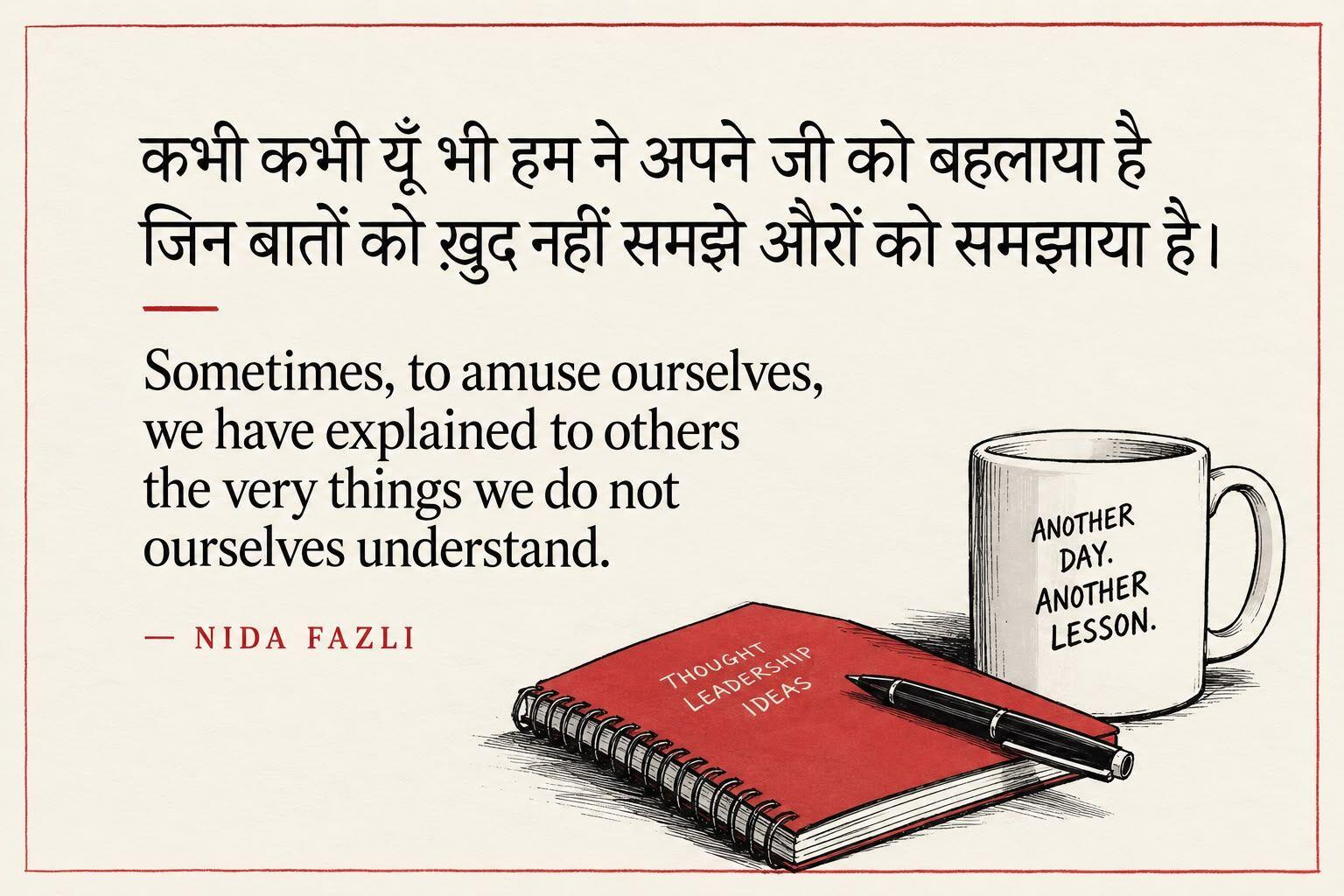
Nida Fazli wrote the platform’s terms of service decades before it existed, in a couplet about the way we console ourselves by explaining to others what we have never understood ourselves.
कभी कभी यूँ भी हम ने अपने जी को बहलाया है जिन बातों को ख़ुद नहीं समझे औरों को समझाया है।
It is hard to improve on that as a description of a man who spends fifteen years being confused by his own career and, in the sixteenth, publishes What 15 Years of Leadership Taught Me. The couplet that follows finishes the joke: a little name, earned in one city.
हम से पूछो इज़्ज़त वालों की इज़्ज़त का हाल कभी हम ने भी इक शहर में रह कर थोड़ा नाम कमाया है।
Not industry leader or transformational executive; not building at the intersection of technology, storytelling and impact. Only the modest acknowledgement that in one corner of a very large world, a few people happen to know who you are.
LinkedIn would recommend strengthening the bio.
None of this means experience has nothing to teach. Older colleagues can save younger ones years of avoidable error, and advice given privately, specifically, and with some acknowledgement that the recipient is not merely a younger version of oneself, remains among the great gifts of professional life.
The trouble begins when experience stops being a story and becomes scripture, when this happened to me hardens into this is how the world works, and when a career containing enough accidents to embarrass a statistician is repackaged as a ten-point operating system.
The most useful thing anyone in their forties can tell someone in their twenties is probably not how to build a career, but how little of their own career was built according to plan. There were wrong turns and lucky breaks, people who opened doors and people who shut them, jobs taken for money and jobs left in anger, promotions deserved and undeserved, risks that worked and equally intelligent risks that did not, bosses who altered a trajectory without ever knowing they had, and opportunities whose significance became visible only years later.
That is not a framework. It is merely a life and makes for a terrible LinkedIn post. No hook, no seven lessons, no photograph of the author staring thoughtfully out of an airport window, and, most damagingly, nothing for the rest of us to learn before 9 a.m.
Disclaimer
Views expressed above are the author’s own.