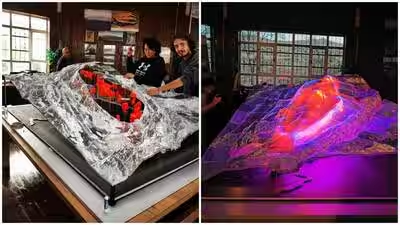
In 2021, engineers reinforced clay with discarded toothbrush bristles; laboratory tests found the waste fibres increased shear strength and reduced mass loss through freeze-thaw cycles |
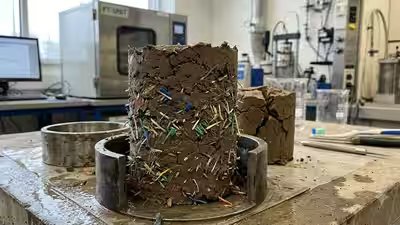
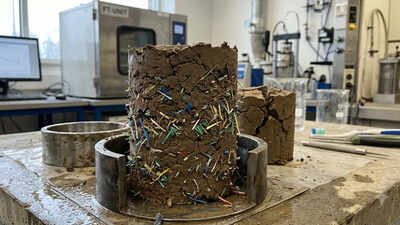
In cold regions, water in pavement and subgrade layers can freeze, form ice lenses, and cause frost heave. During spring thaw, the layers may become saturated and lose bearing capacity. How severe and how long that weakening lasts depends on the site and its materials, so builders keep looking for ways to make fine-grained soils behave better through repeated freezing and thawing. Reinforcement can be sourced from plastic waste. Daily-use objects like toothbrushes are thrown away when they wear out, and their bristles are made of polypropylene, a plastic that engineers already mix into soil as fibers. A team of scientists wanted to know if chopped-up bristles from discarded toothbrushes could help a clay withstand freeze-thawing conditions.Bristles of about 10 millimeters at 0.2% to 0.8% of dry soil weightFatih Isik, R. Kagan Akbulut and A. Sahin Zaimoglu of Atatürk University tested the idea in Influence of Waste Toothbrush Fiber on Strength and Freezing–Thawing Behavior in High Plasticity Clay, published in Studia Geotechnica et Mechanica. Isik, Akbulut and Zaimoglu cut the bristles to about 10 mm and mixed them into the clay at 0.2%, 0.4%, 0.6% and 0.8% of dry soil weight, alongside an unreinforced sample (0%). The researchers ran unconfined compression tests before and after freezing and thawing, then used the peak stress values to calculate peak shear stress and undrained shear strength. Isik, Akbulut and Zaimoglu’s paper reports that the mixtures were brought to an optimum water content of 23.6% and compacted into cylindrical specimens 38 mm in diameter and 76 mm high. In the same paper, each freeze-thaw cycle meant 6 hours at −20°C followed by 6 hours at 25°C.Higher peak shear stress, lower mass loss and a gain of about 63% at zero cyclesHigher bristle content generally meant higher peak shear stress across the freeze-thaw tests. Reinforced samples also carried higher stress at large strains and showed more ductile behavior, which the authors attribute to the bristles acting as bridges between soil particles. At zero cycles, undrained shear strength rose by about 63%, while at three cycles it rose by about 42% as bristle content increased. Freezing and thawing still took a toll: peak shear stress generally dropped in both reinforced and unreinforced samples as cycles accumulated, and undrained shear strength also fell after 6, 9 and 12 cycles.Earlier evidence from polypropylene fibers: 60% to 160% higher strength at 3% contentThe result fits earlier work on virgin polypropylene fibers. Ghazavi and Roustaie reported on kaolinite clay reinforced with steel and polypropylene fibers in The influence of freeze-thaw cycles on the unconfined compressive strength of fiber-reinforced clay, published in Cold Regions Science and Technology in 2010. Ghazavi and Roustaie compacted kaolinite clay in the laboratory, reinforced it with steel and polypropylene fibers, and put it through up to 10 closed-system freeze-thaw cycles; the reinforced clay came out stronger than the unreinforced clay.
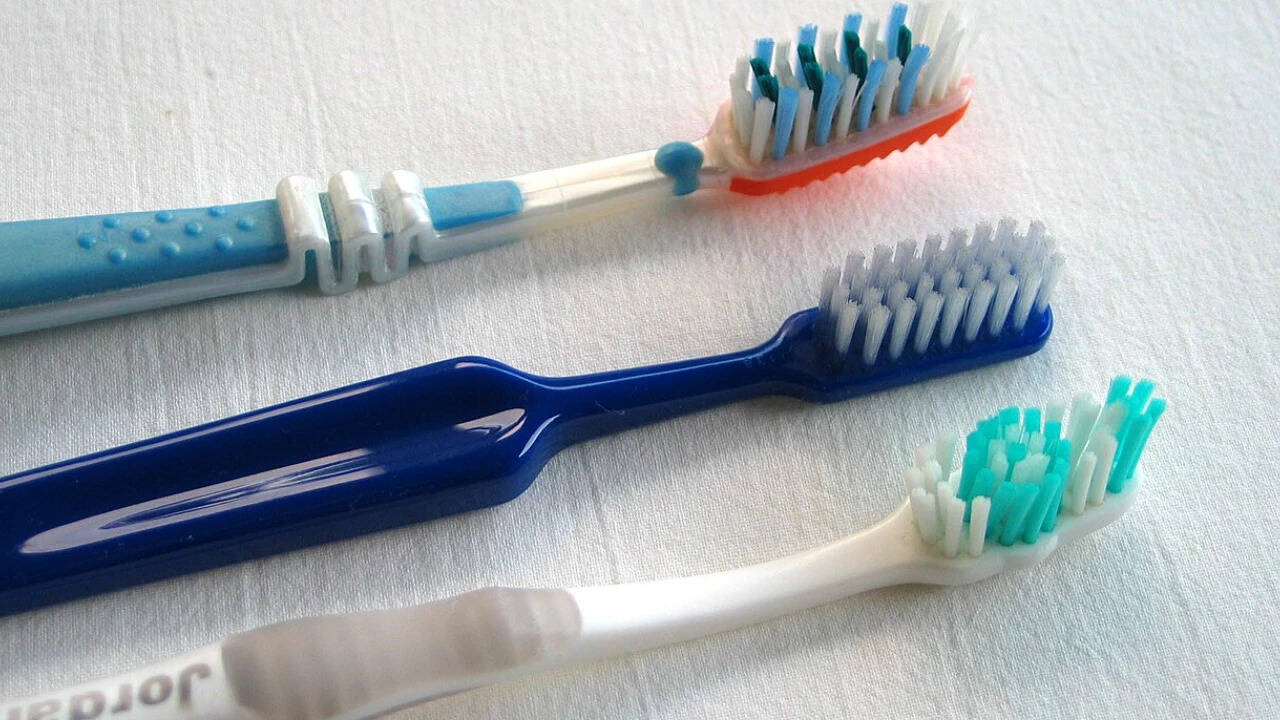
Toothbrushes could help a clay withstand freeze-thawing conditions. Image credits: Wikimedia Commons
Ghazavi and Roustaie found that more freeze-thaw cycles lowered the clay’s unconfined compressive strength by 20% to 25%. Adding fiber helped the clay hold its strength through freezing and thawing, and Ghazavi and Roustaie reported that 3% polypropylene fiber raised unconfined compressive strength by 60% to 160% before and after the cycles while cutting frost heave by 70%. The two studies cannot be compared directly because the soils and doses differ: the toothbrush study used a high-plasticity clay at doses of 0.2% to 0.8%, while Ghazavi and Roustaie used kaolinite at 3%. The toothbrush study also tested only one clay soil.