Every January, California collects discarded christmas trees and sinks them in lakes; their branches become underwater nurseries for young fish |
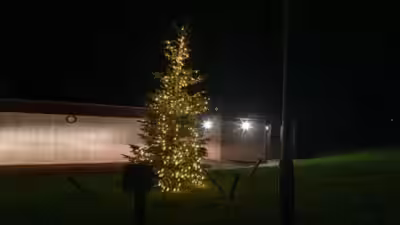
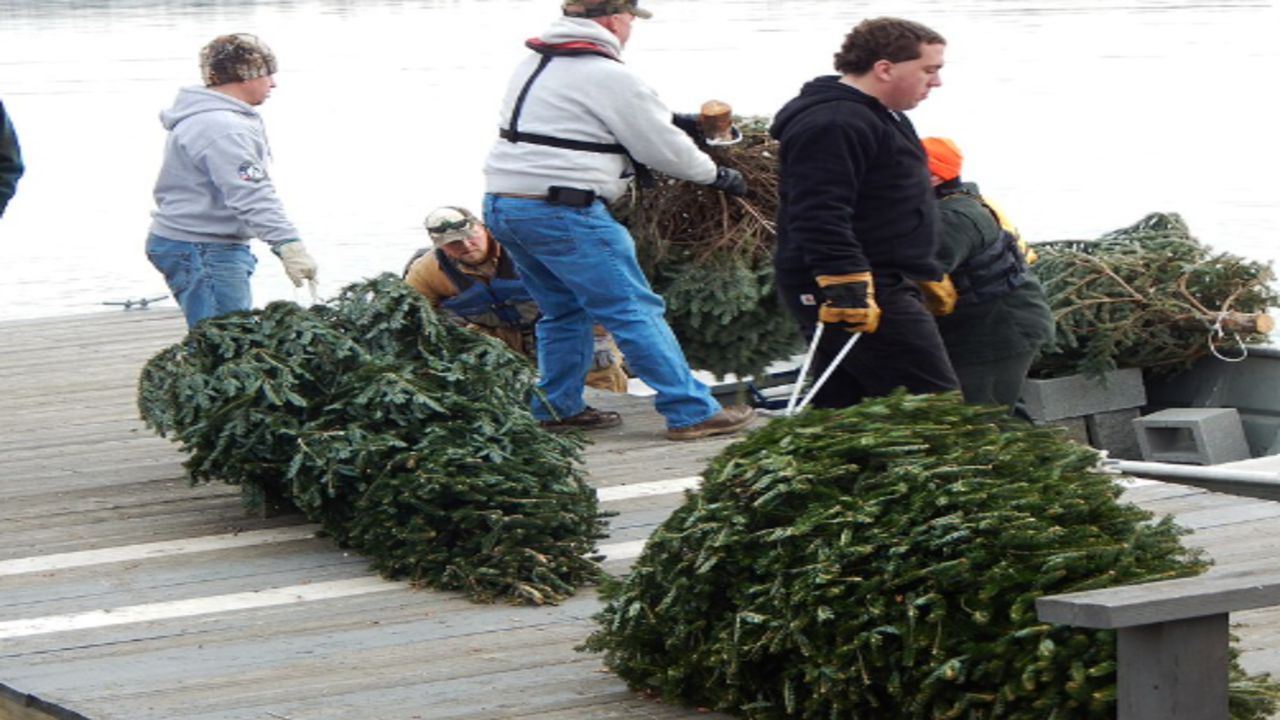
Once the ornaments come down and the lights are packed away, most Christmas trees are set out for collection. In California, though, thousands of them take a very different route: into the water. Every January, wildlife agencies in several regions of the state gather donated trees, weigh them down with cable or cinder blocks, and lower them into lakes and reservoirs. What looks like an odd bit of holiday cleanup is actually a well-established fisheries practice, and the branches that once held tinsel eventually shelter baby bass, crappie, and bluegill for years afterwards.How the program works One of the longest-running programs is run by the California Department of Fish and Wildlife (CDFW). The department’s fish habitat technicians collect trees from various community locations, remove any flocking, lights or tinsel, and transport them to the reservoirs where the trees are cabled together in bunches and sunk. Joseph Rightmier, the fish habitat supervisor at the Fish Habitat Improvement Shop in Yreka with the California Department of Fish and Wildlife, has coordinated projects such as the one at Green Springs Reservoir in Modoc County, where 22 structures were constructed using about 200 recycled Christmas trees. According to him, divers have seen fish begin to inhabit the structures within days of their creation; the trees quickly become “hot real estate.”A similar program has operated at Lake Oroville since at least 1993, when the California Department of Water Resources began its fish habitat improvement program. The work has continued through partnerships with local groups, including Boy Scouts and 4-H clubs, while California Conservation Corps crews install the collected trees in Lake Oroville and the Thermalito Afterbay.Why fish really require thisIt might seem like any branch pile would work, but trees are effective because they create structure. Reservoirs and older lakes lack natural woody structure because old, flooded wood breaks down and is not replenished unless humans step in. As a result, baitfish spread out across large areas of water with few places to hide, and predators have a harder time finding prey. A submerged tree solves both problems by giving small fish a maze of branches to hide in and attracting largemouth bass and catfish to feed nearby.A four-year, whole-reservoir addition of coarse woody habitat (CWH) in a eutrophic Illinois reservoir, published as Ecosystem responses to a whole-reservoir coarse woody habitat addition in Fisheries Management and Ecology, found that zooplankton and benthic macroinvertebrates did not show detectable responses to the habitat addition, but bluegill (Lepomis macrochirus) reproductive productivity and largemouth bass (Micropterus salmoides) size structure increased.The same reservoir study also found that bluegill catch per unit effort did not increase and that the increase in reproductive productivity did not translate into greater recruitment to the adult bluegill population. The researchers therefore distinguished between increased reproductive productivity and an increase in the adult population, while largemouth bass size structure also increased. The findings contrasted with earlier work in an oligotrophic Wisconsin lake, where population-level responses to coarse woody habitat were weaker.Younger, faster‑growing fish tend to respond to this kind of habitat fastest. A 2023 study in a shallow northern boreal lake in Alberta, Ecological Solutions and Evidence, used Bayesian models to estimate habitat use around added wood bundles and whole‑tree drops. Posterior predictions indicated increased use of enhanced areas by spottail shiner (Notropis hudsonius), northern pike, white sucker, and brook stickleback. Wood bundles also lost structural integrity faster than whole-tree structures, with anchoring-related problems recorded as early as one week after construction.
The authors did not find a probable effect of the enhancements on overall fish condition (relative weight), but the rapid colonisation by small, short‑lived species such as spottail shiner is consistent with the idea that younger fish use added structure as cover while vulnerable to predation. That pattern lines up with what CDFW staff report seeing on the ground in California: it’s the smaller, younger fish that move in first, which in turn draws in the bigger predator species anglers are after.But not a forever fixStill, sinking Christmas trees is not a permanent fix. Their structural benefits are relatively short-lived compared with those of hardwoods, which CDFW generally prefers for habitat projects. The department nevertheless uses donated Christmas trees when available because they can be repurposed as fish habitat instead of being chipped or sent to a landfill.Other studies using side-scan sonar have tracked sunken brush piles for several years and found that many flattened before reaching 10 years old. A broader review in Lake and Reservoir Management raised another concern: many projects are not compared with an untouched control area, and fish communities are not studied enough before and after installation to show whether the structures truly help species thrive or simply concentrate fish for anglers. Despite these limitations, California agencies continue to use recycled Christmas trees as a seasonal fish-habitat enhancement, with CDFW and DWR carrying out projects at reservoirs including Green Springs and Lake Oroville.