
In 2026, scientists found oak trees can delay spring leaf growth by three days to starve hungry caterpillars |

​Representative Image of oak trees with delayed budburst as caterpillars wait for young leaves to emerge (AI-generated image) In temperate forests, spring timing can determine whether newly hatched caterpillars find a feast or almost nothing to eat. Many herbivorous insects emerge around the time trees produce their first young leaves, when the foliage is soft…

Read More

Scientists found genetically unusual avocados in Nicaragua that may preserve clues to a 5,000-year-old human journey from South America  |

Avocado (single and halved). Image Credit: Ivar Leidus/Wikipedia Avocados growing in Nicaragua may carry a remarkable record of ancient human migration across the Americas. A new study published in ‘Plants, People, Planet’ has found that several avocado varieties growing in Nicaragua are genetically distinct from the commercial varieties commonly found today and are more closely…

Read More

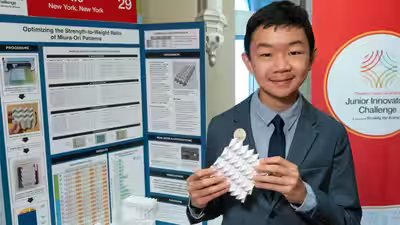
Meet Miles Wu, the 14-year-old New York student using origami to explore stronger, foldable emergency shelters |

Image: Society for Science At 14, Miles Wu is exploring how an ancient paper-folding technique could inspire stronger and more portable structures for emergencies. An eighth-grade student at Hunter College High School in New York, Wu spent the past year investigating the Miura-ori, a geometric origami pattern known for folding flat sheets into compact forms….

Read More

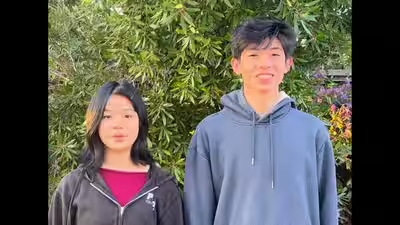
Meet Kiefer Chow and Amelia Chow: The California siblings who are copying beavers to build dams that restore habitats and reduce wildfire risk |

Growing up along Adobe Creek in Mountain View, Kiefer Chow spent his childhood afternoons doing something most people would call child’s play: stacking sticks and mud into makeshift dams. Years later, that same instinct would grow into something far more consequential. Alongside his sister Amelia, Kiefer founded Eco-Engineering In Action, a youth-led non-profit built on…

Read More

Scientists are saying that universe may not last forever because Hawking-like radiation could eventually cause its evaporation |

Supermassive black holes are expected to outlast proton decay, but will eventually evaporate completely. Image Credit: D. Berry/Nasa Earth is expected to remain alive for an almost unimaginable length of time, but new calculations suggest that even massive objects could eventually disappear through a process similar to Hawking radiation. Scientists at Radboud University in the…

Read More

Scientists discover how ancient Chinese paintings used blood to survive for 2,000 Years |

Detail of the main Huashan Rock art. Image Credit: Rolfmueller/Wikipedia Ancient paintings covering limestone cliffs in southern China may owe their remarkable survival to an unexpected ingredient known as ‘blood.’ A new study of the ‘Huashan rock art’ in Guangxi published in the ‘Journal of Archaeological Science’ suggests that the artists used a mixture containing…

Read More

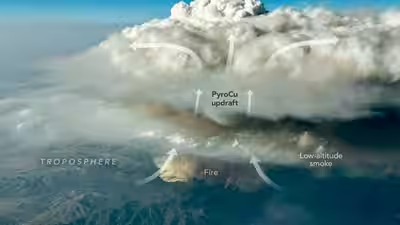
nasa aircraft are chasing giant fire clouds over utah: these towering smoke-filled clouds can punch high into earth’s atmosphere |

A wildfire in Utah has become the focus of an unusual airborne investigation, after towering clouds of smoke and hot air pushed towards the upper reaches of the atmosphere. Nasa aircraft are chasing these smoke-filled formations to understand what happens when an intense fire effectively starts generating its own weather. The clouds, known as pyrocumulonimbus…

Read More

Quote of the day by Stephen Hawking: “However difficult life may seem, there is always…” – a lesson on resilience, perspective and finding what remains possible |

Stephen Hawking‘s words offer a genuinely powerful reminder that a difficult situation rarely means every single possibility has actually disappeared. “However difficult life may seem, there is always something you can do and succeed at,” he said. “It matters that you don’t just give up.” He said this in a speech to the Oxford Union…

Read More

Atolls can take up to 30 million years to form, but these tiny coral islands now support 31 million seabirds across the Indo-Pacific |

Atolls can take up to 30 million years to form, but these tiny coral islands now support 31 million seabirds across the Indo-Pacific (PC: AI Generated) Atolls may look like tiny rings of sand and coral scattered across warm tropical oceans, but they are far more important than their small land areas. These unusual natural…

Read More