
Second Helping, Edition 2: A Brave New Carbonara

On garlic confit, béchamel crimes, the Manchurian defence, and why I am declining my invitation to the future of food.
I was recently offered a taste of the future, at lunch, in the office, and it came in a borosilicate ‘tiffin’ container. A dear friend and colleague had brought his wife’s cooking to work, as he often does and as I have long been grateful for, and he offered me a forkful with the quiet pride of a man carrying something good from home.

Garlic Confit Carbonara. Forty (or some such number that’s too many) cloves of garlic poached in olive oil until they surrendered their dignity, mashed into a paste, folded into cream, tossed through spaghetti, the whole thing eaten cold at a desk the way office lunches are, which is to say without ceremony and against a deadline. It was, I must report, a good rendition. I said so, and meant it, which is the part that troubles me most. I had seen the dish weeks earlier on Instagram (or was it Facebook? ), where the comments were ecstatic and the Italians in the comments were not, though by now the Italians in the comments are a permanent standing army, like the Swiss Guard, except angrier and better fed. The cook was blameless, the colleague generous, the tiffin spotless. The recipe, on the other hand, had form.
Let us be clear about what carbonara is, because the recipe is short enough to fit on a visiting card. Guanciale, egg, pecorino, black pepper, pasta.
That is the whole constitution. It is a codified dish in the way a sonnet is a codified poem, which is to say the constraints are the point. Remove the egg and you have made gricia. Swap the egg for tomato and you have made amatriciana. Remove both and you are in cacio e pepe territory. The Romans did not leave room for interpretation because interpretation was never requested. There is no garlic in it. There is no cream in it. There is certainly no confit in it, a French technique that has wandered into a Roman dish the way a saxophone might wander into a Carnatic concert, technically possible, spiritually actionable.
The rap sheet of carbonara crimes is by now long and distinguished. Martha Stewart added garlic, cream and parsley and was rewarded with headlines describing her creation as a nightmare.
The New York Times published a smoky tomato carbonara, swapping guanciale for bacon and pecorino for parmesan, and managed to trigger what can only be described as a minor diplomatic incident, with Italy’s farm lobby declaring carbonara one of the most betrayed recipes on earth, a phrase I intend to steal for my own obituary. Even an Italian food historian, Luca Cesari, was mobbed online merely for recreating the first printed version of the dish from a 1954 magazine, which, awkwardly, contained gruyère, garlic and bacon. He was accused of blasphemy for reading the scripture aloud.
My own education in carbonara jurisprudence began long before Instagram, at the hands of my pishi (bua / aunt), who has spent several decades sending food back in Italian restaurants with the serene authority of a high court judge returning a badly drafted petition. Carbonara was her specialty. Cream in it, back it went. Garlic in it, back it went, with commentary. As children we adored these proceedings and would sit very still when the waiter approached, the way one sits still at the theatre. I absorbed the doctrine at that table before I could pronounce guanciale. Purity, I learned, was not a preference but a duty, and the send-back was its sacrament.
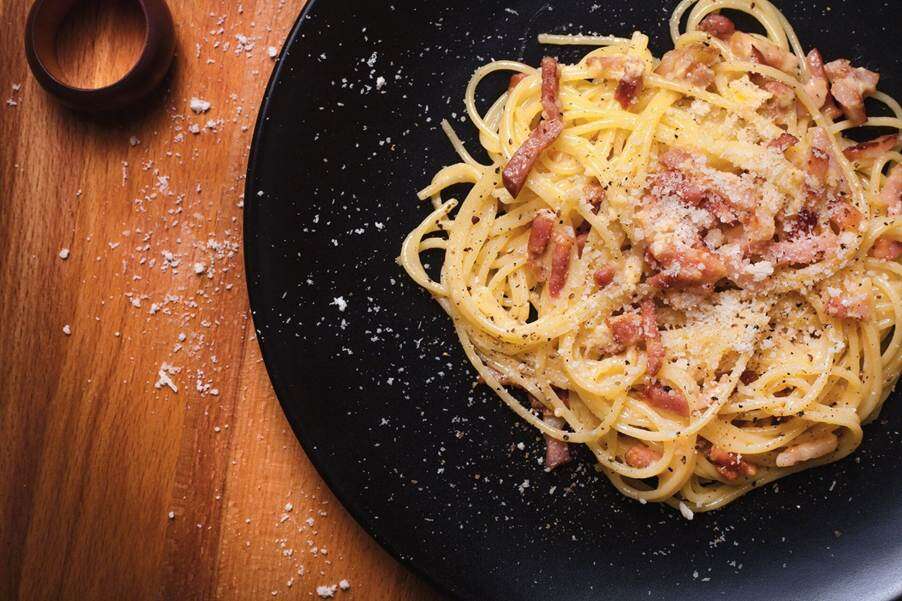

Spaghetti alla carbonara (Source: Wiki)
And here the story turns, as good stories must, on the purists themselves, my pishi regrettably included; because the deeper you dig into carbonara, the less Roman it gets.
One widely cited account, and the one the dish’s own defenders tend to forget, has it first cooked in September 1944 by a Bolognese chef named Renato Gualandi for a dinner marking the Allied breakthrough at Riccione, using what the Americans had in their ration packs, which by his own recollection was fabulous bacon, cream, cheese and powdered egg yolks. The claim is contested, not least because Gualandi did not put his name to it until decades later, but the first printed recipe is harder to argue with, and it appeared not in Rome but in Chicago, in a 1952 restaurant guide, two years before any Italian magazine got around to it.
The historian Alberto Grandi has built an entire career, and survived the wrath of Italian deputy prime ministers, on the broader argument that the sacred canon of Italian cuisine was largely assembled after the war, a set of founding myths invented by a nation rebuilding its sense of self. In other words, the dish now defended like the Ark of the Covenant may well have begun life as fusion food, improvised from a foreign soldier’s supplies. The shrine, if the historians are right, was built around a GI’s tiffin.
Which brings me, as all roads eventually do, to the Cricket Club of India, Bombay, 1975. A young cook named Nelson Wang, born in Calcutta to a Hakka Chinese family, arrived in the city the previous year with twenty-seven rupees in his pocket. A member asked him for something that was not on the menu. Wang started as any sensible cook in this country starts, with chopped garlic, ginger and green chillies, and then, at the moment the recipe expected garam masala, he reached instead for soy sauce, added cornstarch and chicken, and invented the Manchurian. It has no connection to Manchuria whatsoever. It is as Chinese as I am Norwegian. It is also, and I say this without embarrassment, one of the great dishes of the twentieth century, the founding text of an entire cuisine that Chinese visitors regard with confusion and the rest of us regard with devotion.
So no, I am not a purist. I cannot be, my comfort food was invented by a Calcutta boy freestyling at a cricket club, and the dish the purists are defending may well have been assembled from American army rations.
Authenticity, examined closely, is mostly nostalgia with a trademark lawyer. The question was never whether cuisines should mix. They always have, usually because somebody migrated, somebody occupied, somebody ran out of an ingredient, or somebody hungry asked a cook to improvise. Fusion born of necessity has a soul. You can taste the biography in it.
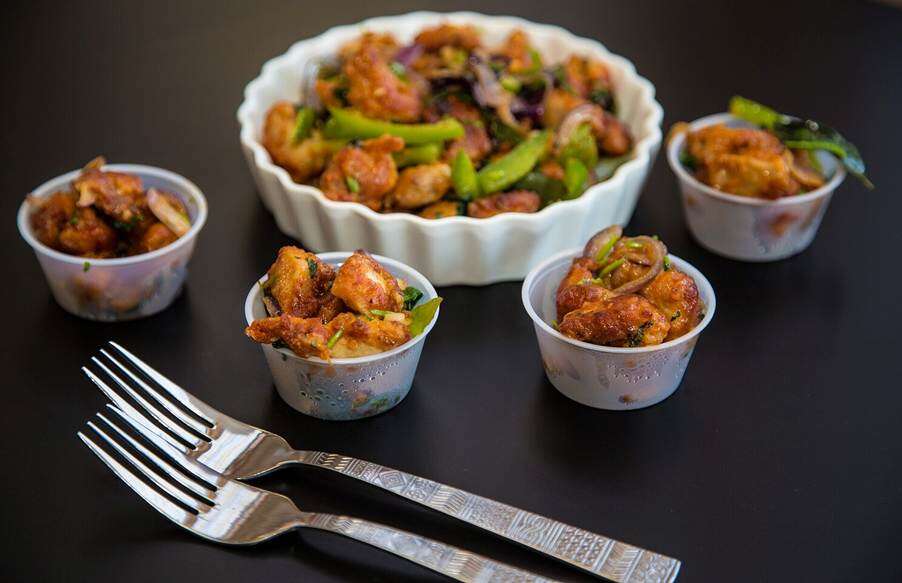

Chicken Manchurian (Wikimedia Commons)
What I object to is the other kind, and this is where I must address my own countrymen and the matter of béchamel. Somewhere in the 1990s, India collectively decided that the answer to pasta was white sauce, a roux of maida, butter and milk, fortified with processed cheese and diced capsicum, and this decision has proven irreversible.
Every café from Alwar to Adyar serves it. Tarla Dalal canonised it. I have eaten it at birthday parties and I will eat it again, because as a dish called white sauce pasta it is honest, cheerful, vegetarian-friendly comfort food. The trouble begins when a menu prints the word carbonara above it. Béchamel carbonara is not fusion, it is mislabelling, the culinary equivalent of selling a Maruti with a Mercedes badge. Call the thing what it is and I will defend it in court. Call it carbonara and we have a consumer protection issue.
And the garlic confit version is a third category altogether, worse than both, because it was not born of migration or necessity or even confusion. It was born of engagement metrics.
Nobody’s grandmother made it, nobody’s homesickness demanded it, no customer at any cricket club requested it. It was reverse-engineered from what performs on a screen, garlic because garlic trends, confit because confit sounds expensive, the yolk because the yolk gives the algorithm its money shot. Its real genius is distribution, because it no longer needs restaurants at all; it travels straight from the reel into home kitchens and steel tiffins, arriving at the office desks of blameless colleagues with forty cloves of garlic and no biography whatsoever. Huxley saw this coming, in his way. In his brave new world nobody suffers, because pleasure has been engineered, optimised and dispensed on schedule, and the one dissenter’s demand is for the right to be unhappy. I find I am with the dissenter. I want the freedom to be disappointed by a real cuisine cooked by a real person for a real reason, rather than soothed by content that has been focus-grouped into frictionless goo.
So mark me absent from the brave new world of the confit carbonara. I will be at the older, stranger party, where an Italian improvises with American bacon and accidentally founds a religion, and a Hakka boy from Calcutta swaps garam masala for soy sauce and feeds a subcontinent. The Manchurian was invented because a customer was hungry. The garlic confit carbonara was invented because an algorithm was.
There remains the matter of my pishi. It occurs to me, writing this, that I have not taken her to an Italian restaurant in years, which is a form of negligence no court in her jurisdiction would forgive. I intend to correct it. I will book a table, order the carbonara, and say nothing at all. And when it arrives with cream in it, as in this country it almost certainly will, I will lean back and watch the old spectacle one more time, no longer a child enjoying the drama but a middle-aged man taking notes. Some traditions, I have learnt from the historians, are invented. The good ones you keep anyway.
Carbonara, Honestly.
You will have noticed that I have spent two thousand words telling you what carbonara is not, which is the easy part of any argument and the coward’s half of any column. So here is the harder half. Here is how to actually make the thing, in a kitchen in Kolkata or Kochi, with what you can actually lay your hands on, and without lying to yourself or your guests at any point in the proceedings.
It serves two, because carbonara is a dish best cooked in small, attentive batches, the way it is best eaten.
First, the shopping, because this is where most Indian carbonara dies before a single burner is lit. You need dry Italian spaghetti, the ordinary good stuff any large grocer now stocks.
You need Pecorino Romano, a hard, salty, faintly barnyard sheep’s cheese, which Foodhall and Nature’s Basket and Le Marché keep, and which the online grocers will deliver; if it defeats you, a well-aged Parmesan is the honourable fallback, and I will not report you. What is not a fallback, under any circumstances, is Amul cheese, which is a decent product doing a completely different job, rather like asking a tabla player to sit in for a cello.
You need eggs which you have. And you need the pork, about which I must be candid: guanciale, the cured pig’s cheek the Romans insist on, is a unicorn outside two or three delis in Delhi and Bombay. If you cannot find it, cure a piece of unsmoked pork belly yourself with salt for three days, which gets you closer to the truth than anything on a supermarket shelf. And if that is a bridge too far on a weeknight, use a good smoked bacon but then you must call the finished dish a bacon carbonara when you set it down. That single act of honest labelling is the whole moral of this column, reduced to a plate.
Now the method which is short because the dish is short. Salt a large pot of water until it tastes of the sea and put it on to boil, and do not, whatever your mother’s kitchen taught you, add oil to it. While it heats, cut a hundred and twenty grams of your pork into small batons and lay them in a cold, dry, heavy pan, a kadhai wiill do, bringing the heat up slowly so the fat renders into a golden pool and the meat crisps at its edges. Kill the heat and leave it there. In a bowl, whisk three egg yolks and one whole egg with a generous fistful of the grated cheese and more coarsely cracked black pepper than feels decent. That paste is your entire sauce. There is no cream in it. There will be no cream in it. If your hand drifts towards the fridge sit on it until the urge passes.
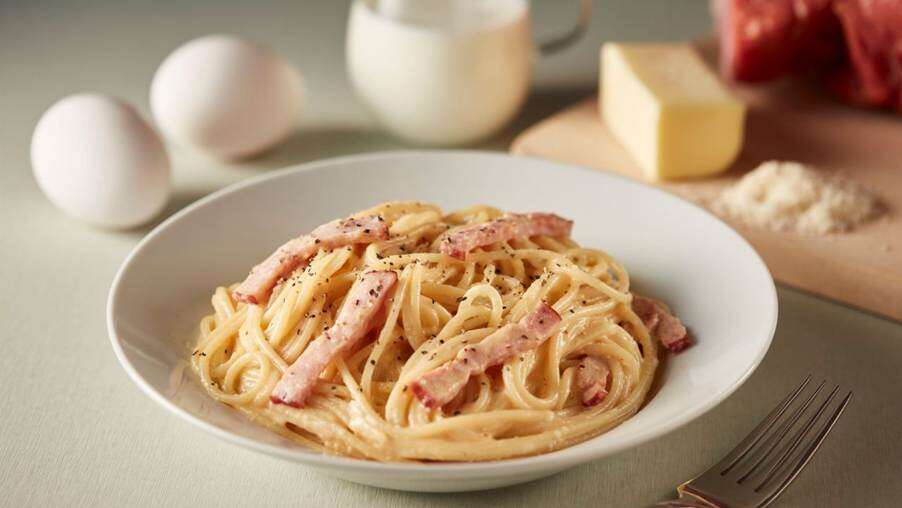

Spaghetti (Source: Wikimedia Commons)
Cook the spaghetti a minute short of the packet’s promise, and before you drain it, save a full cup of the cloudy, starchy cooking water, which is the most important and most freely given ingredient in the dish. Now comes the only difficult moment, the one on which the whole enterprise turns, so read it twice.
Tip the hot, drained pasta into the pan with the pork and its fat, the heat off. Toss for half a minute to take the fierce edge off, because our flames run hot and scrambled egg is the failure state, the thing that turns carbonara into a sad Roman bhurji. Then pour in the egg mixture and toss hard and without stopping, loosening it with splashes of the saved pasta water, until the sauce turns glossy and clings to every strand like silk. Too tight, more water. Too loose, a few more seconds over the barest flame. Twist it onto warm plates, bury it under the last of the cheese and yet more pepper, and carry it to the table at a near-run, because carbonara forgives many things but never delay.
That is all of it. Five ingredients, one nerve-holding minute, and not a drop of cream. And should you find yourself, at the end, having used bacon and calling it a bacon carbonara, take heart: you will have cooked something honest, and it will be very good.
Disclaimer
Views expressed above are the author’s own.