
You won’t believe this animal is the closest living relative of the hippo

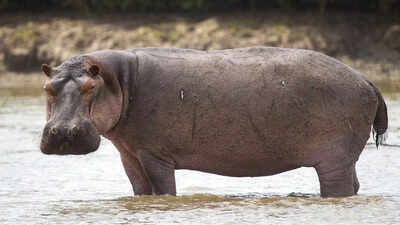
Did you know that the closest living relative to a hippopotamus is not a pig, rhinoceros, or even an elephant but a whale? Yes, the massive creatures residing in the depths of the ocean today have been found to be the closest living relatives of the semi-aquatic hippos. The fascinating scientific breakthrough has revolutionized the process of animal evolution.For quite some time now, scientists assumed that the hippos were related to the pigs due to the similarities in their physical structure and massive body size. Thanks to DNA studies carried out by some scientists recently, it came to light that both hippos and whales shared a common ancestor dating back about 55 million years ago. It was a quadrupedal, deer-like mammal that slowly diverged into two groups through evolution. While one line resulted in today’s whales and dolphins, the other ended up being the hippopotamus.
Similarities between the two creatures
Although the comparison may seem surprising at first sight, there are many parallels between the two creatures. For example, both hippos and whales are mammals adapted for an aquatic lifestyle. The former is able to hold its breath under water for several minutes. As for whales, they became adapted for a purely aquatic way of living during their evolution process. Also, it was found that the two mammals were very alike in terms of skin, hearing mechanisms, and mating rituals. Genetic research provided strong proof of the fact that both hippos and whales belong to the order Cetartiodactyla.
The main discovery behind it
One main discovery supporting this conclusion involved fossils of whale ancestors. Several known fossils of prehistoric whales have limbs, suggesting they were walking creatures adapted to living in water. Animals like Pakicetus and Ambulocetus had many traits of transitional forms connecting terrestrial mammals with modern whales. Ambulocetus’ name means “walking whale” and refers to its appearance, which had physical traits of a crocodile, otter, and mammal.At the same time, today’s hippos also exhibit features that arelinked to the evolution of their ancient relatives. While mostly found in rivers and lakes and living submerged for hours daily, hippos cannot be considered completely aquatic like whales. Rather, they continue walking on dry land, eating grass and requiring freshwater environments for survival. Nevertheless, the semi-aquatic way of life of hippos is a clear hint at the evolution of their extinct ancestors, millions of years ago.The revelation was stunning for many because it seemed as if whales and hippos could never have any common ancestors due to their totally distinct appearance. Indeed, whales are characterized by their size, fins and total absence of legs, whereas hippos can boast of an impressive weight and huge jaws. Still, sometimes evolution can show the most unexpected results.


