Will Srinagar’s garbage mountain vanish or keep making lives miserable?
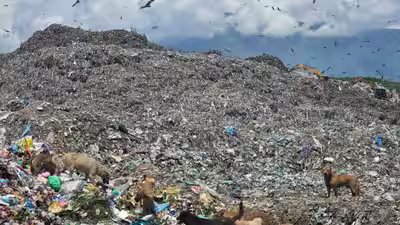
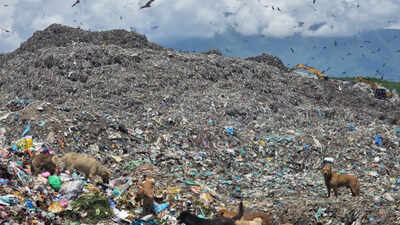
SRINAGAR: In the heart of Srinagar is a huge mountain of garbage. From a distance, it looks as part of the Pir Panjal mountain range. But as one approaches the Achan waste management facility, it becomes clear the hill is man-made, built from decades of accumulated waste.The air stinks. Hundreds of stray dogs move around the base of the mountain while crows circle overhead. Two excavators work on the summit, digging through the waste. On one side, dark leachate seeps from the landfill and spreads across the low-lying ground.This is another side of Srinagar, the city known for Dal Lake, Nigeen Lake and the Mughal gardens. Just five kms from Nageen Lake, around three kms from Sheri Kashmir Institute of Medical Sciences (SKIMS), the valley top tertiary care hospital, is the Achan landfill site of Srinagar Municipal Corporation (SMC) having nearly 1.1 million metric tonnes of legacy waste-garbage dumped over decades.Clearing the towering mountain garbage has become one of the city’s biggest civic challenges.Dozens of trucks unload fresh waste here every day are adding to the problem. Achan, the only designated landfill in Jammu and Kashmir, was established in 1986 after approval by the then state cabinet and the Pollution Control Board.
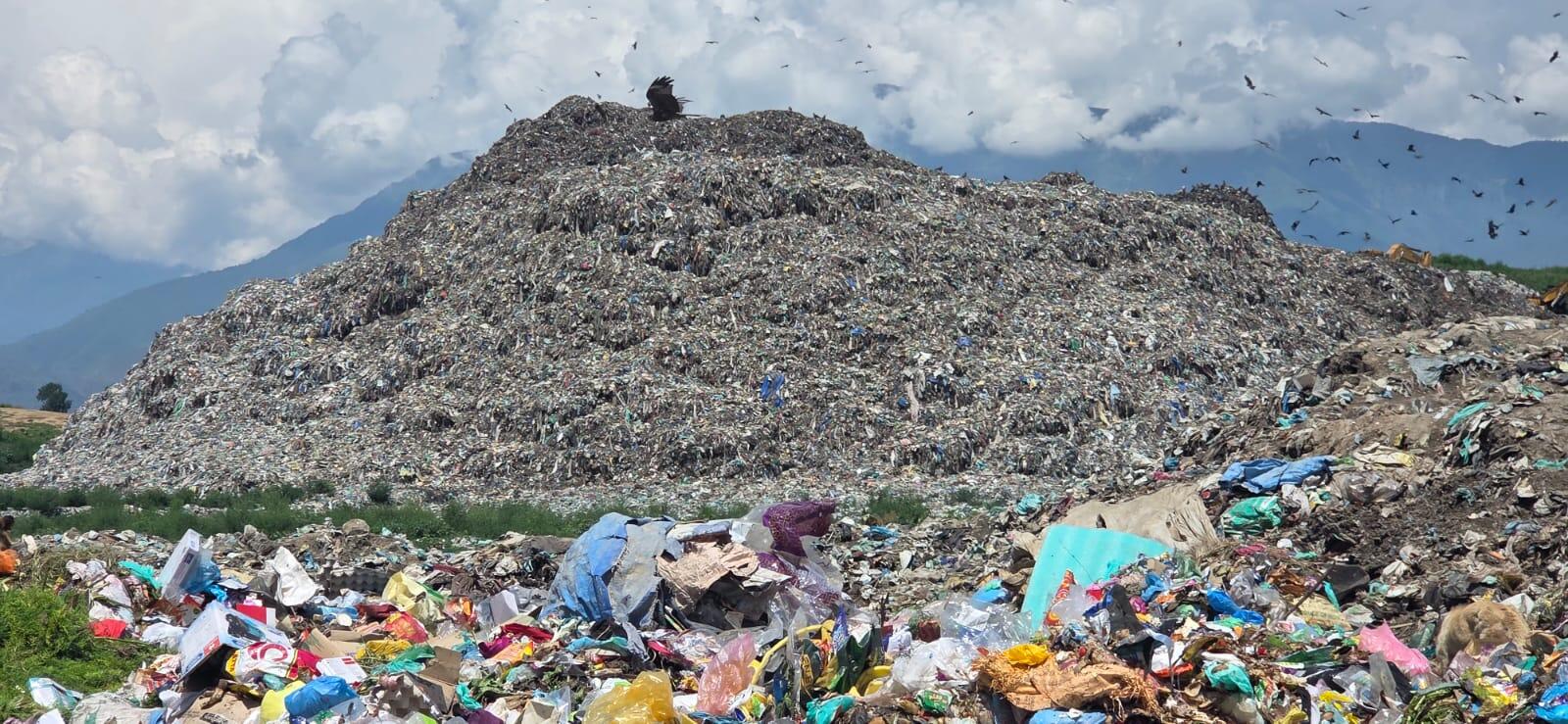
Fresh waste continues to be dumped daily
Located between Eidgah in Srinagar’s old city and the SKIMS with Achaar Lake in the backside, the site was selected when the surrounding area was largely uninhabited.“When the landfill was established in 1986, there were no residential areas around it. They came up gradually over the years,” SMC Commissioner Faz Lul Haseeb said.In the mid-1980s, Srinagar generated only a fraction of the waste it produces today. The city now sends between 520 and 550 metric tonnes of municipal solid waste to Achan every day.According to the 2011 Census, Srinagar had a population of 1.22 million, a figure officials estimate has now reached nearly 1.6 million. The municipal population grew from about 291,000 in 1961 to 431,000 in 1971 and about 605,000 in 1981.For years, Achan functioned largely as an open dumping ground with little scientific processing. Small-scale composting initiatives failed to make a significant impact. As waste piled up, the landfill grew into a mountain.The residential colonies expanded around it with Zoonimar becoming one biggest city settlement but the site has turned the area into one of Srinagar’s biggest public health concerns.Residents say the foul odour often becomes unbearable. Flies invade homes, stray dogs, hundreds inside the site, some also roam the neighbourhood.Flies contaminate food and water, making visits to hospitals a routine part of life. Demands to shift the landfill have become a part of local protests.“This was a vast rural area when the landfill came up,” said RTI activist Raja Muzaffer Bhat. “The liquid from the waste seeped into the groundwater and riverbed and spread to nearby areas including the Anchar wetland, making agricultural practices impossible.”Bhat approached the National Green Tribunal (NGT), alleging that the SMC failed to control leachate from the landfill, allowing contaminated liquid to seep into residential areas and water bodies creating health concerns and killed agricultural practices.The SMC has assured the tribunal that it will clear the legacy waste by 2028.The corporation now faces two parallel challenges: clearing the accumulated legacy waste while ensuring that the 520 to 550 tonnes of fresh waste generated every day does not create another mountain.Under the Centre’s Swachh Bharat Mission, the SMC after the union government approved the plan in 2025 has started removing the legacy waste through biomining and bioremediation.Under it around 1,000 tonnes of legacy waste are now processed every day, said Haseeb. The old garbage is excavated, segregated, recyclable material is treated separately and refuse-derived fuel (RDF), given to cement factories as fuel gradually reduces the height of the garbage mound.He said the long-term solution lies in preventing fresh waste from becoming future legacy waste. The SMC had submitted a Rs 361-crore proposal under the Swachh Bharat Mission to establish an integrated waste management system for Srinagar, which was accepted by the union government in May this year.“Now that people are living around the site and far from it, we have a plan to improve their quality of life and manage waste better,” Haseeb said.“Over the next two years, the landfill will continue to receive waste while also producing biomass and fuel for cement factories. We are setting up a construction and demolition waste processing facility. An eco-park will be developed around the site and thousands of trees will be planted.”To improve conditions around the landfill, the corporation sprays anti-odour chemicals four times a day and plans to plant about 3,200 trees to create a green buffer, he added. A leachate treatment plant has also been commissioned to treat contaminated liquid before it is discharged.Prof. Ashraf Ganie, director of SKIMS, said, “we are hopeful that things will improve over the next two years,” he said.But the residents are not convinced.Firdous Ahmad Bhat of the Zoonimar Social Welfare Committee, which frequently takes public health issues of people of the area, said the odour continues to be as severe despite recent measures.“Nearly 200 vehicles bring garbage here every day. It has been 40 years. The site should be shifted somewhere else,” he said.The SMC says relocating the landfill is not practical. Instead, officials say the current plan to transform the site is the only feasible plan.“It is spread over 123 acres and was established after obtaining all necessary approvals in 1986,” Haseeb said.“We cannot simply take it somewhere else but we assure people that we will transform it into a landfill-cum-eco-park and mountains of garbage will go.”It also challenges Omar Abdullah government with Srinagar being the ruling party’s bastion they are keen to settle this old issue.“May 15 when Rs 361 crore integrated solid waste management project was approved for Achan, it was a historic step towards a cleaner, greener and more sustainable Srinagar. The elected government had promised to deliver and we did it. If there is a will, there is a way,” the NC spokesman and legislator from the area Tanvir Sadiq said.