Why Putin’s first visit to disputed Kuril Islands has rattled Japan
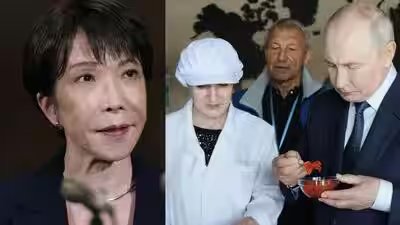
Vladimir Putin first became Russia’s president in 2000 and has remained in power ever since, apart from a four-year stint as prime minister under Dmitry Medvedev from 2008 to 2012.Yet Putin only travelled to the Kuril Islands, a Russian-controlled Pacific archipelago also claimed by Japan, for the first time in August this year. His visit predictably triggered a diplomatic spat between Moscow and Tokyo, reigniting a decades-long territorial dispute.The timing of the visit was also notable: he arrived just two days before the 81st anniversary of Japan’s surrender in World War II.However, the significance of Putin’s trip goes beyond it being his first to the Kurils or its timing, bringing renewed attention to a territorial dispute that has long complicated relations between Moscow and Tokyo.
Putin’s Kuril Islands visit — A territorial dispute reignited
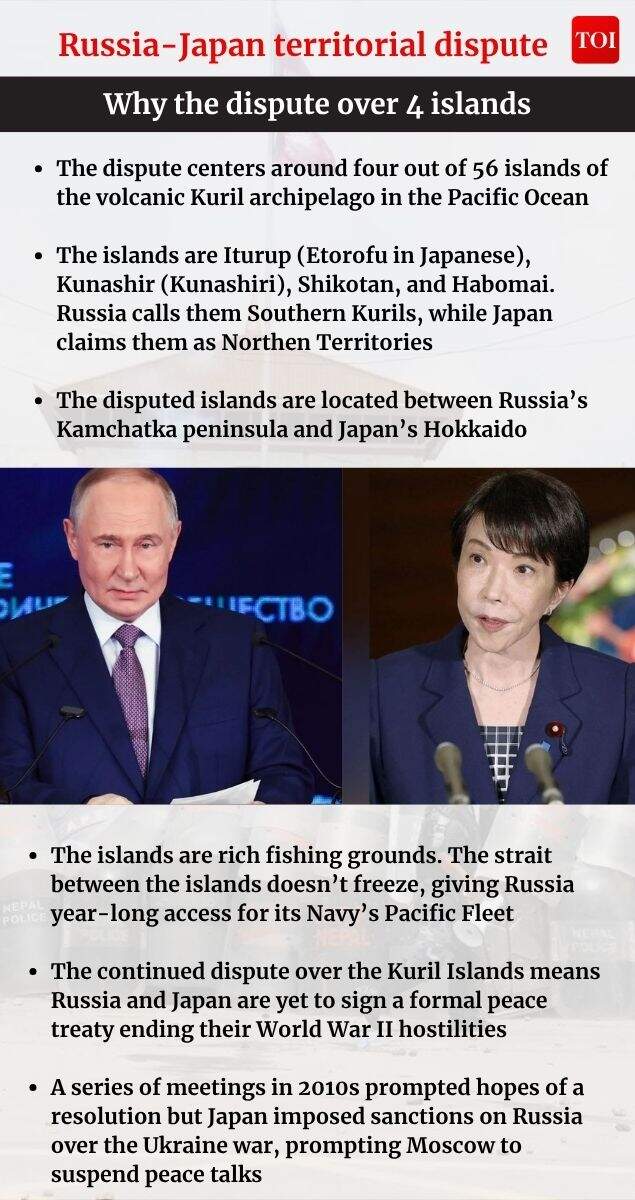
The dispute centres on four of the 56 islands that make up the Kuril chain, a volcanic archipelago stretching between Russia’s Kamchatka Peninsula and Japan’s Hokkaido. The four are the southernmost islands in the chain and, therefore, the closest to Japan, which calls them the Northern Territories. Moscow, on the other hand, claims and administers them as Southern Kurils.
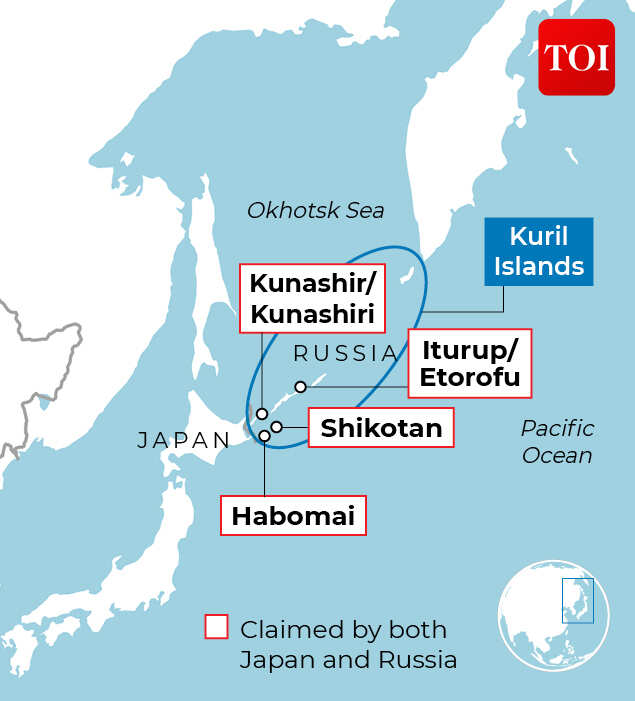
The dispute centres on four of the 56 islands that make up the Kuril Islands
On August 13, Putin went to Iturup, known as Etorofu in Japan, the largest of the four disputed islands. But he was not the first Russian leader to visit the Kurils. In 2010, Medvedev visited the islands as president and returned three times as prime minister, in 2012, 2015 and 2019. Mikhail Mishustin, Russia’s prime minister since 2020, also travelled to the Iturup island in 2021.Putin’s visit also marked a departure from the approach he had taken toward the dispute for much of the 2010s, when he held multiple rounds of talks with then-Japanese Prime Minister Shinzo Abe.
Russia-Japan Kuril Islands dispute
In 2018, Putin even proposed signing a peace treaty “without any preconditions” to formally end the two countries’ World War II hostilities.Abe welcomed the proposal while acknowledging the difficulties ahead, saying, “We are both fully aware that it will not be easy.”However, that potential opening ultimately collapsed in 2022, when Russia withdrew from negotiations.
Ukraine further strains an already tense relationship
On February 24, 2022, Russia launched what it calls a “special military operation” against neighbouring Ukraine. More than four years later, the war continues, with no end in sight.The West responded by imposing sanctions on Russia and has added further measures since then. Japan also imposed sanctions, including on Putin himself. Moscow retaliated by suspending an exchange programme and withdrawing from dialogue on joint economic activities, both involving the disputed territories.
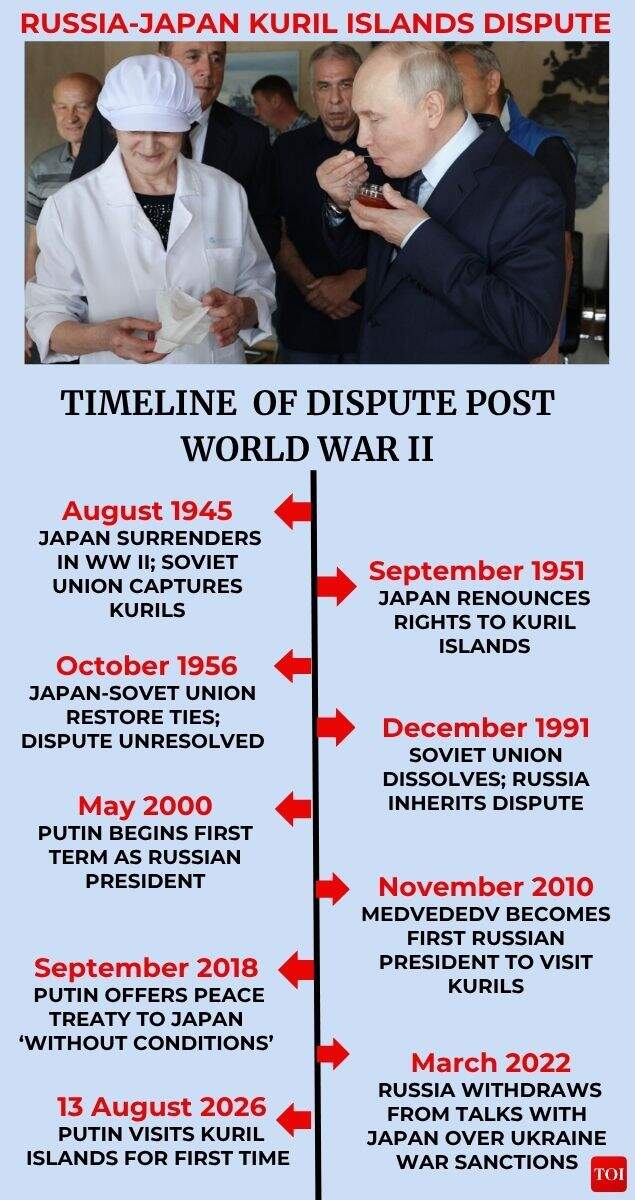
How Kuril Islands dispute unfolded post World War II
It also withdrew from negotiations on a formal peace treaty, leaving the two countries without an agreement formally ending their World War II hostilities.For the Kremlin, Japan’s alignment with the West marked a sharp break from the relationship Putin had spent years trying to cultivate with Tokyo, particularly under Abe.The dispute, once the subject of sustained bilateral negotiations, was now caught up in the much wider confrontation between Russia and the West. In February 2026, the Kremlin declared that there would be “no dialogue” with Japan on a peace agreement, blaming what it described as Tokyo’s “unfriendly” stance.
Russia’s relations with Japan have been reduced to zero over Tokyo’s unfriendly stance… There is no dialogue, and it is impossible to discuss the issue of a peace treaty without dialogue
Dmitry Peskov, Kremlin spokesperson
A message to more assertive Japan?
Putin’s visit to the Kuril Islands coincided with another significant development. On August 21, Russia announced that its Navy had conducted a rare missile test near the disputed islands, drawing another protest from Tokyo.That test, while not specifically aimed at Japan, came amid a significant shift in Tokyo’s security policy. Since becoming prime minister in October last year, Sanae Takaichi has pursued a more assertive security policy, marking a departure from Japan’s traditionally pacifist postwar posture.Much of that shift has focused on the potential threats posed by China and North Korea. But Takaichi has also been sharply critical of Moscow, which has grown closer to both Beijing and Pyongyang.Her response to Putin’s Kuril visit reflected that harder line. She described the trip as “incompatible with the Japanese position on the Northern Territories” and “absolutely unacceptable”, and warned that restoring bilateral ties had become more difficult.
Why Kuril Islands matter to Russia
While the Kuril archipelago has its own strategic importance for Japan, the islands are equally significant to Russia.The chain separates the Sea of Okhotsk from the Pacific Ocean, giving Moscow control over strategically important sea routes and helping protect the area where the Russian Navy’s Pacific Fleet operates.Beyond their strategic value, the islands are surrounded by rich fishing grounds. Before relations sharply deteriorated following the Ukraine war, they had the 1998 Russia-Japan Fisheries Agreement, which allowed Japanese fishermen to operate in the region in return for payments to Moscow.Russia suspended the agreement in June 2022, months after the Ukraine war began, although it cited continued non-payment by Japan as the reason.Beyond Russia’s military presence on the disputed territory, the islands are home to around 20,000–30,000 inhabitants. There is also a civilian Russian presence, with settlements, schools, hospitals and other infrastructure spread across the inhabited islands.Putin’s itinerary on Iturup offered a glimpse of that presence. He toured a fish-processing plant, a hospital and a school, and met local officials and residents.The trip, therefore, also highlighted the civilian population and infrastructure Russia has built on the islands over the past eight decades.
Signficance of Putin’s Kuril Islands visit
The first time a Russian president toured the Kuril Islands, with Medvedev visiting in 2010, Japan responded by recalling its ambassador from Moscow. Since his three subsequent trips were less high-profile, Tokyo limited its response to lodging diplomatic protests and summoning Russian ambassadors.According to experts, Putin’s decision to make the trip himself, therefore, carries a different significance. While Tokyo has protested and reportedly even considered recalling its ambassador from Moscow, it has so far taken no action beyond that.His visit can also be seen as a reflection of the changed relationship between Russia and Japan. Rather than approaching the territory as an issue to be resolved through diplomacy, Putin made it a point to travel there, where he spent time touring local facilities and meeting residents.The timing also stood out. The four disputed islands were seized by the Soviet Union at the end of the war, making the timing difficult to separate from the history at the heart of the dispute.Taken together, this suggests that the visit was not simply a routine trip to territory Russia controls — and claims. It came when diplomacy with Japan has largely stalled, tensions have risen and Moscow has become more willing to publicly demonstrate its control over the islands.
Kuril Islands: A dispute that endures
The episode, therefore, highlights a stark geopolitical reality: the decades-long dispute is unlikely to be resolved anytime soon.More than 80 years later, the islands remain under Russian control and are still claimed by Japan. The disagreement has persisted despite changes in leadership, repeated rounds of negotiations and, now, a major deterioration in bilateral ties.Putin’s trip did not resolve any of those differences. Instead, it highlighted how much the context around them has changed. The president who once proposed ending the two countries’ World War II hostilities “without any preconditions” has now personally visited territory that Tokyo continues to regard as its own.For now, there is little sign that the issue that once brought Putin and the now-deceased Abe to the negotiating table is heading towards another diplomatic opening.