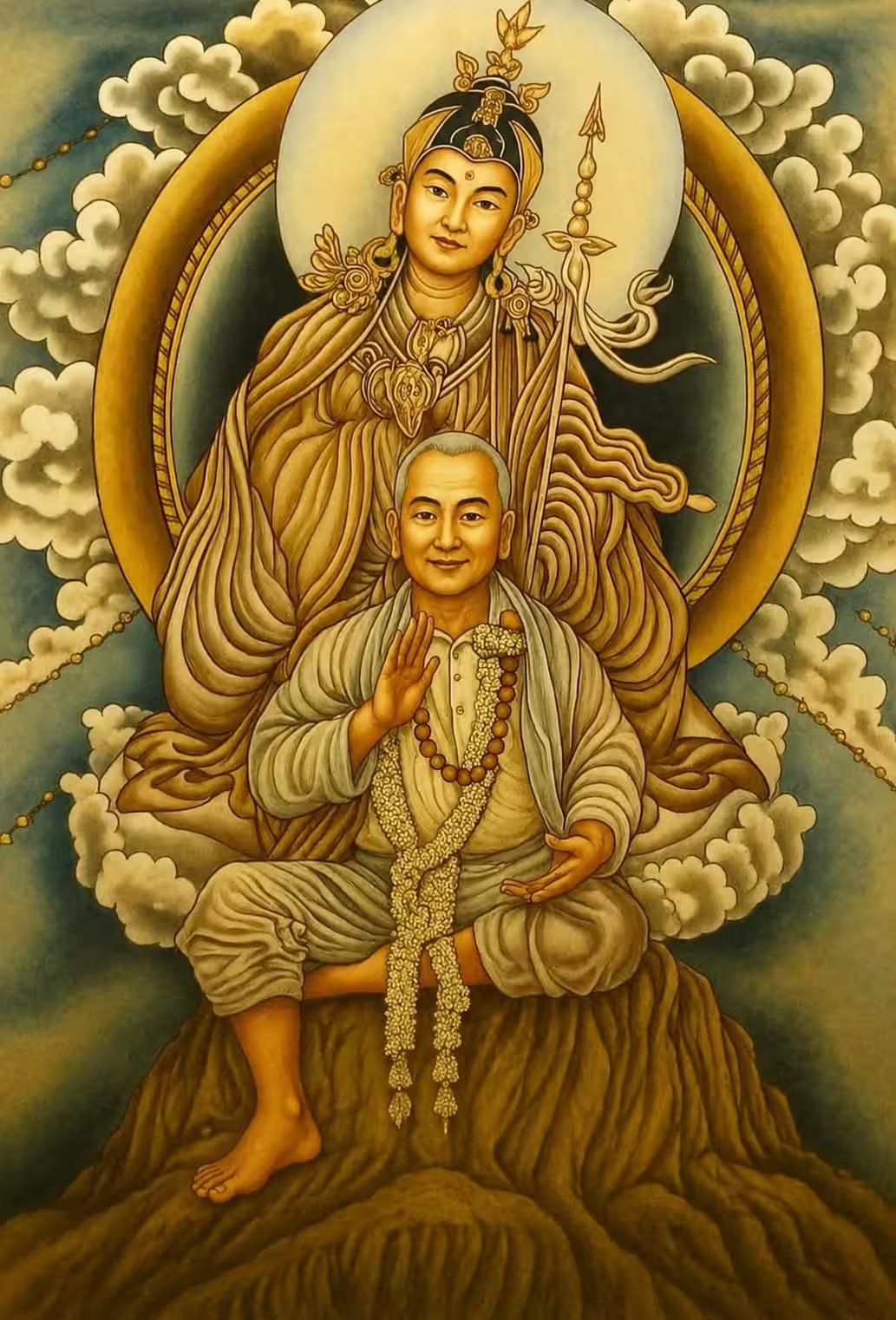
Why I dare to differ from Adi Shankara

By Karan Singh
The question of our relationship to the Divine has challenged all religions and philosophies. Markedly different views have been expressed in religious texts by philosophers. I have tried to express my own response to Adi Shankaracharya’s philosophy.
Adi Shankaracharya is probably our greatest ever philosopher/scholar. Thanks to his commentaries, we can approach the Upanishads, Gita and Brahma Sutras – the three foundations of Vedanta. There is, therefore, no question of denigrating his massive work. What i dare to differ from is his goal. In his writings, Adi Shankara seeks to become Shiv – Chidananda rupa ShivohamShivoham . I do not believe that we can become Shiv; AkhandaMandalakaramVyapatam YenaCharacharanam . The power that pervades the infinite galaxies and all that exists – movable and immovable. We can certainly reach a level at which we regard ourselves as part of Shiv, but that does not mean we can become Shiv.


In contrast, my goal is Shivalokam AvapnotiShivenSahamodate . In other words, i wish to reach Shivalok and then enjoy with Shiv. This is quite different from wanting to become Shiv. Seeing and interacting with Shiv is a more acceptable and realistic goal.
Therefore, rather than Shankara’s Advait Vedanta, i prefer Dvait Vedanta as expounded by Vallabhacharya and Madhavacharya. In fact, Vallabhacharya’s concept of Vishishtadvaita is interesting because it leaves both possibilities open. Shankara’s famous verse is Brahamsatyam jagat mithya jeevo Brahamevnapra – Brahmn is true, the world is untrue, the Atma is Brahmn. I would venture to suggest an alternative approach: Brahamsatyam, Jagat Satyam, JeevoShivenNapra – Brahmn is true, the manifestation is true, the jiva is in fact, Shiv.
While these conceptual differences may be important, what really matters is whether we are internally working on ourselves so that we can begin to absorb the Divine light, particularly when the whole world seems engulfed in a wave of hatred and violence. It is important that those of us on the spiritual path should maintain our equanimity and not get carried away by the current chaos. Wars in Europe and Asia have involved 1,000s of deaths, not to speak of massive dislocation and destruction of heritage sites.
I would like specially to mention the Israel/Palestinian conflict. Few people now recall how close we used to be to the Palestinians and how, as we did with racial discrimination in South Asia, we reiterated our support for Palestine, whenever the occasion arose. In fact, i recall having met Yasser Arafat in Beirut several decades ago. Apparently, he looked upon Indira Gandhi as his sister. It is surprising that the death of over 65,000 Palestinians in the Israel/ Hamas conflict has hardly created a ripple in our press or political life. Israel is undoubtedly a remarkable country, created almost exactly at the time when we attained Independence. However, despite the terrible and suicidal attacks by Hamas on Israel, the response has been overwhelming resulting in a large number of deaths. The question arises as to how we can link contemporary events with philosophical interpretation of the relationship between the individual and the Divine. This is a question that all individuals have to answer themselves.
Disclaimer
Views expressed above are the author’s own.
END OF ARTICLE