What travelled before the organisation did
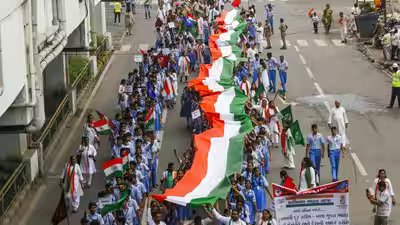
On the morning of 15 August, when the Prime Minister arrives at the Red Fort, the National Song will be sung from those ramparts for the first time. All six stanzas of Vande Mataram, before the National Anthem and before the flag is unfurled, at India’s eightieth Independence Day. The song turns a hundred and fifty this year.Most of what is written about that moment will be about memory and emotion, and rightly so. I want to write about something narrower, because it is the thing I think about most in the work I do.Vande Mataram began mobilising Indians before many of the leaders we associate with the freedom struggle had arrived. When it was written, Gandhi was a child. Sardar Patel was born that same year. Savarkar and Subhas Chandra Bose would not be born for another decade and more.But consider what it was when Bankim Chandra Chattopadhyay wrote it in 1875. A poem, by a novelist who served as a civil servant in the colonial administration and held no political office. No organisation stood behind it. The First War of Independence had been fought and suppressed a generation earlier, and the Indian National Congress would not exist for another decade. There was no political vehicle for it to serve and no strategy for it to form part of. Whatever Bankim intended by it, he was not writing for an organised national movement, because there was not yet one to write for. What he set down was feeling for the motherland, and nothing in the circumstances of its writing suggests it was meant to do more than that.And yet it travelled. Across provinces that shared no common language, through populations that were largely unlettered, without newspapers that reached most people, without any structure to carry it. It ran well ahead of political organisation, into places and among people that no party machinery had yet reached.I spend my working life on the problem of how large organisations move things across a very large country. Instructions, decisions, information, energy. It is difficult work, and it requires structure. Coordinators, functionaries, layers of people whose job is to carry things from one place to another. Every organisation I know of is built out of that necessity.So the question that interests me about Vande Mataram is a practical one. How did it move without any of that?It did not need to be carried. People picked it up and passed it on because they wanted to, not because anyone had assigned them the task. That property is rarer than it sounds. Most of what an organisation produces has to be pushed. Circulars have to be sent, meetings convened, workers instructed. Only occasionally is something made that spreads because people choose to spread it, and when that happens it reaches places no structure could have reached, and it arrives with a conviction that instructed messages never carry.There is a lesson in this that I find uncomfortable, because it cuts against the instincts of everyone who works in organisation.We tend to believe that reach is a function of machinery. Build enough structure, place enough people, and the message will travel. Within limits that is true. It is how most work gets done and there is no substitute for it. But machinery has a ceiling. It reaches exactly as far as it is built to reach and no further. A message that requires an organisation to carry it can never outrun the organisation.Vande Mataram outran everything. It was still spreading decades after it was written, carried by every stream of the freedom struggle, by revolutionaries and constitutionalists, in Bengal and Punjab and Maharashtra, among people who agreed on very little else. It kept reaching places no organisation had yet reached. The song went first. The structure followed.That order of events is worth pausing over. We usually imagine it the other way round, that a movement builds itself and then finds its symbols. What happened here was closer to the reverse. Something existed that people were willing to carry, and the organisation grew in the space that made.Why did they carry it? The answer is not complicated, though it is easy to get wrong.The poem did not instruct anyone. It made no demands and issued no programme. It described the land, its waters and harvests, its nights and its fields, and it gave people a way to feel about all of it that they had not previously had words for. Bankim gave a name to something already there. That is all. And it turned out to be enough, because what people will carry across a subcontinent, at risk to themselves, is not a set of instructions. It is a feeling they recognise as their own.The effect is not in dispute. It worked. It made people who had never met feel they belonged to the same thing, and it did so across distances the political organisations of the time could not yet span.I should admit a personal reason for thinking about all this.In the BJP, every meeting begins with Vande Mataram. Every programme opens with it. Over fifteen years of organisational work I have sung it in district offices, in training camps, in halls in towns whose names I had to learn on the way, and in rooms where nothing of consequence was decided. It is so routine that it would be easy to stop hearing it.But it does something on the days when the work feels only like work. Organisational life is mostly logistics. Lists, arrangements, arguments about who will do what. The song helps with none of that. What it does, in the thirty seconds before a meeting begins, is return me to why I am in politics at all. It is a small thing and I have never found anything that replaces it.That is the same property which carried it across a subcontinent, working now at the scale of one person in one room. A hundred and fifty years ago it made strangers feel they belonged to one thing before any national political organisation existed to tell them so. Today it reminds people inside an organisation what the organisation is for. The same mechanism, running in the opposite direction.For anyone doing organisational work now, and I include myself, that is the durable lesson, and it is not a comfortable one.We have far more machinery than the freedom struggle ever had. We can reach a district in seconds and a state in minutes. Instruction has become almost frictionless, and precisely because the machinery is so good, it is tempting to believe reach is a solved problem.The ceiling has not gone away. It has moved. What we transmit reliably is instruction, and instruction has never been the thing that makes people carry something across a country at risk to themselves. Structure amplifies what already has that quality. It multiplies nothing when the quality is absent.A hundred and fifty years on, that is what strikes me most. A civil servant in Bengal, holding no political office and commanding no organisation, wrote down what he felt about his land. He was not building an instrument. He made something people wanted to carry, and it became the National Song because they carried it. Much of what came after, the marches and the meetings and the machinery, was built in the space that made.When it is sung on Friday from those ramparts, complete, before the flag goes up, it will be an act of remembrance. It is also a reminder to anyone who builds organisations. The structure is necessary. The structure is not sufficient. Something has to be worth carrying first.
Disclaimer: Views expressed above are the author’s own.