Unravelling the law of Karma
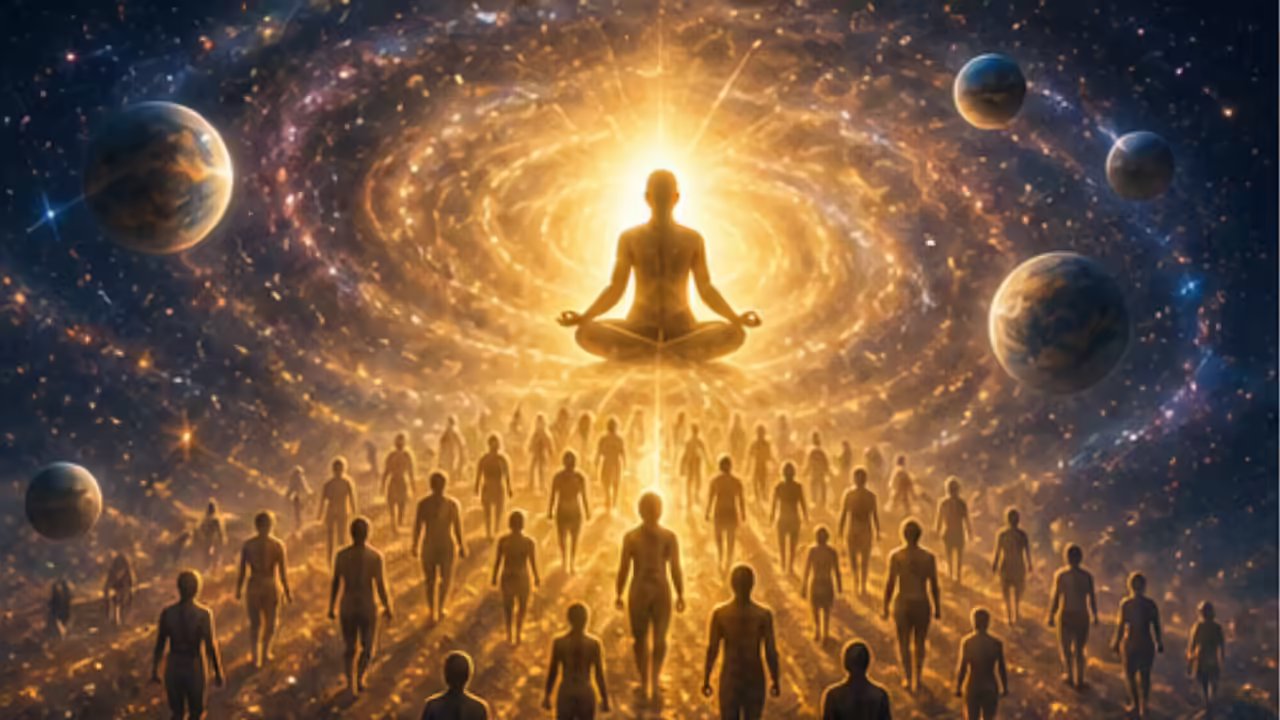
Creation, as understood in the depths of Hindu philosophy, is not born of necessity nor of any lack within the Divine. It is, rather, a spontaneous expression of infinite fullness. The ancient seers of the Upanishads captured this mystery in the profound declaration: “एकोऽहम् बहुस्याम्”—“I am One; may I become many.” This is not a desire arising fromincompleteness, but an overflow of perfection—an expressio bliss (ānanda) seeking manifestation. The universe, therefore, is not a product of compulsion, but of divine play (līlā), where the One appears as many without ever ceasing to be One.
Within this cosmic manifestation, the individual soul (jīvātman) emerges as a reflection of the Supreme Consciousness (Paramātman). In its essence, the soul is eternal, pure, and infinite. Yet, upon entering the realm of nature (prakṛti), it becomes veiled by māyā—the mysterious power that makes the unreal appear real and the eternal seem transient. This veiling does not alter the soul’s true nature; it merely obscures it, just as clouds conceal the sun without diminishing its light.
Under the influence of māyā, the soul begins to identify with the body, mind, and senses. It assumes limitations that do not belong to it and becomes entangled in dualities—pleasure and pain, gain and loss, success and failure. This misidentification is the root of human suffering. The eternal, mistaking itself for the ephemeral, becomes subject to fear, attachment, and sorrow. Like an actor lost in his role, the soul forgets its true identity and becomes bound to the drama of worldly existence.
The Bhagavad Gita reminds us that the Self is unborn, undying, and indestructible. Yet, due to ignorance (avidyā), we experience ourselves as finite beings. Human birth, therefore, holds immense significance. It is regarded as a rare opportunity, for only in human life are discrimination (viveka) and free will fully developed. These faculties enable us not merely to act, but to reflect, to question, and ultimately to transcend.
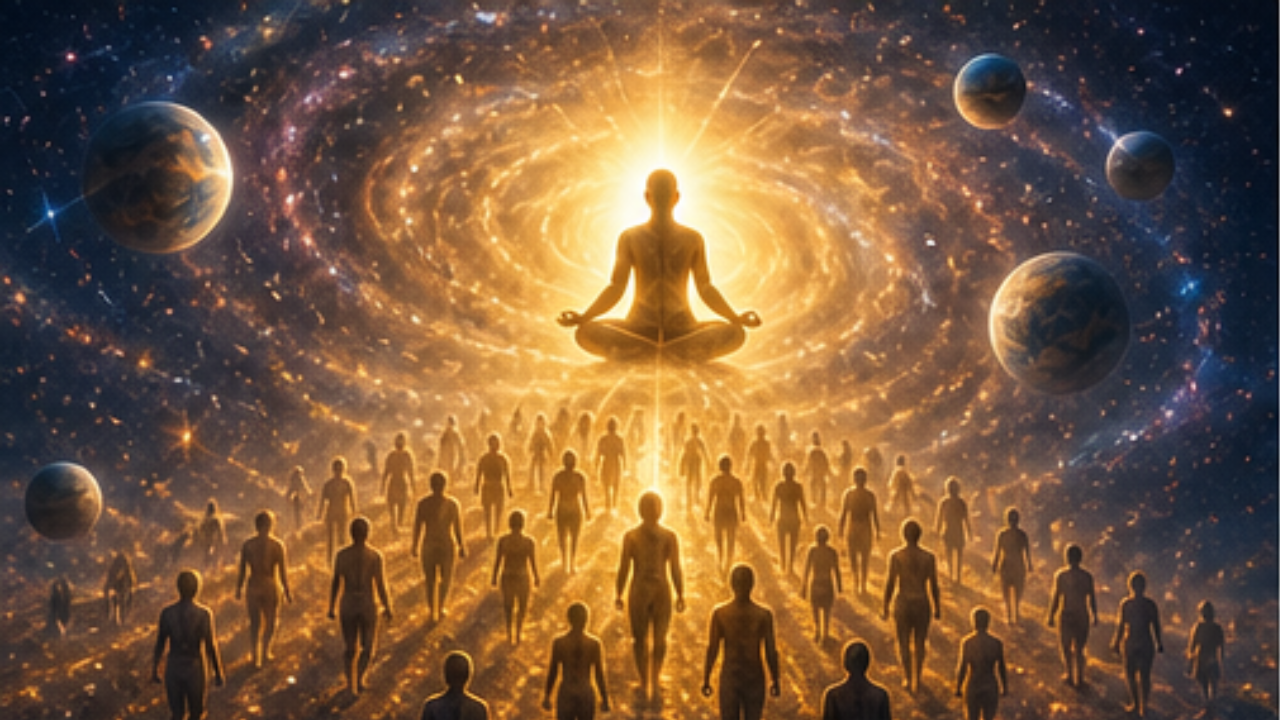

However, freedom carries risk. The misuse of free will leads to actions that bind the soul further, while its right use leads toward liberation (mokṣa). Many, enchanted by the attractions of the material world, become deeply attached to transient pleasures and lose sight of their higher purpose. They seek fulfillment externally, only to encounter cycles of desire and dissatisfaction. This condition is one of spiritual forgetfulness—the soul, though divine, lives as though it were merely material.
The presence of suffering and evil in the world often gives rise to a profound question: if the Divine is perfect, why does suffering exist? Hindu philosophy approaches this question with subtlety. Rather than attributing suffering to God, it sees it as part of the experiential fabric of existence. Contrast is essential for perception—without darkness, light cannot be recognized; without sorrow, joy loses meaning. Life, like a work of art, requires both light and shadow to reveal its depth.
The world is often compared to a drama or a moving picture. A meaningful drama cannot consist solely of pleasant scenes; it must include tension, conflict, and resolution. Similarly, the interplay of opposites—joy and sorrow, virtue and vice—creates the conditions necessary for growth. Suffering, in this sense, is not purposeless; it is a catalyst for awakening. It disillusions us from the fleeting and redirects us toward the eternal.
At the heart of this framework lies the law of karma—the universal principle of cause and effect. Every thought, word, and action generates a corresponding result. This is not a system of divine reward or punishment imposed from outside, but an intrinsic law of the universe operating with perfect justice. God does not punish; we experience the consequences of our own actions. In this sense, we are both the creators of our destiny and the experiencers of its Outcomes.
The doctrine of karma explains the apparent inequalities of life. Our present circumstances are shaped not only by current actions but also by those of past lives. Suffering, therefore, is not arbitrary—it is meaningful. It represents the unfolding of prior causes and offers an opportunity for growth and transformation. The Upanishadic insight, “यथा कर्म यथा श्रुतम्”—“As one acts, so one becomes”—encapsulates this truth.
Seen in this light, suffering is not merely a burden but a teacher. It fosters introspection, humility, and spiritual awakening. Yet its impact depends on our response. Resisted, it breeds bitterness; understood, it becomes transformative. The Bhagavad Gita advises equanimity—to remain steady in both pleasure and pain, recognizing their transient nature and their role in our evolution.
True religion, therefore, is not merely ritualistic or consolatory; it is a systematic path toward the cessation of suffering and the realization of truth. In the Hindu tradition, religion is a science of the soul. It includes ethical living, self-discipline, meditation, devotion, and knowledge—all aimed at purifying the mind and awakening inner awareness.

A crucial part of this process is understanding the role of the mind. While physical pain may be inevitable, much of our suffering is psychological—arising from attachment, resistance, and identification. A less conditioned mind experiences pain more directly and simply, whereas a conditioned mind amplifies it through memory, anticipation, and ego. By mastering the mind through awareness and meditation, one can significantly reduce suffering.
At the core of all spiritual teaching lies divine love. This love is unconditional and all- embracing, seeing all beings as expressions of the same Reality. To realize this love is to transcend hatred and division. When one perceives the same Divine presence in all, compassion and selfless service arise naturally. The ideal of “वसुधैव कुटुम्बकम्”—the world as one family—ceases to be a concept and becomes a lived reality.
Death, often feared as an end, is understood as a transition. It is not annihilation, but transformation. Just as one discards worn-out garments and takes on new ones, the soul leaves the body and assumes another. Forgetfulness of past lives is not a loss but a blessing—it allows renewal without the burden of accumulated memories. Yet, the essence of past experiences is retained as tendencies (saṃskāras), shaping future behaviour and destiny.
Through repeated cycles of birth and death, the soul evolves. It gradually learns that lasting fulfillment cannot be found in the transient. The journey of life is thus a return—a movement from fragmentation to wholeness, from ignorance to realization. Narrow identities give way to a universal vision, in which all existence is seen as one.
The world, then, may be viewed as a vast laboratory—a field in which the soul is tested, refined, and awakened. Every experience, whether joyful or painful, serves a purpose.
Nothing is wasted; everything contributes to the unfolding of consciousness.
In the final analysis, life is not random or meaningless. It is a deeply purposeful
journey—from ignorance to knowledge, from bondage to freedom, from multiplicity to unity.
When the soul realizes its true nature, it transcends the cycle of birth and death and abides in the eternal bliss of the Spirit. The drama of life continues, but the realized being is no longer bound by it—remaining a conscious participant, rooted in unshakable peace and divine awareness.
Disclaimer
Views expressed above are the author’s own.
END OF ARTICLE