The right way for students to use AI? This CBSE batch has answers
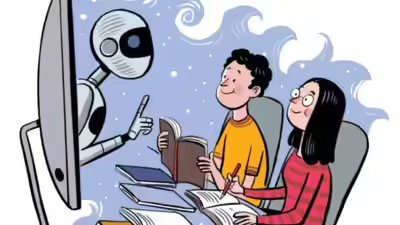

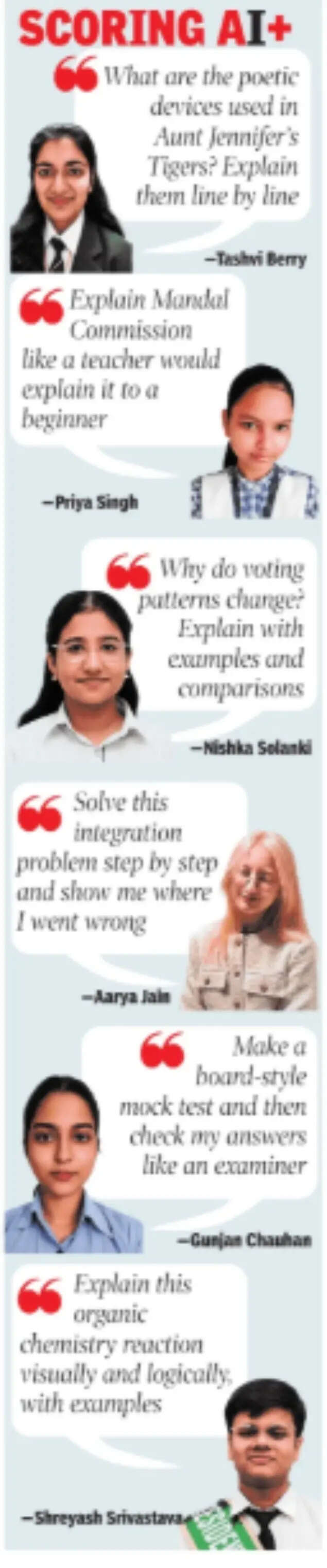
“Aunt Jennifer’s tigers prance across a screen/Bright topaz denizens of a world of green.”Every time Class 12 student Tashvi Berry opened her English literature book to study American poet Adrienne Rich’s 12-line metaphor-drenched rage against patriarchy, these famous opening lines made absolutely no sense.For the 17-year-old with learning disabilities, who had the poem for her CBSE Class 12 boards, the struggle with the many poetic devices – juxtaposition, symbolism, irony – that make up the poem felt like a losing battle. “I felt like I was getting stuck, because I simply couldn’t understand the deeper meaning of the lines,” Tashvi says.Classroom teaching did little to break down the poem. Even private tutors couldn’t help her.But Tashvi was not beyond help. AI knew exactly what to do.Tashvi turned to ChatGPT – almost as a last resort – and it was an eye-opener. The AI, in its tutor avatar, explained not only the opening lines, but the entire poem, line by line. It taught her symbolism through ‘action’ – that the poem’s Aunt Jennifer was actually sewing tigers on a piece of cloth; that embroidery was the mode of self-expression of a woman who felt afraid and trapped in marriage; and that she was speaking her mind through the brave and free tigers she stitches.“ChatGPT explained each metaphor that was used, why certain words like ‘Uncle’ are important, how questions could be framed in exams, and what the answer should be like,” says Tashvi.Once she cracked it, she went back to AI with questions she had about ‘The Third Level’, a short story in her syllabus themed on escapism. “The AI helped me make notes in simple language and in bullet points. I kept turning to AI for anything that I had conceptual doubts about, or when I needed more information, such as for painting theory and Rajasthani art,” says the Delhi-based student, who cleared CBSE Class 12 earlier this month with 87%, a big improvement from her Class 10 score of 70%.Tutoring & mentoring Since the AI dam burst, its use in schools has been frowned upon, especially when it involved students using it as shortcuts, missing the fundamental point of practice – to help write essays, to use it to solve math problems, or when AI-generated answers were copied, word for word, for projects. But the latest graduating CBSE batch is replete with examples of AI being used well – where students used AI as a mentor and guide to supplement classroom learning and improve exam performance.From simplifying difficult concepts and ironing out last-minute doubts, to generating answer-writing patterns and practising with model papers, to even asking AI to generate the best study routine, these students harnessed the power of AI to make themselves better prepared.Aditi Mishra, who scored 99.2%, said AI played a supporting role by summarising long chapters. “Classroom teaching is irreplaceable,” says Mishra, who studied at Rani Laxmi Bai Memorial School in Lucknow and wants to go to medical college, “but AI can be used for assistance and revision.”Priya Singh, who appeared for the CBSE Class 12 exam from Amitasha Foundation in Noida, scored 97%. The daughter of a bus driver, Priya did not have the resources to take additional tuitions or to buy reference books. “AI became my reference book and tutor,” she told TOI. “In political science, there was mention of Mandal Commission, but my NCERT book had limited information. When I used ChatGPT to research it, I got the full picture and its importance in understanding reservation in India.” Priya had scored around 70% in Class 10, so it’s been a huge improvement for her. “For history and home science, I prompted it to explain topics to me like a teacher would explain to a beginner. That made chapters I found difficult easier to retain,” she says.Others used AI whenever they needed better analytical understanding of a topic. One such example is that of Nisha Solanki, who scored 92.4% in Class 10 and cleared her Class 12 boards with 98.2%.“Instead of memorising chapters, I wanted to understand why voting patterns change and how electoral verdicts reflect social and political shifts,” says the DPS Gurgaon student. “And Gemini explained trends with examples and comparisons, which made my answers better.” Nisha says she used AI for deeper understanding because exams today are “competency-based”, where one cannot hope to do well by “simply mugging up definitions”, as questions are framed such that application and interpretation also become important.Nisha says she also used Gemini to understand Sigmund Freud’s theories for her psychology answers. “Freud’s concepts were not easy to understand directly from the textbook. But I developed a genuine interest in the topic after asking questions and exploring examples on AI.”Nisha, however, has a word of caution. Using AI meaningfully needs a foundational understanding of a subject, she says, so one can’t just skip classes and hope to catch up using AI. “Teachers,” she says, “build that basic foundation, and my teachers were amazing. AI only works properly if you know how to give the right prompts. If your prompt is general, so would be the response.” ‘Integral’ to mathsEven as AI can make sense of Freud’s theory of dreams, it can also, as it turns out, dispel maths nightmares. Just ask Aarya Jain, who took her Class 12 boards from Apeejay School in Noida. Aarya scored just 60 in her Class 11 exams. “Integral calculus used to confuse me, because the same method would work for one question and fail for the other. But AI tools solved each problem I had failed to grasp step by step, showed alternative methods and explained where exactly mistakes happened,” says Aarya, who improved her maths score to 85 at the boards.Several utilised AI for exam practice and time management. Gunjan Chauhan used AI to create and evaluate mock tests in all papers. “I would write the answers and upload them back to the chatbot, which suggested improvements, pointed out weaknesses and explained how answers could be structured better for boards. It felt like practising with a teacher who was available anytime,” says the NCR-based student. Lucknow’s Aishwarya Pandey, who scored 99%, used AI to create a timetable for board preparation. By entering details such as school hours, study time, rest and hobbies, she was able to generate a structured daily schedule.Shreyash Srivastava of DPS Greater Noida, who had an overall score of 98.4%, says he used AI for his organic chemistry preparation. “Reactions can become confusing – like what breaks into what, why a reagent behaves differently, or how mechanisms change. AI tools explained reactions visually and logically. To stand out, you need extra conceptual clarity. Referring to multiple books takes time, but AI gives quick explainers with as many examples as you want,” he says.‘Can’t replace teachers, textbooks’Educators welcomed meaningful use of AI, but they also had a word of caution. “AI tools can certainly be used as guidance platforms for homework, concept clarification and gaining additional knowledge beyond textbooks,” says educationist Aditi Basu, president (Noida) of All India Principals Association. “Many students today use AI. But they must remember that these tools should support learning, not replace teachers. It is always advisable to cross-check information with teachers or tutors because AI-generated responses can sometimes be incomplete, oversimplified or even inaccurate.”Ritu Srivastava, principal of Sri Chaitanya School, Noida, acknowledges that AI has made life a bit easier for “both students and teachers”. For teachers, she says, mock tests, academic schedules, personalised assignments, lesson plans and even assessment tools can be created within seconds using AI. At the same time, she warns against over-reliance, saying there are drawbacks that educators and students must learn to address. “In many instances, there was an obvious lack of a ‘human touch’ in answers framed by students in this year’s CBSE boards. Hopefully, as AI evolves further, with more advanced prompts, these gaps will gradually be addressed,” she says.Seema Jerath, principal of DLF Public School, Ghaziabad, echoed her. “I have seen many students – who used to struggle with certain chapters, subjects or concepts – become far more confident and fluent after using AI tools to clarify doubts. The speed with which kids have taken to this technology is truly remarkable.”And she, too, signs off with a note of caution. “It is equally important for teachers to guide students responsibly and help them understand what is right, accurate and meaningful learning,” she adds.
– Inputs from Mohita Tewari in Lucknow