
The paper leak isn’t India’s biggest exam problem
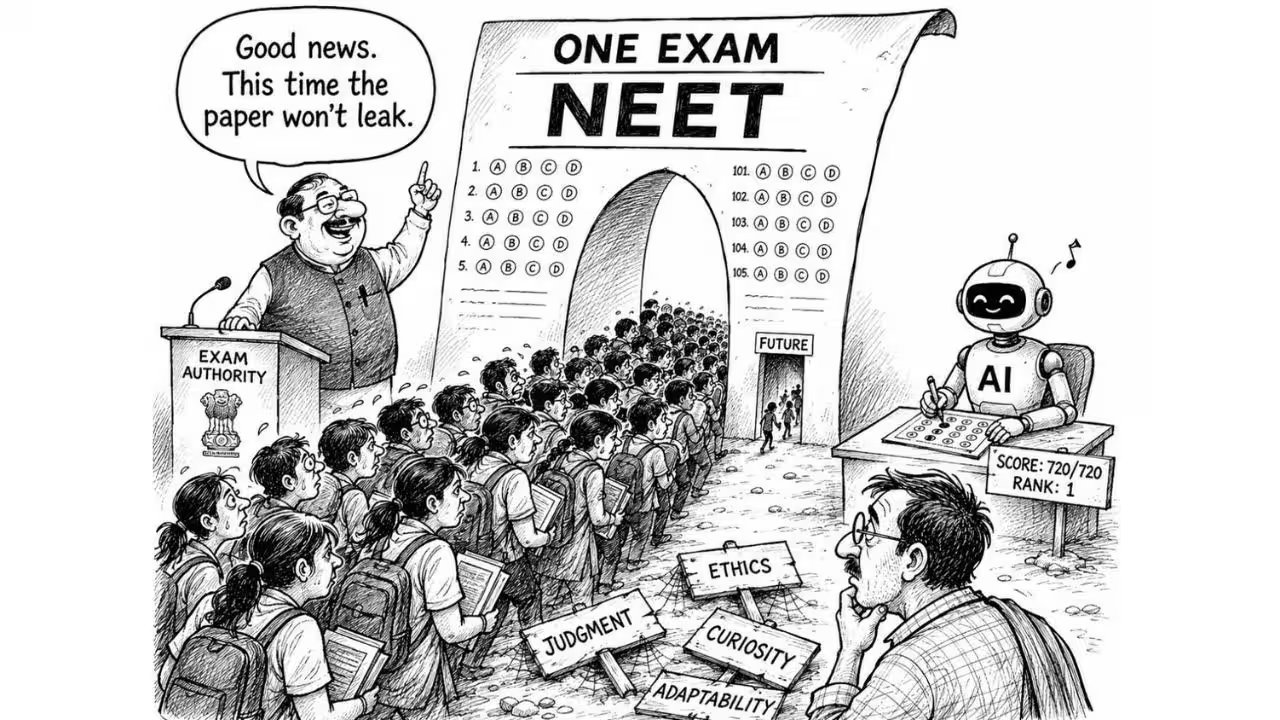
Even a perfectly secure NEET would still ask one narrow performance to carry the weight of an entire life. In the age of AI, that is becoming harder to defend.
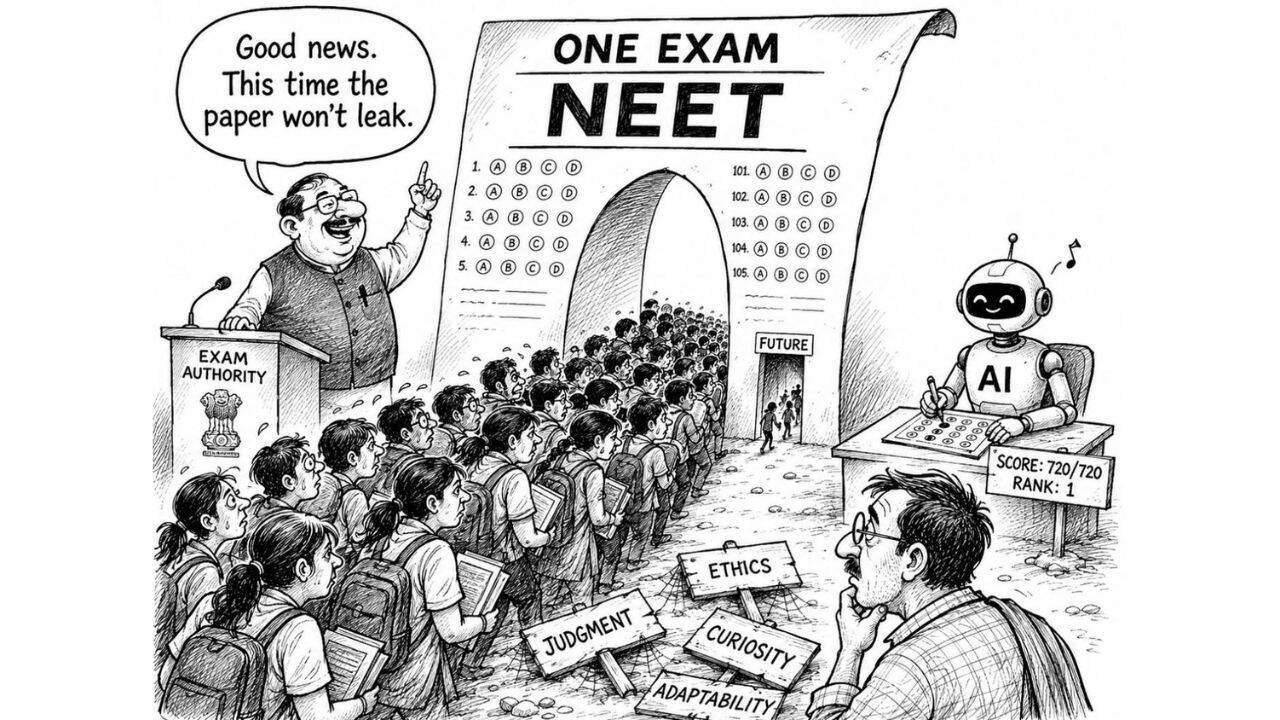

When an examination paper leaks, the immediate demand is obvious: find those responsible, compensate the students harmed and conduct the test fairly.
That demand is entirely justified.
But once the paper is secured and the answer keys are corrected, a more uncomfortable question remains. Why have we allowed a few hours in an examination hall to decide so much about a young person’s future?
India does not merely use entrance examinations to test knowledge. We ask them to perform several different jobs at once. An exam must certify competence, rank millions of students, ration scarce college seats, identify future potential and reassure society that the final outcome represents “merit”.
No examination can carry that much weight without eventually collapsing under it.
The recurring crises around NEET are therefore not only failures of security or administration. They expose a deeper design problem. We have taken one measurable performance and turned it into a verdict on the person taking it.
A student who performs well is assumed to be intelligent, disciplined and deserving. A student who falls short may be treated as if they lacked all three. Yet the score also reflects access to coaching, family income, language, health, geography, schooling and what happened in that student’s life during one decisive week.
We call the result objective because everyone answers the same questions. But equality of questions is not equality of circumstances.
This does not mean standardised examinations should simply be abolished. In India, that could create another form of unfairness. Interviews, recommendations and institutional discretion can easily favour wealth, social networks, polished English and familiar surnames. A transparent examination can protect students from patronage and arbitrary selection.
The problem is not that examinations exist.
The problem is their monopoly.
AI has made the mismatch harder to ignore
Our education system still rewards the ability to retrieve information, recognise familiar patterns and solve clearly defined problems under pressure.
These are useful abilities. They are also precisely the areas in which AI is advancing most rapidly.
A machine can already summarise a chapter, translate between languages, generate an essay, identify patterns in data and solve many well-structured problems. It can often do these things faster than the student being trained to compete with it.
The more important human abilities are becoming judgment, ethical reasoning, collaboration, curiosity and the capacity to act when the problem itself is unclear. These are sometimes dismissed as “soft skills”, as though they were decorative extras.
They are not.
When an AI system makes a biased decision, produces a convincing falsehood or recommends something harmful, the central question is rarely whether it processed enough information. The question is whether a human being understood the context, challenged the assumptions and accepted responsibility for the outcome.
Yet our most powerful examinations continue to reward certainty over questioning and speed over reflection. Students learn that every serious problem has four options and one officially correct answer.
Real life is increasingly refusing to cooperate.
What gets tested eventually becomes what gets taught
High-stakes examinations do not merely measure education. They reshape it.
Once one score determines access to opportunity, schools and families naturally optimise for that score. Coaching begins earlier. Subjects are reduced to likely questions. Curiosity becomes a distraction. Failure becomes psychologically catastrophic because the system has provided so few alternative routes.
This is not because parents, teachers or students are misguided. They are responding rationally to the incentives placed before them.
If one examination can change a family’s economic future, preparing obsessively for it is not irrational. It may be the only rational choice available.
That is why asking schools to teach creativity and ethics while continuing to reward only examination performance will achieve little. Students quickly understand which parts of education count and which parts merely decorate the brochure.
The alternative must also be designed carefully
Replacing examinations with portfolios, personal interviews or teacher recommendations is not automatically more progressive.
A polished portfolio may reflect parental assistance. An interview can reward accent and confidence rather than ability. Teacher assessments can reproduce caste, class and gender prejudice. Multiple criteria can create multiple hiding places for bias.
Assessment reform therefore cannot mean replacing one opaque system with another.
Examinations should remain part of selection, but as one source of evidence rather than the final judge. Students could have more than one serious attempt. Scores could be combined with sustained academic performance, structured assessments of reasoning and evidence of work completed over time. The weight given to each component should be public, reviewable and tested for social bias.
Different institutions may require different combinations. The ability needed to study medicine is not identical to the ability needed for law, design, research or public administration. Yet our system often behaves as though speed and accuracy in one format can predict success everywhere.
It cannot.
The examination is also hiding a scarcity problem
There is another truth that assessment reform alone cannot solve.
Millions of students are competing because India still has too few high-quality institutions and too much inequality between them. When the difference between the best college and the available alternative is enormous, every rank becomes a life event.
The examination then becomes a convenient way to manage scarcity. It sorts students neatly and allows the state to describe the outcome as merit.
But no testing system can make an inadequate number of good seats feel fair.
India must improve examination integrity. It must also expand high-quality institutions, strengthen public universities, invest in faculty and create credible routes between education and employment. Otherwise, we will continue redesigning the gate while refusing to examine why so few people are allowed through it.
Students demanding a fair NEET are right. They deserve a process that is secure, transparent and humane.
But policymakers should not confuse a clean examination with a just education system.
A test can tell us something about what a student knew and could reproduce on a particular day. It should not be asked to determine the limits of that student’s intelligence, potential or life.
The exam can remain a tool.
It cannot remain the verdict.
Disclaimer
Views expressed above are the author’s own.