The Long Walk to Cannes

In 1987, in a remote village in Kollam district, people arrived carrying mats and pillows for an experience many had never had before—a free film screening i n their own neighbourhood. Some expected a conventional superstar-led film. Instead, they encountered a deeply political work that often reflected their own realities.
Actor Joy Mathew still remembers the atmosphere at one such screening. Spotting the film’s pro-tagonist in person, a woman from the audience approached him with concern. “Do you want food? You have been walking for days, right?” she asked, mistaking the actor for the weary traveller he portrayed on screen. The film crew dissolved into laughter.
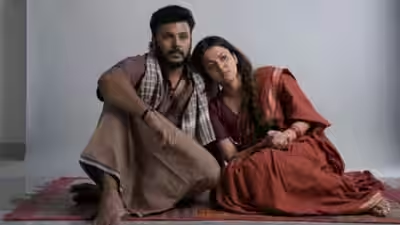
Set against the political turbulence of 1970s Kerala, ‘Amma Ariyan’ follows Purushan, a young man who travels to inform a mother of her son’s death, gathering companions along the way in a journey that becomes both personal and political. Blending documentary and fiction through a non-linearnarrative, the film unfolds like a letter from a son to his mother.
Produced through the Odessa Collective— a people’s film movement that raised funds from ordinary citizens— the film was screened free of cost in hundreds of villages, youth clubs and libraries across Kerala. It never received a conventional theatrical release, yet it travelled widely among the very public it sought to represent.
Four decades later, ‘Amma Ariyan’ has found a new global audience. A restored 4K version was screened at the Cannes Film Festival a few days ago, making it the only Indian feature film to premiere there in 2026. It received a standing ovation. The restoration was undertaken by the Film Heritage Foundation using surviving 35mm prints preserved by the National Film Archive of India.
The film’s editor Beena Paul described the Odessa Collective as a singular experiment. “It wanted people to contribute to the making, the process, and the distribution of the film. Though the film was never formally released, it was seen widely by the people of Kerala.”
Recalling his first meeting with John during a bus journey, Mathew said the filmmaker noticed the W B Yeats book in his hand and jokingly asked whether it contained the poetry of Ayyappa Paniker. The encounter led to a collaboration on a proposed film about the Kayyur struggle, a project abandoned after a single day of shooting when the producer withdrew, allegedly citing police pressure over claims that the film glorified Naxalites.
“My studies were dropped midway due to the subsequent police case,” Mathew said. “I stayed on Pune Film Institute campus for over a year, though I hadn’t gained admission. When I returned, John contacted me and said it was good that I hadn’t joined the institute.” He recalled that it was at a Kozhikode arrack shop—run by Mohan, a film enthusiast who often allowed John to drink on credit—that the filmmaker first asked him to play the lead role.
One of most memorable scenes in Amma Ariyan features a character reading a Malayalam translation of revolutionary Guatemalan poet Otto René Castillo: “One day/the apolitical intellectuals/of my country/will be interrogated/by the simplest/of our people.” The lines distilled the mood of political activism in that era and gave voice to opposition against the indifference of the privileged during times of injustice.
Yet those who knew John say he resisted rigid ideological labels. Mathew said John was left-leaning but sharply independent. “John was once commissionedtofilmadocumentaryonEMSNam boodiripad, but the project was abruptly halted midway. John made fun of the veteran leader during the shoot, eventually prompting party workers to demand that he call off the production.”
The restoration was made possible because the film’s celluloid prints had survived at the National Film Archive of India. Only two prints were found, and just one was in usable condition. “We had to first work on the print and digitise the film, which took a year and a half,” said Shivendra Singh Dungarpur, founder of the Film Heritage Foundation. Cinematographer Venu and sound recordist Unnikrishnan worked alongside editor Beena Paul to create the digital version.
Discussions are now underway with the Odessa Collective for a theatrical release in Kerala. If realized, it would mark the first major theatrical run for ‘Amma Ariyan’— finally bringing the film home to the people who shaped its journey.
Disclaimer
Views expressed above are the author’s own.
END OF ARTICLE