
The four sutras of life
Every human being desires to live a meaningful life.
Yet despite possessing limitless information, countless books, and endless advice, we continue to struggle with the simplest questions.
How should we live? What principles should guide our decisions?
What truly makes a life successful?
Knowledge has never been scarce. Wisdom has.

Throughout history, great civilizations have attempted to answer these questions through principles, maxims, and aphorisms. Some have inspired courage, others have nurtured discipline, while many have guided people toward spiritual awakening.
Every generation has sought to preserve its deepest insights in a few memorable words, believing that a single timeless truth, if sincerely lived, can transform an entire lifetime.
Sanatan Dharma, however, presents a vision unlike any other.
It is not a religion built upon commandments or a fixed collection of rules. In fact, the word Dharma itself cannot be fully translated into any language.
At different moments it may signify righteousness, duty, truth, harmony, morality, or the natural order that sustains the universe. Yet none of these definitions alone is sufficient.
Dharma is not something that can be confined within a definition because life itself cannot be confined within one.
It is eternal, ever-living, and ever-unfolding. While its principles remain timeless, their application requires wisdom, discernment, and compassion. Every individual faces different circumstances.
Every stage of life presents different responsibilities. What remains unchanged is the search for truth.
This is why the role of the Guru is indispensable.
The greatness of a true Guru does not lie merely in possessing knowledge, but in making the infinite understandable. He takes the immeasurable wisdom of the scriptures and distils it into principles that can be remembered, contemplated, and, most importantly, lived.
A Guru does not burden us with complexity.
He liberates us through simplicity.
He does not merely sharpen the intellect; he purifies the heart. He does not simply answer questions; he transforms the one who asks them. Under his guidance, spiritual wisdom ceases to be philosophy and becomes a way of life.
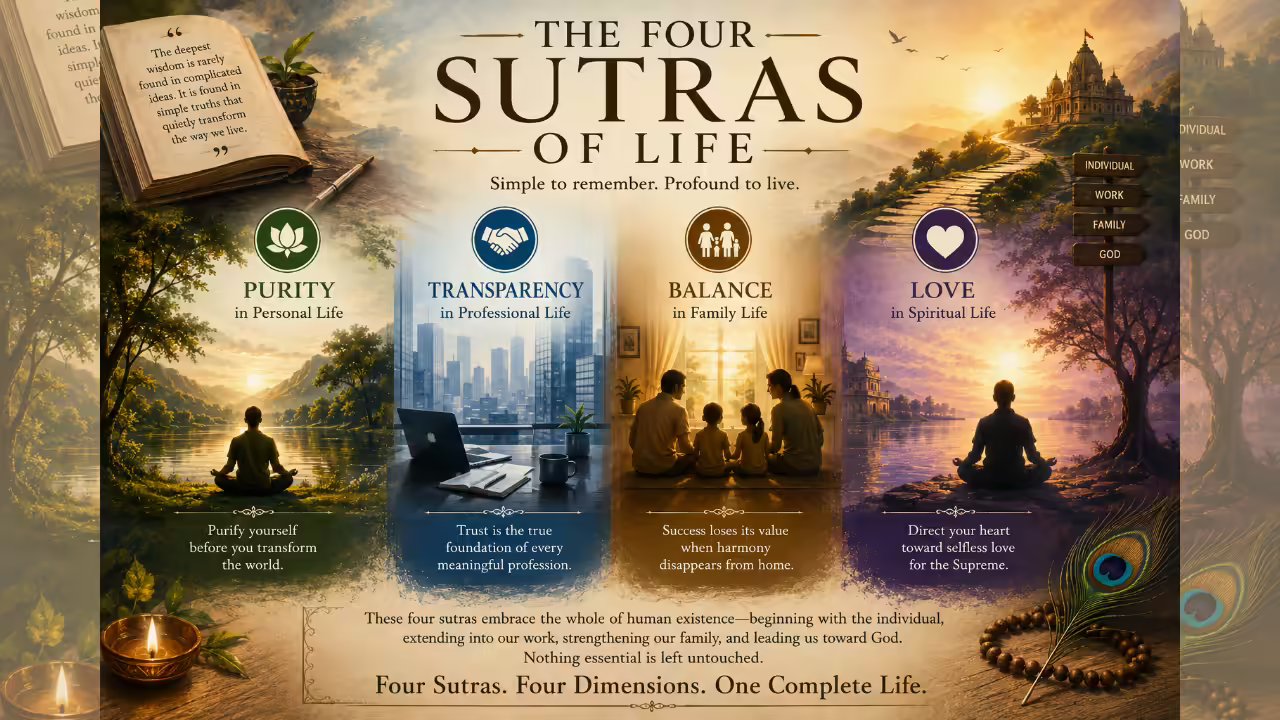
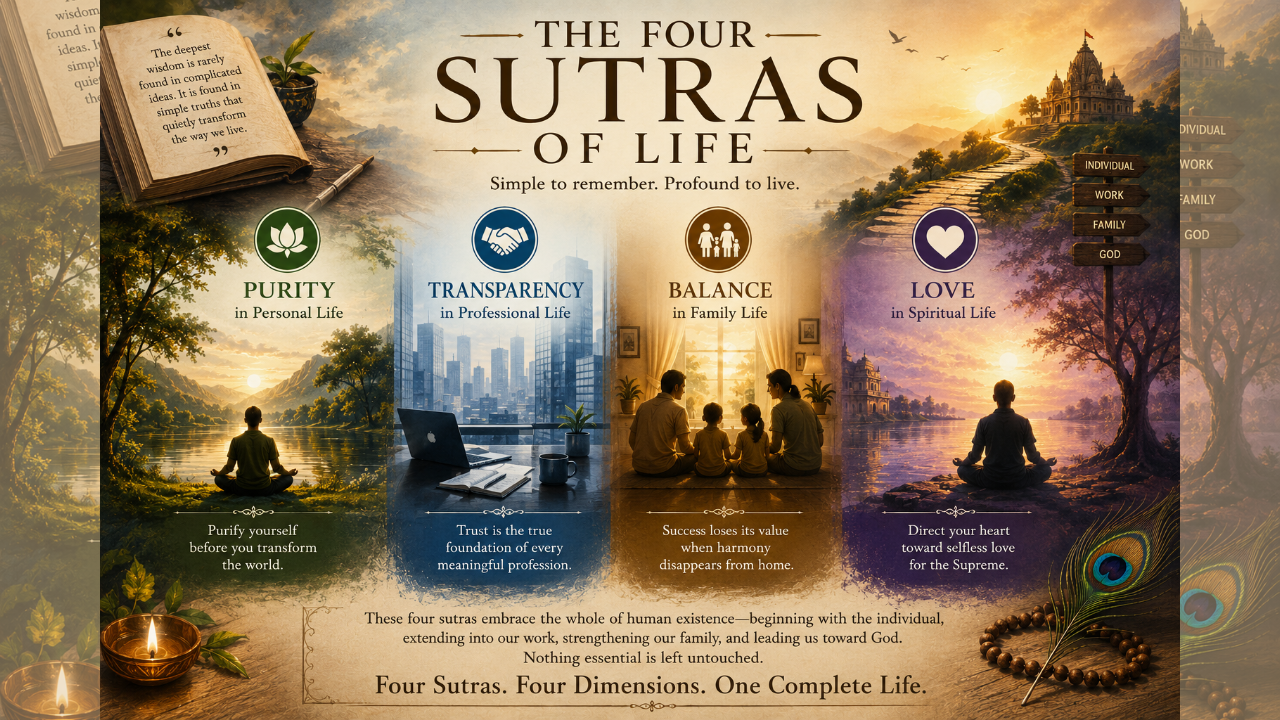
From the boundless ocean of Sanatan Dharma, my revered Gurudev once shared four simple sutras. They are remarkably brief in expression, yet profound enough to illuminate every dimension of human life.
Purity in Personal Life.
Transparency in Professional Life.
Balance in Family Life.
Love in Spiritual Life.
At first glance, they appear almost too simple.
Yet the greatest truths often do.
Like a seed that silently contains an entire tree, each of these sutras carries within it a complete philosophy of living.
The first teaches us how to purify ourselves before attempting to change others. The second reminds us that trust is the true foundation of every meaningful profession. The third reveals that success loses its value when harmony disappears from the home.
The fourth elevates every aspect of life by directing the heart toward selfless love for the Supreme.
Notice how naturally these four principles embrace the whole of human existence. They begin with the individual.
They extend into our work.
They strengthen our family.
And finally, they lead us toward God.
Nothing essential is left untouched.
When personal life becomes pure, relationships become sincere.
When professional life becomes transparent, integrity replaces pretence. When family life finds balance, stability replaces conflict.
And when spiritual life is rooted in divine love, every other dimension of life gradually finds its rightful place.
Modern life often teaches us to pursue success by constantly adding more—more possessions, more achievements, more recognition. Spiritual life teaches the opposite. It invites us to simplify. To identify the few eternal principles that remain true regardless of changing circumstances.
That is the beauty of a sutra.
It does not attempt to explain everything.
It reveals the one truth from which everything else can be understood.
Over the coming reflections, we shall contemplate each of these four sutras individually. Though they can be spoken in a few moments, they require a lifetime to truly realise.
For the deepest wisdom is rarely found in complicated ideas.
It is found in simple truths that quietly transform the way we live.
Disclaimer
Views expressed above are the author’s own.