South Africa’s wildlife corridor was broken for decades, but one female elephant is now helping reconnect a 400-km route through the forest | World News
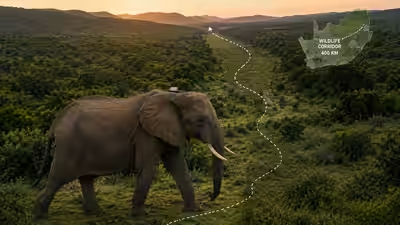
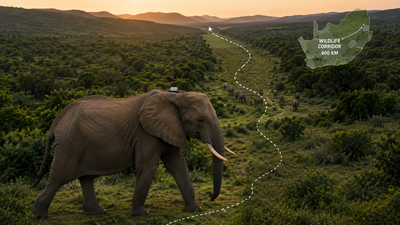
Deep in South Africa’s Knysna forest, a female elephant named Strangefoot continues to walk through a landscape where her kind once moved in much larger numbers. At around 50 years old, she is believed to be the last survivor of the forest’s elephant population, after decades of habitat fragmentation left her isolated. A plan to bring other elephants to join her failed, leaving her future unchanged. Yet Strangefoot’s story now sits alongside a very different conservation effort taking shape across the region. For 20 years, the Eden to Addo Corridor Initiative has been working to reconnect fragmented habitats across a roughly 400km route linking major protected areas, with privately owned land much of the missing ground between them. The aim is to give wildlife space to move between habitats as conditions change. Strangefoot cannot benefit from that work herself, but her isolation shows what can happen when those connections disappear.
How habitat fragmentation left South Africa’s last Knysna forest elephant isolated
Strangefoot’s story begins with a population that survived by retreating into the Knysna forest. For generations, elephants in the wider region were able to move between the coastal forests of the Cape and areas farther north-east. That movement became increasingly restricted as the landscape was divided, leaving the animals in smaller and more isolated pockets. Today, at about 50 years old, Strangefoot is thought to be the final elephant of that forest population.There was an attempt to change that situation. A proposal to bring elephants from elsewhere and give her companions did not go ahead, leaving Strangefoot alone. As per the Mail & Guardian, a South African publication, she was not a straightforward conservation success but “a warning of what isolation looks like when it has gone on for too long to undo”. That distinction matters. The corridor work around her is not designed to rescue this one elephant alone; it is aimed at preventing other species from reaching the same kind of dead end.
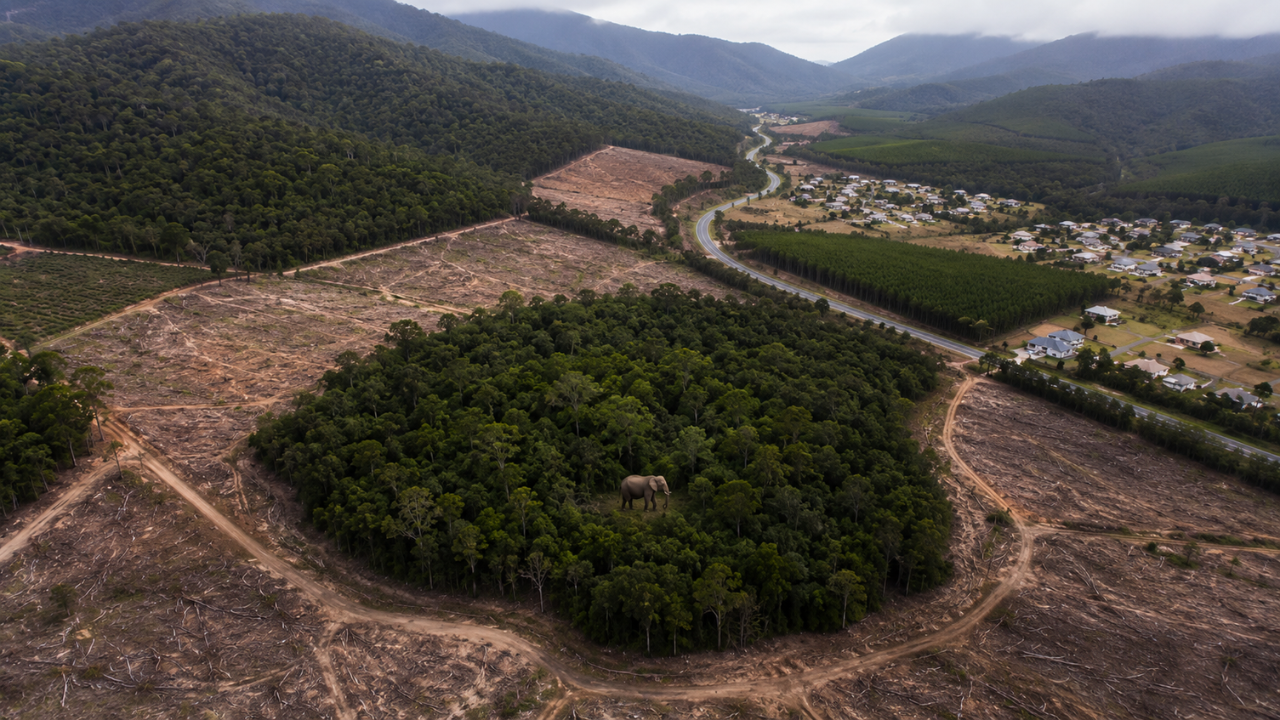
Image AI generated
How the Eden to Addo Corridor is reconnecting South Africa’s protected areas and wildlife habitats
The Eden to Addo Corridor Initiative, known as E2A, is working to connect three major protected areas: Garden Route National Park, the Baviaanskloof World Heritage Site and Addo Elephant National Park. Instead of relying only on government-owned reserves, the project brings privately owned properties into biodiversity stewardship arrangements. The resulting network stretches for about 400km, crossing seven mountain ranges and five of South Africa’s seven biomes. If the full vision is achieved, it could link nearly one million hectares of conservation landscape.That approach is different from keeping wildlife inside isolated reserves. Animals need to move, whether to find food and water, maintain populations or respond to changing environmental conditions. According to the study published in Springer Nature, titled ‘Landscape connectivity for biodiversity conservation: a mammal-based multi-species corridor approach for the Eden to Addo corridor initiative, South Africa’, the Senckenberg Society and E2A modelled the movement of nine mammal species across this landscape and identified 40 possible corridors. The authors said connected landscapes would be important for helping biodiversity endure the effects of climate change.
How Joan Berning founded the Eden to Addo Corridor Initiative in South Africa
E2A was founded in 2006 by Joan Berning, a farmer, conservationist and cheesemaker living near Plettenberg Bay. Her interest began with elephants in the Garden Route, but the idea soon expanded beyond the species that first drew her attention. The elephants became evidence of a broader problem: when habitats are separated, the damage reaches plants, animals, water systems and other ecological processes that depend on functioning landscapes.Since then, the organisation says it has helped bring about 55,000 hectares of privately owned land into interconnected biodiversity stewardship across five corridors. Much of that work has depended on individual landowners deciding to manage their properties differently. At Pietersrivier Nature Reserve, for instance, landowner Katot Meyer has spent years removing invasive alien vegetation from riverbeds. He explained the motivation simply: “It’s not for me, it’s for the future.”
Why protecting South Africa’s 400km wildlife corridor remains a long-term challenge
Creating a corridor does not mean drawing a line on a map and declaring the habitat safe. The work depends on long-term agreements with landowners, restoration on individual properties and funding for a small non-profit organisation. E2A has spent two decades building those relationships, often in places where farming and conservation have to exist alongside one another. The result is a landscape assembled gradually rather than protected in one large block.That fragility can still be seen around the Robberg Coastal Corridor. The area has faced development proposals, including a 166-erf residential and commercial subdivision and a 121-unit retirement estate. A citizen campaign, Save Robberg, has opposed the applications, arguing that the land contains critically endangered fynbos habitat and lacks municipal water and sewer infrastructure. Public comment periods have closed and the objections are before the authorities. For E2A, the episode illustrates an uncomfortable reality: reconnecting habitat does not automatically shield it from future development.The larger ambition is therefore less about creating a perfect sanctuary than about keeping movement possible. A connected landscape could help protect water catchments, give farmland some resilience against drought and flooding, and allow species to shift their ranges as conditions change. WWF South Africa endorsed E2A’s nomination for the 2027 Earthshot Prize, citing the initiative’s focus on ecological connectivity and the processes supporting clean water, pollination, soil stability and climate regulation.Strangefoot’s situation cannot be reversed by the corridor. She is expected to spend the remainder of her life alone, and no newly restored route can return the elephant population that disappeared from the forest. But her presence gives the 400km project a particularly tangible reference point. The question is not only what has already been lost, but whether the next elephant, leopard or aardvark moving through the region will encounter a landscape that still connects one habitat to another.