Scientists find a surprising way to turn egg and rice waste into a material that can store electricity |
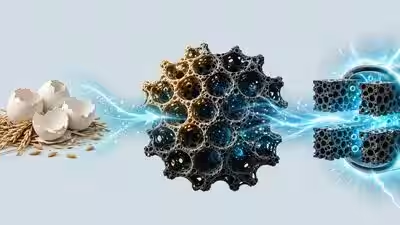
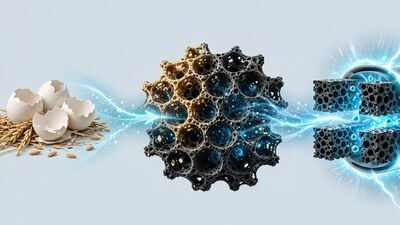
Egg and rice waste can be converted into a material for storing electrical energy. Researchers developed a nitrogen- and oxygen-co-doped porous carbon from a mixture of egg waste and rice waste and tested it for use in supercapacitors. The material was produced through pre-carbonisation followed by pyrolytic activation. According to the study published in Molecules (MDPI), the researchers found that the best-performing sample had a three-dimensional honeycomb structure with abundant micropores and mesopores. It also had a high specific surface area of 1572.1 m² g⁻¹. The findings suggest a possible route for turning mixed food waste into energy-storage material.
How researchers converted egg and rice waste into energy storage material
The study focused on converting nitrogen- and oxygen-rich biomass waste into porous carbon for supercapacitor applications. Researchers tested egg yolk and egg white separately, each combined with rice waste, producing two parallel series of samples. This approach brought protein-rich egg material and carbohydrate-rich rice waste together in each feedstock. The resulting materials were designed to contain nitrogen and oxygen within their carbon structure. It was produced through two main stages: pre-carbonisation and pyrolytic activation. Among the samples tested, YPAC-1 (Yolk-derived Porous Activated Carbon) showed the strongest performance. Its structure contained numerous micropores and mesopores arranged in a three-dimensional honeycomb-like network. This architecture gave the material extensive internal space for energy-storage processes.
Why the porous structure is important for energy storage
YPAC-1 had a specific surface area of 1572.1 m² g⁻¹. Its three-dimensional honeycomb structure contained micropores and mesopores. According to the study, these features provided enough storage space while also creating pathways for electrolyte ions to move through the material. The combination of surface area and porous structure was important to the sample’s performance as a supercapacitor electrode material. Rather than relying on a dense carbon structure, the material offered a network of spaces. The researchers linked this architecture to its ability to support charge storage and ion transport within the electrode during operation and testing.
What happened when the carbon material was tested in a supercapacitor
The researchers also assembled a symmetrical capacitor using YPAC-1 in a two-electrode configuration. This device reached an energy density of 8.3 Wh kg⁻¹ at a power density of 136 W kg⁻¹. These measurements provide a different view of the material’s performance because they describe the behaviour of a two-electrode capacitor rather than the three-electrode test alone. The study therefore examined both the electrode material and its performance when incorporated into a symmetrical device. The reported values show that the carbon derived from the mixed waste feedstock could function in a working supercapacitor configuration while maintaining measurable energy and power performance.
Significance of waste-derived energy-storage materials
The study presents mixed egg and rice waste as a feedstock for producing heteroatom co-doped porous carbon for supercapacitors. The researchers’ results show that the YPAC-1 sample combined a high surface area with a porous three-dimensional structure, strong capacitance, and retention over repeated cycles. Its performance in the two-electrode symmetrical capacitor also demonstrated energy-storage capability at a measured power density. Together, these findings reveal that waste containing proteins and carbohydrates can be converted into a functional carbon material rather than remaining as discarded biomass.