Scientists discover hyenas have a secret language of facial expressions and sounds that helps prevent fights from turning deadly |
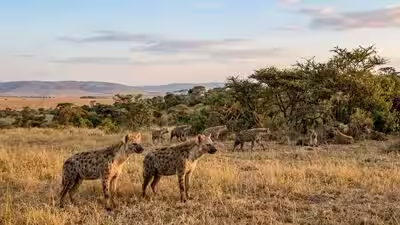
If you watch nature documentaries, they often paint the hyena as the ultimate villain of the animal kingdom, a cowardly, cunning scavenger known only for its eerie laugh. However, a new study by researchers from the Department of Ethology at the University of Pisa, the Ngorongoro Hyena Project at the Leibniz Institute for Zoo and Wildlife Research, and Siyafunda Wildlife & Conservation has revealed that this widespread reputation is far from the truth. Published in the journal Behavioral Ecology and Sociobiology, the research shows that spotted hyenas live in some of the most complex matriarchal societies in the animal kingdom and use a sophisticated “language” of facial expressions and vocalisations during play to prevent conflicts, strengthen social bonds, and maintain peaceful relationships. Their communication skills and social intelligence rival those of many primates, challenging long-held myths about these remarkable predators.
Why is ‘play-fighting’ such a serious business for hyenas?
For a spotted hyena, play is not just about having fun, it is a vital social tool. These animals live in large, matriarchal clans where females hold all the power and every individual has a specific rank in their family. In such a high-stakes environment, play fighting allows both youngsters and adults to bond, practice hunting skills, and navigate their social hierarchy without the risk of real injury.Because hyenas are incredibly powerful predators, equipped with jaws strong enough to crush the thickest bones, a ‘play fight’ could easily turn deadly if a misunderstanding occurs. To prevent this, hyenas have developed a series of signals. These ‘rules of the game’ ensure that when one hyena attacks another, the recipient knows it is a friendly gesture rather than a declaration of war.
How do the Hyenas say ‘I’m only joking’ with their face?
Imagine you are a hyena jumping on another hyena. How do you make sure they don’t bite back in their defence? The answer lies in facial expressions. Researchers have found that hyenas use a specific signal called the ‘Relaxed Open Mouth’ (ROM). This expression, which looks a bit like a human smile or a laugh, is the sign for ‘this is just a game’ among many mammals, including dogs and chimps.By keeping their mouths open and relaxed, hyenas signal their friendly intentions. They also use a physical gesture called ‘head bobbing’ to convey that the interaction is playful. Hyenas are very particular about who sees these faces. They usually wait until they have direct eye contact with their playmate before making a ‘play face,’ ensuring the message is received loud and clear.
Image Credit: AI Generated
How do they use these signals in the dark night
A smile works great when you are face-to-face, but what happens when you are playing in the middle of a dark night? This is where the hyena’s vocal skills come to play. A recent study revealed that hyenas use 13 different vocalisations while playing, five of which were previously unknown to the scientists.When hyenas play in groups, they cannot always see each other’s faces. For this lack of eye contact, they combine their facial expressions with specific sounds. If a hyena is worried that its playmate can’t see the ‘smiling face,’ it will add a vocal signal to ensure everyone in the group knows the situation is friendly. This ability to switch between sight and sound depending on the situation, shows a level of social intelligence found in our closest monkey relatives.
What is actually hidden in a hyena’s giggle
We often call them ‘laughing hyenas,’ but scientists prefer the term ‘giggle.’ This high-pitched sound is not a sign of amusement, but a signal of stress or frustration, often heard when a lower-ranking hyena is being bullied or is waiting for its turn to eat. But there is more to the giggle than just stress.Research shows that a single giggle can tell us about other hyenas, the age of the caller (the pitch gets lower as they get older), their identity, and even their social status. For instance, a dominant hyena has a steady, confident-sounding giggle, whereas a lower-ranking hyena has an out-of-control giggle. By listening to these ‘giggles,’ a hyena can keep track of exactly who is calling in the family.
Do hyenas ‘kiss and make up’ after a row a fight
Even with all these play signals, real fights do happen. Studies of hyenas have shown that after an aggressive encounter, the opponents are likely to engage in friendly behaviours like social grooming or ‘body rubbing’.What is truly fascinating is that it doesn’t matter for them who started the fight. Both the ‘winner’ and the ‘victim’ are equally likely to initiate a friendly reunion. This is because hyenas recognise the value of their clan mates/groups. Since they need to work together to hunt large prey like zebras or to defend their territory from lions, they cannot afford to hold a grudge for long.The next time you hear a hyena ‘laugh,’ remember that you are listening to a highly developed social language. Whether they are using a ‘play face’ or a ‘giggle’ to communicate, these animals are far more than just scavengers. They are the sophisticated, ‘backbone’ of the African wilderness. As we uncover the secrets of their ‘language of play,’ we can finally start respecting the spotted hyena for being one of the ‘most intelligent and socially complex creatures’ on our planet.