Scientists develop underwater glue that bonds in 10 seconds and gets stronger over time
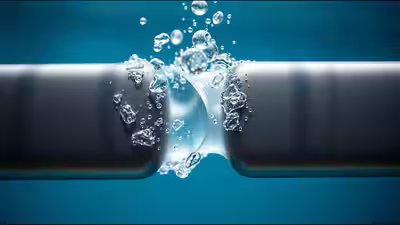
Modern life runs on adhesives, from the soles of shoes to the joints that hold furniture together, yet most of them share one stubborn weakness: they fail when water gets involved. A thin layer of water molecules naturally coats any submerged surface, forming a barrier that keeps conventional glue from bonding properly. In contrast, ongoing exposure to water gradually erodes and washes away whatever adhesive does manage to stick. Scientists have now developed a new type of underwater adhesive that not only overcomes that barrier but performs better the longer it stays wet. Built from a class of material called a supramolecular ionic liquid, the adhesive reaches strong bonding within seconds of contact with water, has held a two-kilogram weight in place for more than three years of continuous underwater immersion, and can be peeled off and reused multiple times without losing its grip.
Why ordinary glue struggles to stick to surfaces underwater
Underwater bonding has remained a persistent challenge in materials science largely because of what happens the moment a surface meets water. Water molecules quickly coat any submerged material, forming what scientists call a hydration layer, a thin repulsive film that most adhesives simply cannot push past to make real contact with the surface underneath. Beyond blocking the initial bond, ongoing water exposure continues to erode and wash away many conventional adhesives over time, which makes maintaining infrastructure like undersea pipelines and marine equipment a persistent and expensive problem. Any adhesive built for long-term underwater use needs to solve both issues at once, forming a strong bond quickly while resisting gradual breakdown over months or years of continuous submersion.
How the new adhesive actually works underwater
The research team built their adhesive around a compound named BP16TPB, a supramolecular ionic liquid made by combining flexible and rigid molecular components. They then dissolved this compound in dimethyl sulfoxide, a strong solvating solvent that splits some of the BP16TPB molecules into mobile, charged particles capable of moving freely within the solution. Once this mixture makes contact with water, those particles begin reorganising themselves, locking into a new and far more stable structure through a process called solvent exchange-mediated self-assembly. The reorganised particles bond to each other using hydrogen bonds and a molecular interaction called pi stacking, while the whole process is accelerated by something known as the Marangoni effect, the same underlying phenomenon responsible for the streaks that form on the inside of a wine glass, here helping to actively push the water barrier out of the way rather than working around it.
What the lab results actually showed
According to the study, titled Macroscopic assembly of supramolecular coacervates for underwater adhesion and published in the journal Nature Communications, the researchers tested their adhesive across a range of submerged surfaces, including ceramic, epoxy and plastic. The material reached an adhesive strength of 1.1 million pascals after just 10 seconds of underwater curing, a figure the researchers describe as significantly exceeding that of traditional underwater adhesives tested under similar conditions. Durability proved just as striking, with a sample supporting a 2 kilogram weight for more than three years of continuous underwater immersion without failing. The researchers describe this long-running test as a definitive proof of concept, pointing to the material’s resistance to water-driven degradation and structural creep across a multi-year timescale.
Why the adhesive can be detached and reused repeatedly
Beyond its strength and durability, the adhesive also proved unusually practical for repeated use. In testing, researchers detached and reattached the material underwater across eight separate cycles, with the adhesive reliably retaining its bonding properties each time. That reusability sets it apart from many conventional adhesives, which typically form a permanent bond or lose significant strength once removed and reapplied to the same surface. The material also performed consistently across different chemical environments, holding up in acidic, alkaline and salty solutions alike, though the researchers noted it becomes less effective once temperatures climb above 70 degrees Celsius.
Why this matters beyond the laboratory
Because the adhesive strengthens through direct contact with water rather than despite it, researchers see clear potential for uses where conventional adhesives routinely fail, including maintaining and repairing submerged infrastructure such as pipelines, marine sensors and other underwater equipment that must withstand years of constant water exposure. The researchers describe their work as introducing not just a high-performance underwater adhesive but a broader strategy for developing materials that respond intelligently to their environment rather than simply resisting it. If the approach proves scalable beyond laboratory conditions, it could offer engineers a genuinely practical alternative for underwater repair and construction work that has long been constrained by materials never designed to get stronger the wetter they become.