Scientists built a tent that generates electricity from rain, wind and human movement; one tap charged a capacitor to 5.8 volts |
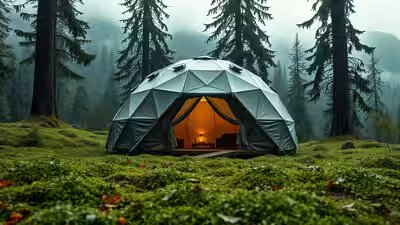

Scientists at the University of California, Los Angeles have developed a tent that can generate small amounts of electricity from everyday movements, wind and raindrops. The prototype uses a phenomenon called magnetoelasticity, in which a material’s magnetic properties change when it is stretched, bent or compressed. The researchers incorporated a soft magnetoelastic material into the tent’s floor and roof, allowing mechanical movements to generate electrical signals. In one demonstration, tapping the material with a hand charged a capacitor to 5.8 volts in about 1.5 seconds. The technology is described in a study titled Self-powered magnetoelastic tents for sustainable energy access in unhoused communities, published in Matter. The researchers designed the system with people living in temporary shelters in mind, where small amounts of electricity could potentially be used for lighting, sensors, phone charging or other low-power electronics without a connection to the electrical grid.
How the magnetoelastic tent turns movement, wind and rain into electricity
The tent’s floor uses alternating ribbons of ordinary fabric and a soft magnetoelastic material made from silicone containing neodymium-iron-boron magnetic particles. A conductive fibre coil is woven between the layers. When the material is compressed or deformed, its magnetic field changes and induces an electrical current in the coil. The roof uses a different layered arrangement of magnetoelastic film and conductive fibres, allowing mechanical forces from wind and falling raindrops to be converted into electricity as well. In tests, a 20-by-20-centimetre unit produced a peak power of about 0.094 milliwatts under its optimal electrical load. The researchers also subjected the material to 12,000 compression cycles and found that it continued to operate. The material remained waterproof after exposure to water, retaining most of its electrical output. The researchers estimate that incorporating the system into a conventional tent would add only about 10 grams of weight, while an individual unit could cost around $2 to manufacture based on their materials and fabrication approach.
Why UCLA researchers designed the system for people living in tents
The technology was developed partly with unhoused communities in mind. People living in temporary shelters may need electricity for basic uses such as lighting, communication and small electronic devices but may not have access to the electrical grid. Existing portable power options can have their own limitations. Generators require fuel and produce noise, while solar panels depend on sufficient sunlight and can add weight, cost and installation requirements. The magnetoelastic system is designed to harvest energy from forces that are already present around a tent. A person walking or pressing on the floor can generate an electrical signal, while wind and rain can activate the material in the roof. That means the system can produce energy under a wider range of conditions than a technology that depends entirely on sunlight, although its output also varies with how much mechanical activity is available.
What the self-powered tent can actually power
The electricity produced by the material is still small, so the researchers do not present the tent as a replacement for conventional batteries or grid electricity. Instead, the technology is intended as a supplementary energy source that can collect small amounts of power and store it for low-energy applications. In experiments, the generated electricity was sufficient to briefly power devices including an LED and a digital thermometer. The researchers also demonstrated that larger capacitors could accumulate greater amounts of stored energy over time. In one test, a capacitor reached 5 volts and stored 8.5 millijoules of energy. The 5.8-volt demonstration therefore does not mean the tent can continuously supply 5.8 volts of useful power. Voltage and stored energy are different measurements, and the amount of usable electricity depends on the electrical load and how much mechanical energy the tent receives.
What could come next for magnetoelastic tents?
The researchers believe the system could be scaled by increasing the area covered by the magnetoelastic material or connecting multiple units together. More material would provide more opportunities to harvest energy from footsteps, movement, wind and rain, potentially allowing the technology to support a wider range of low-power devices. The same approach could also be useful beyond temporary housing. Lightweight energy-harvesting fabrics could potentially be incorporated into disaster-relief shelters, outdoor equipment and other situations where access to conventional power is limited. But the prototype remains a small-scale energy-harvesting system, and further work will be needed to establish how it performs under prolonged outdoor exposure and real-world use. For now, the most interesting part of the design is not the amount of electricity it produces, but the fact that the tent itself becomes the energy-harvesting surface. Every footstep, raindrop or movement that deforms the material creates another opportunity to collect a small amount of power.