Ottawa may rename Trump Avenue, but residents were split 21-21 when they first voted on the name | World News
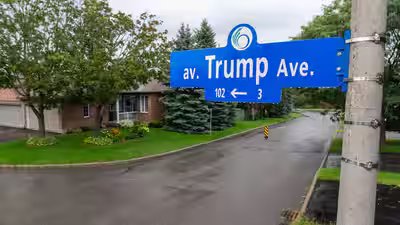
A street in Canada’s capital could soon lose the name Trump Avenue, but changing it may be much harder than simply putting up a new sign. The residential street in Ottawa acquired its name more than two decades ago, when Donald Trump was known primarily as a New York real estate developer. It was part of the Central Park neighbourhood, where several streets were given New York-themed names. Today, the name has taken on a very different meaning. Ottawa leaders have begun the process of considering a rename following growing tensions between Canada and US President Donald Trump, including his decision to refer to Lake Ontario as “Lake America” on US federal maps.But Ottawa has already tried to change the name once. In 2021, residents were asked whether Trump Avenue should be renamed. The result was an almost perfect split, 21 residents supported changing the name, 21 opposed it, and 20 did not respond. The episode is now being revisited at a time when place names themselves have become part of the political dispute between Canada and the United States.
Trump Avenue was named before Trump became president
Trump Avenue does not date from Trump’s political career. The street was named more than 20 years ago, when the future president was primarily known as a New York property developer and television personality. Its location helps explain the choice. Ottawa’s Central Park neighbourhood was developed with a New York theme, and surrounding streets include names that evoke the city.At the time, placing Trump’s name on a residential street carried a very different political meaning from what it does today. The name was essentially connected to his identity as a prominent New York businessman. That context has become increasingly important in the current debate. In their September article, University of Victoria geographers Reuben Rose-Redwood and CindyAnn Rose-Redwood, together with University of Tennessee geographer Derek H. Alderman, explain that the meaning attached to a place name can change dramatically as political circumstances change. For Ottawa residents, a name that once fitted the neighbourhood’s New York theme now sits against the backdrop of an increasingly difficult relationship between Canada and the United States.
Ottawa residents split 21-21 when the street was first challenged
The first serious attempt to remove Trump’s name came shortly after his first presidential term ended in January 2021. Ottawa city councillor Riley Brockington polled residents of Trump Avenue to determine whether they wanted the street renamed. The result could hardly have been more evenly divided.Exactly 21 residents voted in favour of renaming the street, while another 21 voted against it. A further 20 residents did not respond. At the time, Ottawa’s naming policy required more than 50% of the residents on a street to support a renaming application. With the responding residents divided equally, the proposal did not move forward.The result is notable because the 21-21 split did not necessarily represent a simple division between people who supported Trump and those who opposed him. The University of Tennessee article points out that changing a street name can impose practical burdens on residents, including updating addresses and documents. That means a resident can oppose a name without necessarily endorsing the person it commemorates, simply because changing an established address can be inconvenient and expensive.
Why Ottawa is considering Trump Avenue again
The issue returned after Trump ordered US federal agencies to use “Lake America” instead of Lake Ontario. For Canadians, the move was especially provocative because Lake Ontario is a shared body of water, with about half of its surface area in Canada. The University of Tennessee authors describe Ottawa’s renewed interest in Trump Avenue as part of a wider geopolitical response to Trump’s policies towards Canada. The dispute illustrates how geographical names can become political messages.Rose-Redwood, Rose-Redwood and Alderman describe this practice as “toponymic diplomacy,” the use of place names to communicate political positions between countries. Governments and cities can use names to show solidarity, commemorate allies or send a symbolic rebuke to another government.The authors point to examples such as Glasgow naming a public square near the South African Consulate-General Nelson Mandela Place in 1986, a gesture of opposition to apartheid. In more recent years, some cities have renamed streets near Russian diplomatic missions in support of Ukraine.In that context, removing Trump’s name from an Ottawa street would be more than a local administrative decision. It could become a small but visible expression of Canada’s political frustration with Washington.
Renaming Trump Avenue may be harder than it sounds
The biggest obstacle is Ottawa’s own naming process. Since the unsuccessful 2021 attempt, the city’s policy has changed. The University of Tennessee article notes that a street renaming application now requires more than 75% approval from residents and property owners on the affected street. That is a dramatically higher threshold than the one in place when the 21-21 vote took place.The change illustrates one of the central problems with politically motivated renaming campaigns: public anger may be strong, but converting that anger into an official place-name change requires a formal process involving residents, property owners and municipal authorities. The authors argue that this is one reason outrage alone cannot erase a place name. Even when a name becomes controversial, cities have to balance symbolic concerns against the practical consequences for the people who live there.There is also a broader principle at stake. The Ontario Geographic Names Board, although it does not control municipal street names in Ottawa, does not support commemorative naming until a person has been dead for at least five years. Ottawa’s current policy similarly expects people being commemorated to have brought honour to Ottawa, Ontario or Canada, criteria that would likely make a new Trump street name difficult to approve today.
Trump’s name has become part of a much larger place-name debate
Trump Avenue is only one example of how names can become politically charged. According to the Canadian Geographical Names Database, eight officially recognised geographic places in Canada currently carry the name Trump. These include Trump Lake and Trump Creek in Ontario and the Trump Islands in Newfoundland and Labrador.But those places were not named after Donald Trump. Trump Avenue in Ottawa is different because it was explicitly associated with the former New York developer who later became US president. That distinction makes the street particularly vulnerable to changing political interpretations of his name.The University of Tennessee article also notes that some places have moved in the opposite direction, naming roads and other sites after Trump as a form of political tribute or an attempt to signal loyalty. That leaves Ottawa facing an unusual question: should a street name remain because it is part of the neighbourhood’s history, or should it change because the person it honours has acquired a very different public identity?The answer may ultimately depend less on the controversy surrounding Trump than on whether enough residents are willing to make the administrative change. For now, Ottawa has begun the process again. But the 21-21 split of 2021 remains a striking reminder that even one of Canada’s most politically contentious street names cannot be changed without bringing the people who actually live there into the decision.