
Navy to commission submarine hunter Malvan as China, Pakistan expand underwater fleet
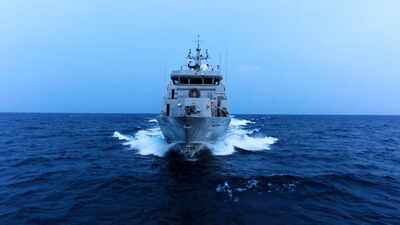
The Indian Navy is set to commission the anti-submarine warfare shallow water craft (ASW-SWC) Malvan at Karwar on Wednesday, marking another addition to its fleet of home-built sub-hunters amid rising Chinese and Pakistani submarine activity in the Indian Ocean Region. Named after the coastal fort town in Maharashtra, Malvan is the second of eight Mahe-class ASW-SWCs being built by Cochin Shipyard Limited with over 80% indigenous content.The ASW-SWC programme is designed to strengthen India’s ability to counter underwater threats in littoral waters. A total of 16 vessels in two classes are being built: eight Arnala-class vessels for the Eastern Fleet by Garden Reach Shipbuilders & Engineers and eight Mahe-class vessels for the Western Fleet by Cochin Shipyard Limited. These ships are tailored for subsurface surveillance, search-and-attack missions and coordinated anti-submarine warfare operations with naval aircraft. They also have secondary roles such as minelaying and search-and-rescue. Equipped with advanced sensors and weapons, this class of vessels is capable of detecting, tracking and neutralising hostile submarines in shallow waters, found nearer to the coast and protect ports more effectively from these threats.The weapons suite of the Mahe-class reflects its primary mission. It includes a forward-mounted RBU-6000 rocket launcher, triple 324 mm lightweight torpedo tubes on both port and starboard sides armed with Advanced Light-Weight Torpedoes, and anti-submarine mine-laying rails. For defensive measures, the ships are fitted with Mahindra Defence Systems-supplied torpedo decoy launching systems as part of the Integrated Anti-Submarine Warfare Defence Suite. Surface warfare capability is provided by a 30 mm naval gun and two 12.7 mm stabilized remote-controlled guns, the Indian variant of Elbit Systems’ Remote Controlled Naval Weapon Station. This mix of offensive and defensive systems ensures the vessels can operate independently in contested littoral zones.By design, the Mahe-class has a displacement between 896 and 1,100 tonnes, a length of 78 metres, a beam of 11.36 metres and a draft of 2.7 metres. The ships can achieve a maximum speed of 25 knots (45 km) and have a range of 1,800 nautical miles (3,300 km) at a speed of 14 knots (25 km), with an endurance of 14 days. They are propelled by three marine diesel engines producing 6 MW of power, each coupled with a water jet, making them the largest Indian Navy warships to use pump-jet propulsion. The Arnala-class employs MTU’s 20V 4000 M93L diesel engines. Both classes incorporate stealth features, including reduced radar cross-section, low acoustic signature and low infrared signature. The programme has drawn on domestic suppliers such as Bharat Electronics, Mahindra Defence and Larsen & Toubro. The final hull of the 16-ship project is expected to be delivered by June 2028.The commissioning of the Malvan comes at a time of heightened submarine activity in the Indian Ocean region. China continues to expand its fleet of conventional and nuclear-powered submarines, while Pakistan has added the first of the eight Hangor-class submarines to its existing fleet of five vessels. This comes at a time when India’s conventional submarine strength, which currently stands at sixteen, is not set to increase in the near future. Thus, making the induction of ASW-SWCs critical to maintain undersea deterrence. These vessels will provide the navy with a flexible and cost-effective means to counter adversary submarines in coastal waters, complementing larger surface combatants, anti-submarine aircraft and submarines.