Nasa’s Curiosity rover discovers evidence of an ancient sandstorm preserved in Mars rocks for billions of years |
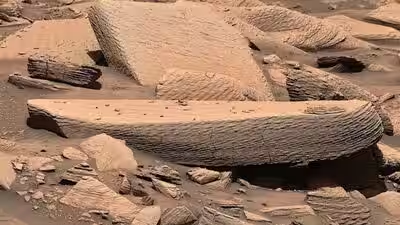
Mars still experiences powerful dust storms, but one patch of rock inside Gale Crater appears to have preserved something far older. What looks like a collection of layered stone has turned out to be a record of a single weather event that unfolded billions of years ago. Rather than relying on computer models or indirect clues, scientists have identified physical traces left behind by moving sand that later became rock. The discovery gives researchers a rare glimpse of how Mars behaved during a period when its atmosphere was very different from the thin one seen today. It also shows how ordinary-looking outcrops can quietly preserve fleeting moments from the planet’s distant past.
How Nasa’s Curiosity rover found signs of an ancient sandstorm on Mars
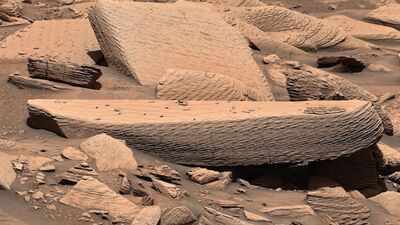
The rocks were photographed by Nasa’s Curiosity rover in December 2024 while exploring a region known as Jawbone Canyon. At first glance, they resembled fractured slabs of sedimentary rock, but closer examination revealed delicate ripple-like layers stacked over one another.Scientists identified these formations as climbing wind ripple strata, a sedimentary structure produced when fast-moving sand ripples continue advancing while fresh sand is deposited on top of them. According to Nasa, this is the first time such structures have been recognised on Mars, preserving evidence of an ancient sandstorm that likely lasted for several hours before the landscape settled again. The findings appeared on the cover of the journal Geology study, titled “An ancient sandstorm recorded by supercritical climbing wind ripple strata in Gale crater, Mars”, published on March 27, 2026. Unlike many Martian rock layers that reflect environmental conditions over centuries or longer, these ripples appear to preserve an event measured in hours. Once buried beneath later sediments, they gradually hardened into rock, allowing the storm’s signature to survive for billions of years.
Ancient Mars sandstorm reveals the planet once had a much thicker atmosphere
The discovery carries wider significance because such ripple structures require conditions that Mars cannot easily produce today. As per EarthSky, the modern Martian atmosphere is too thin to create these distinctive sedimentary patterns. Their presence suggests that, around 3.5 billion years ago, Mars possessed a much denser atmosphere capable of generating stronger and more sustained winds than those seen on the planet today.Steven Banham, planetary geologist at Imperial College London and lead author of the study, described the discovery as the first definitive evidence of an ancient Martian sandstorm. He said: “Everybody knows that the wind blew on Mars… But this is the first definitive evidence that we’ve found of such a sandstorm.”The study reports that the ripple layers record both brief wind gusts lasting only minutes and a larger storm that probably continued for several hours, offering one of the shortest-duration weather records yet identified from ancient Mars.
Nasa’s Curiosity rover made the ancient Mars sandstorm discovery by chance
The rock formation was not something the team had set out to find. According to EarthSky, researchers first noticed unusual textures while reviewing Curiosity’s panoramic images from Jawbone Canyon. Only after closer inspection did they realise the patterns closely resembled rare sedimentary structures previously documented on Earth.Banham described the find as unexpected, explaining that the team had not been searching for these deposits when the rover happened to pass the outcrop. Their recognition depended on specialists identifying the unusual millimetre-scale laminations preserved within the exposed rock.As per Nasa, the layered rocks are an unusually well-preserved record of a dramatic wind event from early Martian history, preserved after sediment hardened into stone over immense spans of time.
Ancient sandstorm discovery helps scientists understand Mars’ early climate
The newly identified sandstorm evidence is only one part of a broader effort to reconstruct Mars’ ancient climate.EarthSky notes that researchers already have strong evidence for rivers and lakes that once existed inside Gale Crater, pointing to a warmer and wetter environment billions of years ago. The team now hopes future rover observations might reveal preserved raindrop impact marks in Martian rocks, something scientists have searched for since the earliest rover missions but have yet to find.For now, the ripple-marked rocks stand as an unusually detailed record of a weather event that unfolded long before complex life appeared on Earth. A sandstorm that lasted only a few hours has remained locked inside Martian stone for billions of years, waiting for Curiosity to uncover it.