
Nasa heated a yoga-ball-sized Venus probe model to 869°F in a Pennsylvania furnace, running the test 6 times |
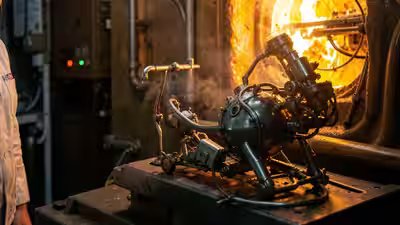
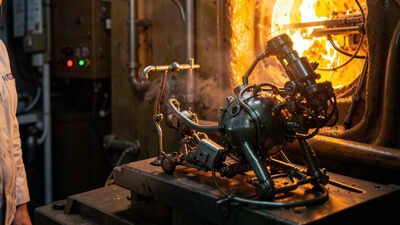
Nasa engineers have tested whether an engineering model of the DAVINCI Venus descent probe can protect its scientific instruments from the extreme heat it will encounter while travelling through the planet’s atmosphere. The model, roughly the size of a yoga ball, was placed in a furnace at Rex Heat Treat in Bedford, Pennsylvania, and heated to 869°F (465°C) over about 1 hour. The team repeated the thermal cycle 5 more times, and the model emerged from all 6 runs without damage, according to NASA Science. Conducted from Aug. 28 to Sept. 10, 2026, the test assessed the probe’s ability to insulate its internal instruments as the outside heats rapidly during descent. The results are an important engineering milestone, although the test does not by itself establish that the complete flight spacecraft is ready for launch.
Nasa’s DAVINCI probe heat test: 869°F in a Pennsylvania furnace
The test took place at Rex Heat Treat in Bedford, Pennsylvania. Nasa selected the facility because it is among the few capable of raising hardware to Venus-like temperatures at a rate comparable to the heating the probe will experience during its descent. Engineers placed the engineering model inside a ceramic-lined furnace chamber and raised the temperature to 869°F (465°C) over approximately 1 hour. They then repeated the thermal cycle 5 times, producing 6 runs in total. The model remained intact throughout the tests.More than 100 thermal sensors monitored hardware simulating the probe’s internal science instruments. These measurements allowed engineers to assess how effectively the probe’s outer structure would shield the instruments from the rising temperature. Jim Garvin, DAVINCI’s principal investigator at Nasa’s Goddard Space Flight Center, described the experiment as a successful series of 6 runs following the mission’s planned 55-to-60-minute descent timeline, with the internal instrumentation represented in the test setup. He also said that the United States had not conducted such a complete assessment of spacecraft-scale hardware at Venus temperatures since the mid-1970s. The test showed that the engineering model survived the six thermal cycles while protecting hardware simulating the probe’s instruments. They do not mean that every part of the eventual flight probe has completed qualification or that the spacecraft has already received approval for its next development phase.
DAVINCI probe design: titanium shell, thermal protection and gas-inlet ports
The probe must protect its instruments while allowing them to sample Venus’s atmosphere. These requirements create a difficult engineering problem: the vessel needs to limit heat transfer to its internal hardware, but it must also admit atmospheric gases for scientific analysis. Nasa says the probe is enclosed in a corrosion-resistant titanium shell designed to be strong yet lightweight. Special inlet ports will allow atmospheric gases to enter so that the instruments can measure their composition. The recent furnace test focused on the model’s ability to manage the thermal environment, rather than demonstrating every aspect of the probe’s scientific operation. During its descent, DAVINCI’s instruments are intended to examine the composition and structure of Venus’s atmosphere. The mission will measure atmospheric properties and sample gases to investigate how the planet formed and evolved.The probe will also carry cameras designed to capture close-up images of a mountainous region called Alpha Regio. Nasa says these observations are intended to provide detailed views of the terrain and help scientists build a 3D understanding of the surface. A spacecraft flying above the descent probe will receive the data for transmission back to Earth. The planned descent will last roughly an hour. The thermal test therefore addresses a critical design requirement: the probe must preserve its instruments long enough to collect measurements in an environment far hotter than conditions on Earth.
DAVINCI mission to Venus: helicopter imaging tests and the search for the planet’s past
The furnace experiment is one part of DAVINCI’s wider development programme. The mission is designed to investigate how Venus’s atmosphere formed and evolved, including whether the planet may once have had liquid-water oceans and conditions more favourable to life. Although Venus is similar to Earth in size, its present-day environment is dramatically different. Its dense atmosphere produces an extreme greenhouse effect, making it the hottest planet in the solar system. Measurements from DAVINCI could help researchers understand how the two planets developed along different evolutionary paths.In July 2026, Nasa reported another preparation milestone: helicopter flights over Crater Island in Utah tested a prototype of the probe’s imaging system. During the campaign, the helicopter carried a basket containing 9 instruments, including infrared cameras and sensors. The flights simulated a near-vertical descent, allowing researchers to test whether images from the camera system could be used to reconstruct terrain and identify rock types. The resulting maps were compared with existing geological and topographic maps. The imaging campaign and the thermal tests address different technical challenges. The Utah flights evaluated the approach to collecting and interpreting descent images, while the Pennsylvania furnace runs tested the engineering model’s ability to protect simulated instruments from intense heat.Nasa says DAVINCI is working towards approval to enter the final design and fabrication phase. The successful furnace test is therefore a significant step in evaluating the probe’s design, but it is not evidence that the mission has already entered that phase. By combining atmospheric measurements with detailed images of Alpha Regio, DAVINCI aims to provide new information about Venus’s chemistry, surface and history. The recent tests help engineers assess whether the probe’s systems can withstand the conditions required to gather that information.