Meet the hovercraft: India’s new Coast Guard craft that can glide across water, mudflats and marshes
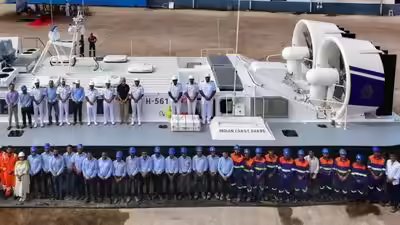
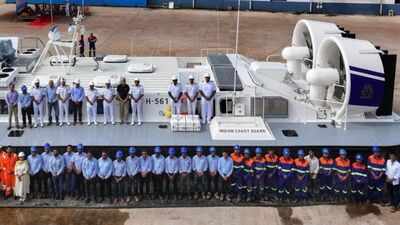
NEW DELHI: India’s coastal security capabilities received a major boost with the induction of the first indigenous Air Cushion Vehicle (ACV), commonly known as a hovercraft, into the Indian Coast Guard (ICG). The vessel is the first of six hovercraft being built under a Rs 387.4 crore contract awarded to Chowgule Shipyards.Built under a technology licence from Griffon Marine Ltd, the hovercraft features more than 50% indigenous content and will be maintained by Chowgule Shipyards for five years after delivery.Designed for operations in some of India’s most challenging coastal environments, the hovercraft has a payload capacity of eight tonnes, a top speed of 45 knots and a cruising speed of 35 knots. It can carry up to 42 personnel and remain operational for up to nine hours.The induction ceremony was attended by senior Coast Guard officials and representatives from the shipbuilding industry.The new platform is expected to enhance the Coast Guard’s ability to conduct coastal surveillance, maritime law enforcement, interdiction operations and search-and-rescue missions across diverse terrain.What is a hovercraft?A hovercraft, or Air Cushion Vehicle, is an amphibious platform that travels on a cushion of air generated beneath its hull.Unlike conventional boats, which remain in direct contact with the water, a hovercraft is lifted slightly above the surface by pressurised air trapped underneath. This allows it to operate across multiple terrains without being restricted by water depth or surface conditions.Powerful lift fans generate the air cushion, while propulsion systems push the vehicle forward. Because the craft rides on a layer of air rather than directly on land or water, friction is greatly reduced, allowing it to move quickly and efficiently.This unique capability enables hovercraft to travel across water, mudflats, marshes, sandbanks, shallow coastal areas and even certain stretches of land that are inaccessible to conventional vessels.Why does the Coast Guard need hovercraft?The Indian Coast Guard is responsible for securing more than 7,500 kilometres of coastline and conducting missions ranging from maritime surveillance to anti-smuggling operations and disaster response.Many areas along India’s coastline, particularly shallow waters, tidal creeks and marshlands, are difficult for conventional patrol boats to access. Hovercraft fill this gap by providing rapid mobility across both land and water.The Coast Guard currently operates 18 Griffon 8000TD hovercraft. The induction of indigenous platforms will further strengthen these capabilities.The new hovercraft will be particularly useful in the shallow waters of the Gulf of Kutch, the mudflats of the Rann of Kutch and the complex creek systems around Sir Creek near the India-Pakistan maritime boundary.It can also operate effectively in the marshy terrain of the Sundarbans in West Bengal, where conventional patrol vessels often face navigational challenges.By enabling faster deployment and access to difficult terrain, the hovercraft will improve the Coast Guard’s ability to conduct surveillance, intercept suspicious vessels and respond to emergencies.Boost for defence manufacturingThe induction also marks an important milestone for India’s defence manufacturing sector.As the first indigenously built hovercraft to enter Coast Guard service, the platform supports the government’s push for self-reliance in defence production and maritime capability development.With its ability to move seamlessly across shallow waters, mudflats, creeks and marshes, the indigenous hovercraft is expected to become a valuable asset in strengthening India’s coastal security architecture while showcasing the growing capabilities of the domestic shipbuilding industry.