Meet John Moretti: The Texas palaeontologist who put on a wetsuit to search an underwater cave and found Ice Age animals beneath the water |
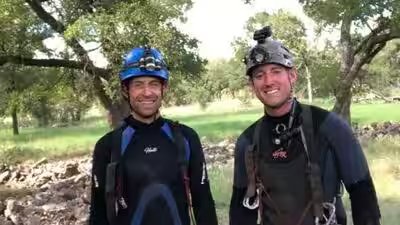
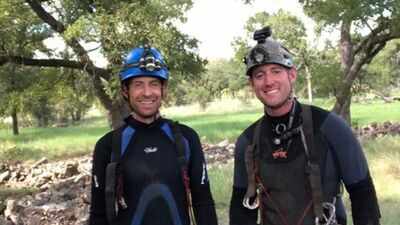
The discovery beneath Bender’s Cave in central Texas began in an underground stream where fossils lay hidden beneath the water. John A. Moretti, a palaeontologist at the University of Texas in Austin, and caver John Young investigated bones preserved in the water-filled passages of the cave. Their study published in ‘Quaternary Research‘ in March 2026, identified a diverse collection of Late Pleistocene (Ice Age) animals, including several species previously unknown from the Edwards Plateau. The findings also raise the possibility that some of the fossils came from a much warmer period before the last Ice Age.
How John Moretti found Ice Age animals beneath Bender’s Cave
Bender’s Cave lies in Comal County, Texas, within the limestone of the Edwards Plateau. Unlike a typical fossil site, much of the cave contains an active underground stream connected to the Trinity Aquifer and the Guadalupe River basin. According to the study, researchers reached the cave by descending through narrow sinkholes before following passages containing flowing water.The cave had already been explored and mapped by cavers from the 1990s onwards, mainly because of its importance to local groundwater systems. Its palaeontological potential became apparent when cavers first noticed Pleistocene fossils inside. Moretti and Young later carried out fieldwork to document and collect these remains.The researchers collected fossils during six sampling episodes between March 2023 and November 2024. Because many of the remains were lying underwater, the team used snorkels and dive masks to collect them from gravel bars, sediment banks and the stream bed. The study describes the cave as a challenging but valuable place for studying animals that lived tens of thousands of years ago.
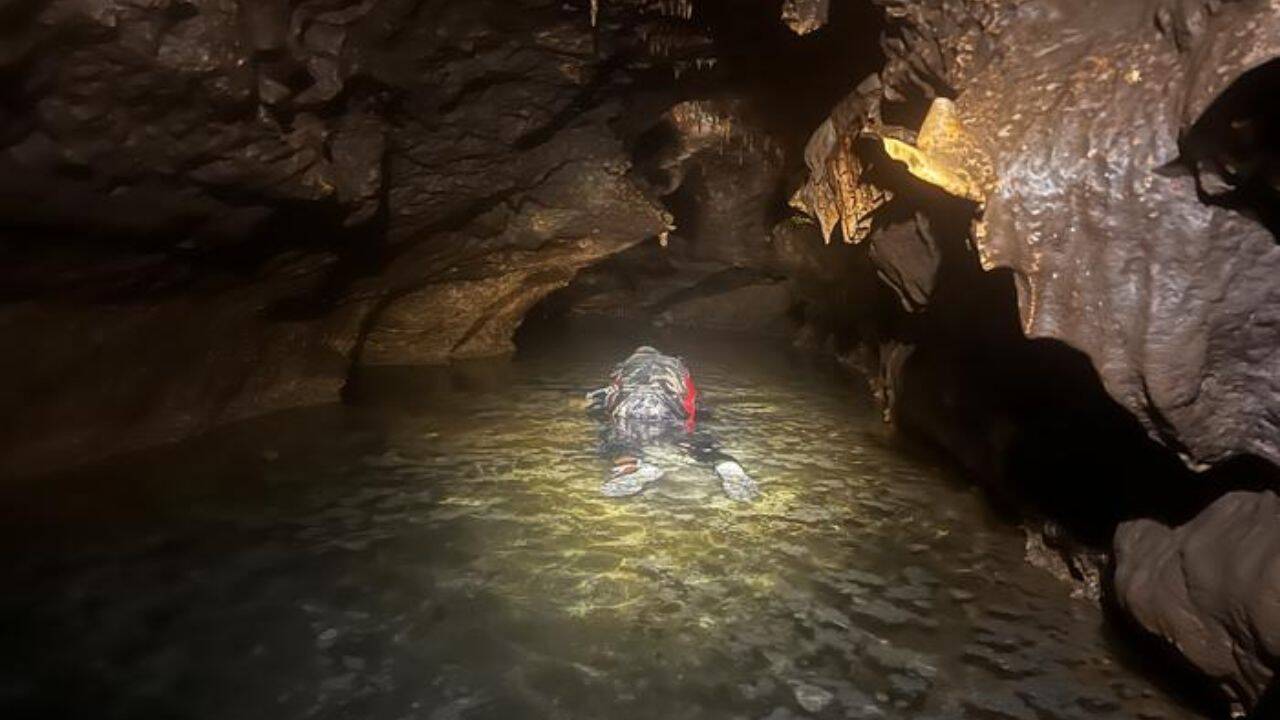
With a wet suit and goggles, paleontologist John Moretti searches for fossils in the stream that flowsthrough Bender’s Cave. Image Credit: John Young
The underwater cave preserved a varied Ice Age animal community
The fossils included animals that are already known from other late Ice age sites across the Edwards Plateau. These included mammoths, bison, horses, camels and deer. The researchers also identified remains belonging to animals that are rare or had not previously been recorded from the region.Among the most notable finds was Megalonyx jeffersonii, a large extinct ground sloth. The researchers identified it from several bones and a tooth, including a distinctive lower tooth and claw-like bones. The cave also contained remains of Mammutidae, the family that includes mastodons.Another important discovery was Holmesina septentrionalis, a large extinct pampathere. The researchers identified it from a bony plate from the animal’s protective armour. The study states that this represents the first record of Holmesina from the Late Pleistocene of the Edwards Plateau.The team also identified a giant form of Hesperotestudo, an extinct giant tortoise. Its presence, together with the ground sloth, pampathere and mammutid, makes the fossil collection at Bender’s Cave notably different from those found at other nearby sites.
Importance of these unique fossils for Texas palaeontology
The combination of animals creates a problem for scientists trying to determine when the fossils were deposited. Most comparable fossil sites on the Edwards Plateau contain evidence associated partly or entirely with the last glacial interval, known as Marine Isotope Stage 2. That period was characterised by a relatively dry, open grassland and a cooler climate.The animals from Bender’s Cave do not fit neatly into that picture. Moretti and Young found that the four unusual groups from the cave commonly occur together at other Texas sites that have been interpreted as belonging to earlier warmer periods. These include Marine Isotope Stage 3 and Marine Isotope Stage 5, with MIS 5 representing the last interglacial.The researchers therefore suggest that the cave could preserve evidence from a warmer interval that existed before the last major glacial period. Their analysis placed Bender’s Cave among sites whose animal communities most closely resemble those of the last interglacial.
Water helped in moving and preserving the fossil remains
The underwater setting also explains why determining the history of the fossils is difficult. Moretti and Young found that many bones had been polished, rounded and battered, consistent with prolonged exposure to groundwater and movement by flowing water.The researchers describe the fossils as a lag assemblage, meaning that water appears to have transported and concentrated remains in particular areas of the cave. A filled sinkhole at the upstream end of the cave is considered one possible source of the material. Erosion could have carried older bones into the stream, where later changes in water flow moved them again.Some fossils were also found within loose pieces of bone-rich sediment, while others occurred separately. A buried blue-green clay deposit contained a particularly notable concentration of remains. The researchers suggest that deposits such as this could have formed during quieter periods when water flow was low before later flooding disturbed and redistributed the material.
New dating could reveal the cave’s deeper history
The study notes that Bender’s Cave has added an important piece to the understanding of Late Pleistocene wildlife in Texas. The regional record is not yet complete.Moretti and Young say new radiometric dating is needed to test the possible warm-period interpretation. They are focusing on techniques involving cave deposits and mammal teeth, alongside dating of any organic material that can be recovered from intact deposits. Mammoths and bison were part of the story, but the presence of a giant tortoise, ground sloth, pampathere and mammutid suggests that the cave may also preserve evidence of a very different landscape from the colder, drier world usually associated with the region’s Ice age record.