Meet Jainendra K. Jain: The first Indian-origin physicist to win the Wolf Prize and transform quantum physics |
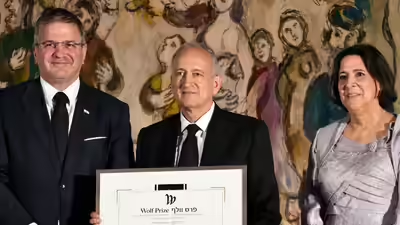
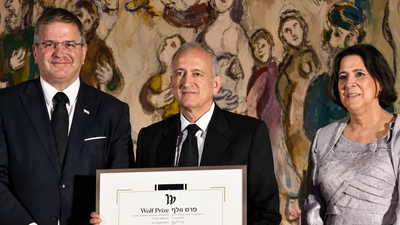
In the world of theoretical physics, some ideas solve a problem. Others reshape an entire field. Jainendra K. Jain’s theory of composite fermions belongs firmly in the second category.Born in rural Rajasthan and now the Erwin W. Müller Professor of Physics at Pennsylvania State University, Jain has spent much of his career tackling questions that lie at the very edge of human understanding. His work has influenced generations of physicists studying quantum matter, and in 2025 it earned him one of science’s most prestigious honours: the Wolf Prize in Physics. In doing so, he became the first physicist of Indian origin to receive the award.Yet the story of Jain’s career is not simply one of scientific achievement. It is also a story of perseverance, curiosity, and an idea that emerged from one of the most perplexing mysteries in modern physics.
How Jainendra K. Jain’s composite fermion theory earned him the prestigious Wolf Prize
When physicists discovered the fractional quantum Hall effect in the early 1980s, they knew they were looking at something extraordinary.Electrons confined to an ultra-thin layer and subjected to extremely strong magnetic fields were behaving in ways that existing theories struggled to explain. Electrical conductance appeared not in neat whole-number steps but in fractions. The experimental evidence was undeniable, yet the underlying mechanism remained elusive.For many researchers, the phenomenon represented one of the great unsolved problems in condensed matter physics.Jain saw an opportunity. In 1989, he proposed a remarkably elegant explanation. Under extreme magnetic conditions, he suggested that electrons effectively bind with an even number of magnetic flux quanta, creating entirely new particles known as composite fermions.The idea transformed a seemingly impossible many-body problem into one that could be understood using familiar physical principles.What initially appeared to be a theoretical insight soon became one of the most successful frameworks in modern quantum physics. Today, hundreds of experimentally observed quantum Hall states are interpreted through composite fermion theory, and terms such as”Jain states” and “Jain sequences” have become part of the discipline’s vocabulary.Jain’s pioneering work on the introduction of composite fermions has fundamentally transformed our understanding of condensed matter physics.
A theory that kept growing
Scientific ideas are often judged by their longevity.More than three decades after its introduction, composite fermion theory remains central to some of the most active areas of physics research. Scientists continue to use the framework to investigate topological phases of matter, anyons, strongly correlated electron systems, and quantum states that may eventually contribute to fault-tolerant quantum computing.What makes the theory particularly influential is that many of its predictions were later verified experimentally. In physics, experimental confirmation is the ultimate test. Composite fermion theory passed that test repeatedly.The Wolf Foundation recognised this contribution when it awarded Jain the 2025 Wolf Prize in Physics alongside James P. Eisenstein and Mordehai Heiblum for advancing the understanding of two-dimensional electron systems in strong magnetic fields.For Jain, the award represented recognition not just of a single discovery but of decades of research that helped redefine how physicists think about quantum matter.
From a village in Rajasthan to the frontiers of science
Long before his work became known in research laboratories around the world, Jain was a young student growing up in Rajasthan.His path to physics was far from straightforward. As a child, he suffered a serious accident that left him with a lifelong disability and required the use of a prosthetic limb.Years later, reflecting on his journey, he wrote:“Growing up in a poor village in India, traumatised by an accident that left me on crutches with a lifelong disability, I did not think I would ever walk again or attend college, let alone pursue my dream of becoming a physicist.”Despite those challenges, he continued his education, attending government schools before studying at Maharaja College in Jaipur and later IIT Kanpur. He eventually moved to the United States, earning a doctorate from Stony Brook University in New York.Jain has often credited the Jaipur Foot prosthetic for helping him maintain the mobility necessary to pursue his studies and academic career.
Jain’s work beyond awards and recognition
The significance of Jain’s work extends beyond the honours attached to it.His composite fermion theory fundamentally altered how scientists approach some of the most complex quantum systems ever observed. It provided a conceptual framework that continues to generate new research decades after its introduction, a rare achievement in any scientific discipline.The Wolf Prize places him among an elite group of researchers whose work has had a lasting impact on science. Many Wolf Prize recipients later receive Nobel Prizes, and the award is widely regarded as one of the highest distinctions in the scientific world.For India, Jain’s recognition marks a historic milestone. For physicists, it is a reminder that some of the most transformative ideas often begin with a simple question: what if we are looking at the problem the wrong way?More than 35 years after proposing composite fermions, Jain’s answer to that question continues to shape our understanding of the quantum universe.