
Maine buried 20,000 discarded tyres beneath a road to fight frost and spring mud, while turning a growing waste problem into an engineering solution | World News
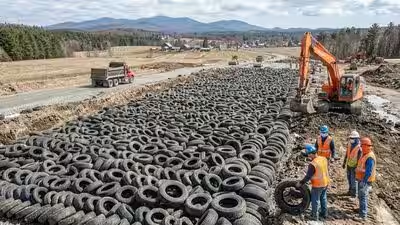
Along a quiet stretch of road in Maine, engineers buried something most people would expect to see in a scrapyard rather than beneath their tyres: about 20,000 discarded car tyres. The unusual experiment was designed to tackle two problems at once. Maine’s roads face a difficult seasonal cycle, with winter freezing the ground and spring thaw turning it soft and unstable. Gravel roads can quickly develop ruts and potholes as vehicles pass over the weakened surface. At the same time, the state produces more than a million unwanted tyres each year, creating a growing waste problem with few easy outlets.University of Maine engineer Dana Humphrey wondered whether shredded tyres could become part of the solution. Cut into large chips and placed beneath a conventional gravel surface, the rubber acted differently from ordinary road fill. When spring arrived, the experimental section showed noticeably less frost penetration and deterioration than nearby parts of the road.
Maine tested old tyres beneath roads to make them stronger in spring
Maine has a particularly large network of unpaved roads, many of them exposed to repeated cycles of freezing in winter and thawing in spring. As temperatures rise, water held in the ground can turn road surfaces soft. Heavy vehicles then make matters worse, leaving sections of gravel roads difficult to travel.The tyre-chip idea was developed by University of Maine civil engineer Dana Humphrey, who was investigating whether the unusual properties of shredded rubber could be put to work inside a road structure.The material was not being used as a replacement for the road surface. Instead, it formed a layer beneath conventional gravel. The chips were intended to change what happened below the surface, rather than provide the wearing surface on which vehicles travelled.
20,000 tyres went beneath one Maine road for a winter test
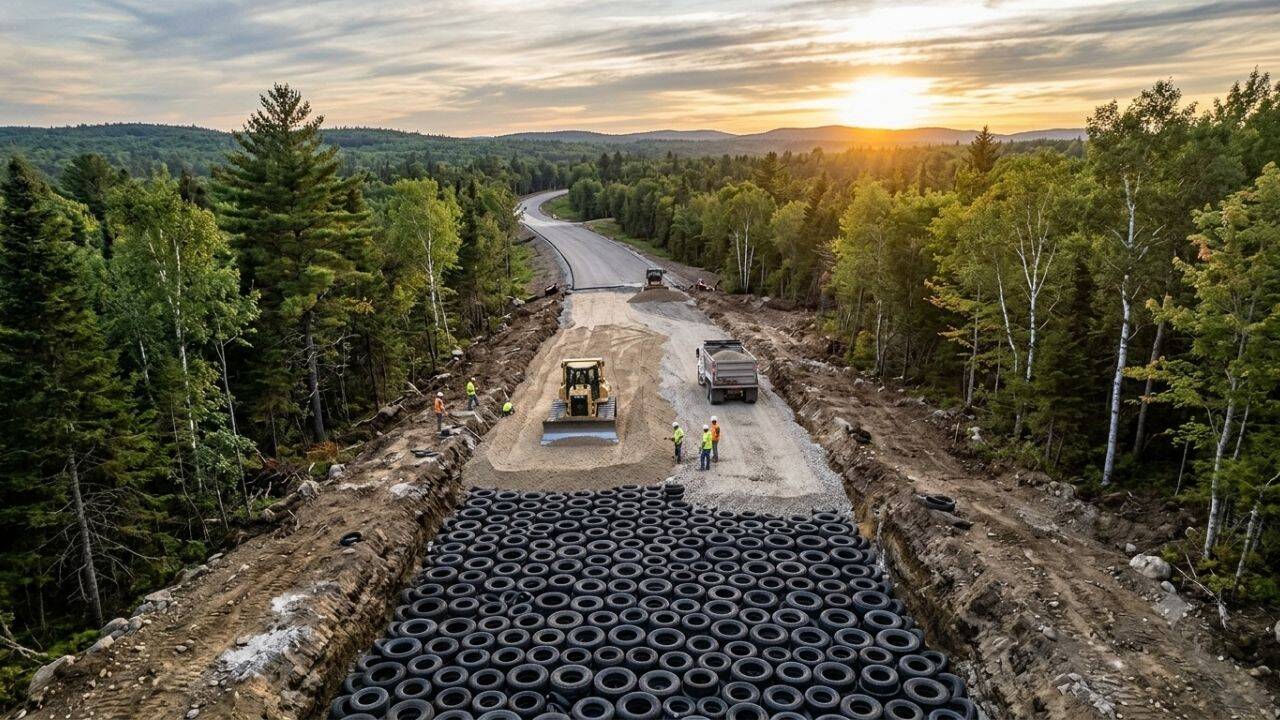
As reported by Los Angeles Times, a section of Dingley Road in Richmond became the site of a winter-long experiment. About 20,000 discarded tyres were cut into pieces roughly 2 to 3 inches across. The pieces still contained their steel belts.They were spread across a 600-foot section of the road, forming a layer between about 6 and 12 inches thick. Gravel was then placed above them in successive layers, eventually creating a conventional-looking road surface.Reportedly, the experiment was closely monitored. More than 100 temperature sensors were installed at different depths within the roadbed by Robert A. Eaton of the US Army Corps of Engineers Cold Regions Research & Engineering Laboratory. The sensors were connected to computers in Hanover, New Hampshire, allowing temperatures inside the road structure to be recorded throughout the winter.By spring, the tyre-chip section was behaving differently from nearby portions made entirely with gravel. Frost had penetrated to roughly half the depth observed in the comparison sections, while the gravel-only portions deteriorated badly during the thaw.
Why shredded tyres worked differently from ordinary gravel
Tyre chips have a physical advantage over ordinary road aggregate: they are much lighter. Gravel weighs about 125 pounds per cubic foot, whereas the tyre material used in the experiments weighed around 40 pounds.That difference can become important when large quantities of fill are needed. A lighter material places less weight on the soil below it, which makes the approach particularly interesting for construction on weak ground.Rubber also behaves differently from mineral soil when temperatures change. It does not transfer heat as readily, giving the chips an insulating quality. At the same time, the irregular pieces leave spaces through which water can move.The three characteristics: low weight, insulation and drainage made the material useful for more than just keeping frost out of a road.
Engineers began testing tyre chips beyond road construction
Humphrey and two graduate students also began constructing a retaining wall on the University of Maine campus. The planned structure was about 15 feet high and was intended to explore whether tyre chips could serve as lightweight fill behind a wall.That application had implications for places where conventional earth fill puts substantial pressure on slopes or retaining structures. Humphrey suggested that the method could have uses on steep roads in Southern California, where reducing the weight of material placed against a hillside could be useful in managing problems associated with unstable slopes.The concept was different from using finely ground rubber in asphalt. Crumb rubber had already been incorporated into some highway paving, but it required a much more processed product and was considerably more expensive.For one mile of interstate resurfacing in Maine, the material reportedly accounted for about 6,000 tyres, at a cost exceeding $20 per tyre. Using larger tyre pieces as fill could consume far greater quantities without requiring the same degree of grinding.
Maine had millions of old tyres with few places to go
The engineering experiment was taking place against a substantial waste problem. Maine residents were estimated to discard about 1.2 million tyres each year. Some ended up stored in large piles, including abandoned stockpiles that created environmental and fire concerns. Tyres can hold rainwater, providing places for mosquitoes to breed, while large tyre fires can burn for long periods and produce difficult-to-manage smoke.The state’s recycling policy had also been shaped by legal and environmental problems surrounding two enormous tyre stockpiles. Government authorities were eventually placed in the position of dealing with the sites, adding pressure to find uses for tyres after disposal.For recyclers, however, finding an outlet was not necessarily the difficult part of collecting them. The market for products made from old tyres was still relatively small. In many cases, the disposal service itself generated more revenue than the sale of recycled material.Some tyres were already being burned for energy. Maine had waste-to-energy facilities that could use tyre chips, while a paper mill also used them as fuel. But preparing the material for combustion brought its own costs, particularly because the steel had to be removed as far as possible and the rubber needed to be cut into smaller pieces.
The next test moved closer to a normal highway
The Richmond experiment used a gravel surface, so it did not answer every question about how tyre chips would perform beneath an ordinary paved road.That was the purpose of a planned test in North Yarmouth. An asphalt-topped section of highway was due to be constructed later that summer, providing an opportunity to see whether the material could perform beneath a conventional pavement under traffic.Earlier tests had indicated that once the chips were compacted using ordinary road-building equipment, they could support the loads imposed by heavy lorries.