
Ladakh begins using 90 million litres of glacier water daily; Shashi Tharoor hails LG UT administration | Srinagar News
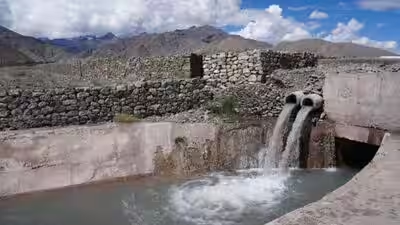
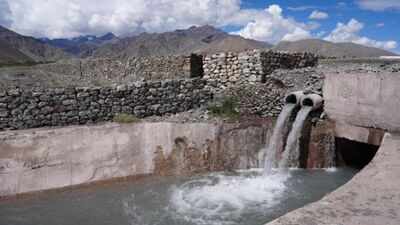
SRINAGAR: The Ladakh Union Territory has started utilizing a 90 million litres of glacier water per day, for sustainable water and agricultural security in Ladakh, a government spokesperson said.“Previously lost as untapped runoff into the river Indus, this colossal volume of glacial-melt water from Stok village Nallah in Leh, is now being directly channelized into the Igoo-Phey Irrigation Canal, catering to nearly 12 villages and augmenting irrigation of over 1000 acres of barren land that earlier remained parched due to paucity of water into the canal,” the spokesman said.The initiative has earned praise for Ladakh LG Vinai Kumar Saxena. Congress leader Shashi Tharoor while lauding the initiative wrote on X, “Well done, @lg_ladakh. As I discovered during my Committee’s recent visit, Ladakh promises to be a national showcase for environmental progress and sustainability. Let’s keep at it!”This initiative, uses simple earthwork to channelize and utilize the glacial runoff, without incurring any capital expenditure. This comes as a step toward transforming the region’s agricultural productivity and realizing the vision of a green, water-secure, and self-sustaining Ladakh.While Ladakh is endowed with abundant glacier and snowmelt resources, vast stretches of its cultivable land have historically faced acute irrigation shortages. The imbalance between the large volumes of untapped, draining water and the parched agricultural lands has, since ages, constrained rural livelihoods.The spokesman said that recognizing this critical gap, during his visits to various villages, LG VK Saxena ideated and spearheaded a comprehensive, systematic campaign by identifying such places, where large quantity of glacier water is flowing down the Indus River.To ensure that every drop of glacier and snowmelt is harnessed for productive use rather than going to waste, LG first identified Stok village Nallah, as one such place for diverting the glacier water into the existing canal. The Stok Nallah is fed by the Stok Kangri Glacier near Leh“On the directions of LG Saxena on August 14, the Irrigation and flood control department successfully diverted excess glacier water from main water channel of Nallah to Igoo-Phey Canal by creating two tranches using JCB,” the spokesman said.The discharge from Stok Nalla, flowing downstream and ultimately into the River Indus, was assessed at approximately 36.60 Cusecs (1 cusec is equivalent 28.32 litres of water per second, i.e, approx. 90 million litters of water in 24 hours).However, two diversions have been created to channelize additional 26 cusecs of water – 19 cusecs towards Igoo village (upstream) and 7 cusecs towards Phey village (downstream) – from the Stok Nalla into Igoo-Phey Canal. Planning is underway to utilize the remaining 10 cusecs of water.The construction of the 43-km Igoo-Phey Canal began in 1979 and was completed in 2005. “During that period about 200 meters part of the Canal was constructed underground to allow Stok Nallah water to pass over it without disturbing the Canal’s flow. This indicates that water was readily available when the project was conceived 47 years ago.”However, no one ever visualized the potential of this water source or undertook any step to harness this important resource for greater water security, until LG Saxena ideated this pioneering initiative to channelize abundant water into the canal, the spokesman said.By intercepting and utilizing this daily flow of 90 million litres, the administration has proven the feasibility of large-scale water diversion to bolster the region’s cold desert agriculture. Crucially, this intervention will substantially augment the total water flow in the Igoo-Phey Canal, increasing it from the present 50 cusecs to nearly 80 cusecs.Previously, water from the Igoo-Phey Canal was distributed to villages on a restrictive roster basis due to limited availability of water. Now, with the influx of excess water, supply will be guaranteed on a daily basis to all the 12 villages, directly augmenting irrigation across thousands of acres of land.Consequently, farmers will experience higher crop yields, leading to increased farm incomes, greater employment opportunities, and a revitalized rural economy.“By successfully saving 90 million litres of glacier water daily and diverting this huge volume of water from the Stok Nallah into the Igoo Phey and Yokyur canals, we have proven that large-scale, sustainable water management is entirely feasible in our cold desert. This is a monumental step toward our vision of a Green, Water-Secure, and Self-Sustaining Ladakh. Our administration’s unwavering commitment is to harness every single drop for irrigation. This successful model is just a blueprint. We will expand these cost-effective interventions across Ladakh, transforming scattered glacier flows into a permanent lifeline for agricultural prosperity, revitalized rural economies, and long-term climate resilience for the people of Ladakh,” Saxena said.