Jamir: ‘Are we saying a piece of writing can’t be that polished unless AI wrote it?’ : Jamir Nazir
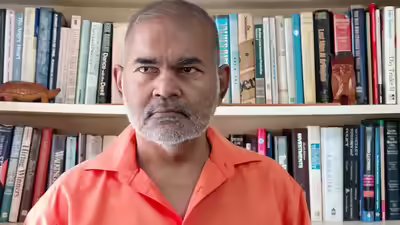
Becoming the regional winner of the Commonwealth Short Story Prize should have been a big moment for Jamir Nazir. Instead, it was marred by allegations that his short story was AI-generated. Now that the Trinidadian writer of Indian origin has finally been named overall winner after a jury review, he spoke to Sneha Bhura about the controversy, his use of assistive technology, and the power of human imagination1. Congratulations on winning the 2026 Commonwealth Short Story Prize. After the AI controversy, what did winning mean to you?It has been very difficult. It’s a small island, so friends and family heard everything, especially my mother. When she read those reports in the local newspaper, it was very upsetting. The newspaper never called me for my side of the story, yet claimed it had. When the Commonwealth called to tell me I’d won the overall prize, they said, ‘Jamir, it’s okay to go and tell your mother now.’ I was overjoyed. Not just because of the victory, but because I could finally tell my mother, and she could finally feel proud again. After all the scrutiny, we felt the judges couldn’t possibly make the same mistake twice. Now I’m frightened about publishing new work because the attacks haven’t stopped.2. What inspired your award-winning story ‘The Serpent in the Grove’?I grew up in a rural sugarcane village in Trinidad that, in many ways, reminded me of what rural India might once have been like. Every day, I walked to school through cane fields and past rum shops where sugar workers gathered after work. At school, I met children without shoes or books who spoke about how alcohol was tearing their families apart. My father often warned us about alcohol because his own father, who had come from Bihar as an indentured labourer, had struggled with drinking. He had seen its impact firsthand and never drank himself. Those memories, and what I witnessed growing up, became the seed for ‘The Serpent in the Grove’.3. Which passages attracted the most criticism, and why do you think they were misunderstood?People criticised a line where I wrote: ‘She had the kind of walking that made benches become men.’ That’s magical realism. Think Salman Rushdie or Gabriel Garcia Marquez. It’s a literary technique. In my story, the character ‘Zoongie’ believes she is so beautiful that even when no men are around, she imagines the benches becoming men who admire her. It exists only in her imagination. People interpreted it literally. There was another line about light reflecting from a sink. That came directly from my childhood. Our kitchen faced east, and my mother liked to keep everything spotless. We used to polish the sink, and when the morning sun hit it, it glittered brightly. People claimed that the image must have been AI-generated. But it’s from my lived experience.4. You’ve said you rely on speech-to-text because of your health. How has that changed the way you write?A few months ago, I was diagnosed with lymphoma after years of taking immunosuppressant medication following a kidney transplant. I’ve lived with diabetes for 62 years, which has damaged the nerves in my fingers and feet, and I’m currently undergoing chemotherapy. That’s why I began using speech-to-text on my Android phone. It doesn’t write for me; it just transcribes my words. I still have to edit everything because it often mishears my accent. In fact, constantly revising and polishing my work may be one reason AI detectors flagged it. I hope this episode leads to a better understanding of the difference between assistive technology and AI-generated writing.5. On June 19, literary magazine and publisher Granta withdrew from its partnership with the Commonwealth Foundation over concerns about AI-generated work. What was going through your mind when that happened?When the controversy first began, I received a kind email from a senior representative at Granta. They expressed sympathy for what I was going through and noted that even classic works had been wrongly flagged by AI detectors. I was therefore surprised when Granta later raised concerns about AI. I wrote back and was told that they had been misquoted. Because of those exchanges, I didn’t take Granta’s decision personally. I saw it as a business decision. I wish both Granta and the Commonwealth Foundation well. In Trinidad, we have a word—bacchanal—which means creating unnecessary drama. I think that’s what much of this became.6. The judges said writers from the Global South are increasingly being asked to prove their humanity alongside their talent. Did you feel that happened to you?I think so. The literary establishment didn’t know me, and there’s a literary elite in Trinidad that I wasn’t part of. I also believe that because my biography described me as an Indian living in the Caribbean, that became another factor. At times I was angry when they asked me to submit drafts and other material, but my wife kept saying, ‘Just do it.’ The Commonwealth also told me these weren’t part of the competition rules and I wasn’t obliged to comply. But I chose to because I didn’t want to jeopardise my place in the final judging. What I don’t understand is why people continue to question the judges’ decision.7. Many acclaimed writers like Ursula K Le Guin, Mary Shelley, and JRR Tolkien have also been falsely flagged by AI detectors. Where does this leave writers?What these AI detectors are saying is that if a piece of writing is too polished, it must have been written by AI. I refuse to accept that. AI was trained on human writing. Large language models, to me, are tools, much like a word processor. They don’t replace the human spirit behind creative writing. Ask an AI to write a prize-winning story on its own and see what it produces. You still need human imagination and judgment to create literature.8. Tell us about your upcoming novel, ‘Fire in the Cane’, which is inspired by your grandfather’s journey from India to Trinidad as an indentured labourer.It’s really centred on what happened after my grandfather arrived in Trinidad. The novel follows him and his wife as they struggle to obtain the two acres of land that indentured labourers had been promised, so they could establish their own small cane plantation. It’s what I would call fictionalised history. India is my ancestral homeland. My grandfather, Nazir Ahmed, attended the inaugural Pravasi Bharatiya Divas in New Delhi in 2003. After hearing how he and his mother had been deceived into boarding a ship to Trinidad under the indentureship system and never saw his father or siblings again, the then PM (A B Vajpayee) presented him with a special award. That connection with India has always stayed with our family.9. How do you see Indo-Caribbean literature fitting into the wider landscape of world literature today?I don’t think we’ve done enough to highlight the distinctiveness of the Indo-Caribbean experience. Even writers such as VS Naipaul, who had Caribbean and Indian roots, tended to move away from that identity and become associated more closely with England. We’ve not really had a champion of this cultural blend. Although I wasn’t born in India, I grew up in an Indian household. My mother was Hindu, and my father a Muslim, so I attended both Hindu and Muslim prayers as a child. That cultural fusion is something I try to reflect in my work, including my poetry. Poetry has always been my first love. I have been greatly inspired by Rabindranath Tagore, and I am currently working on a collection influenced by his style. I have also been influenced by Pablo Neruda and Derek Walcott. But I’m frightened about publishing new work. I don’t want to put my family through another ordeal. Perhaps I should look to India as a place to publish. I don’t know if that’s a good idea.