In 2016, Biologists at Rutgers University discovered that the globe skimmer dragonfly is the world’s longest-distance flying insect
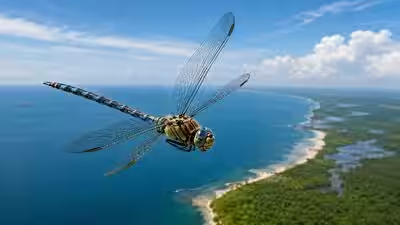
In March 2016, researchers identified the globe skimmer dragonfly, Pantala flavescens, as the world’s longest-distance flying insect. Led by researchers at Rutgers University-Newark, the study used genetic analysis rather than direct observation to reach its conclusion, comparing DNA samples collected from dragonfly populations scattered across multiple continents. Rutgers University-Newark findings suggested these insects were travelling extraordinary distances and interbreeding across oceans, creating a single global gene pool. The research displaced the monarch butterfly, long regarded as the insect world’s most accomplished migrant, and offered the first genetic evidence to support decades of speculation about the dragonfly’s transcontinental range.
DNA study reveals globe skimmer dragonflies share one global population
According to the study published in PLOS ONE, titled ‘A Global Population Genetic Study of Pantala flavescens’, samples were collected from Guyana, Japan, India, Korea, Canada, and the United States, with additional sequence data drawn from GenBank and BOLD Systems databases. In total, 49 CO1 mitochondrial DNA sequences were analysed using phylogenetic trees, a haplotype network, and molecular variance calculations.The results showed minimal genetic distinction between populations from different continents. An analysis of molecular variance found that only 4.26% of genetic variation occurred between different geographic populations, while the remainder occurred within them, a pattern consistent with a single interbreeding population rather than several isolated ones. The Rutgers press release quoted senior author Jessica Ware explaining that had North American dragonflies bred only with other North American dragonflies, and Japanese dragonflies only with other Japanese dragonflies, distinct genetic differences between the groups would be expected. Because no such differences were found, the study concluded that genetic material was mixing across vast geographic distances.
What helps the globe skimmer dragonfly fly across continents
The genetic findings raised an obvious question: how does an insect barely four centimetres long complete journeys of thousands of kilometres? The answer lies largely in the dragonfly’s physical structure. Ware noted that Pantala flavescens has evolved an increased wing surface area that allows it to catch and ride wind currents, alternating short bursts of active flight with long periods of gliding to conserve energy. The dragonfly’s enlarged hindwing base allows it to glide while expending minimal energy, a trait considered central to its migratory capacity. The species is also dependent on freshwater for reproduction, which shapes its flight behaviour. Daniel Troast, who analysed the DNA samples for the study, explained that the dragonflies effectively follow seasonal moisture, moving from India during the dry season to Africa during its wet season, a pattern reported to occur annually.Globe skimmer dragonfly flies farther than monarch butterfliesBefore this research, the monarch butterfly was widely considered the insect world’s most impressive long-distance migrant, travelling roughly 2,500 miles each way across North America. The globe skimmer’s estimated migratory range of 4,400 miles or more surpassed this figure substantially, and even exceeded the distance of Charles Lindbergh’s transatlantic solo flight by several hundred miles. The dragonfly’s documented migratory circuit between India and East Africa, spanning multiple generations, could total 14,000 to 18,000 kilometres. This figure draws on isotope research by Hobson and colleagues, which found that individual dragonflies may cross more than 6,000 kilometres in a single generation, including a stretch of over 3,500 kilometres across open ocean. This is described in the study as the only known transoceanic migration undertaken by any insect species.
Pantala flavescens genetic study reveals a worldwide gene pool
The genetic data pointed to a specific pattern within the wider gene pool. A small clade of individuals from Texas and New Brunswick, Canada, showed some regional clustering, yet one Canadian sample was found to be most closely related to a sample collected in Gujarat, India, suggesting that even population groups with apparent regional structure remained connected to distant continents through gene flow. The researchers described this as evidence that Pantala flavescens exists as what they termed a global panmictic population, a designation otherwise documented only in a small number of species, including certain corals, eels, and deep-sea fish.This absence of clear regional genetic boundaries carries implications beyond the dragonfly itself. Strict adherence to fixed regional migration routes would be expected to produce distinct genetic clusters tied to geography, which the data did not show. Instead, the pattern implied that migratory routes are neither entirely fixed nor confined to specific continents, allowing individuals from geographically distant populations to periodically interbreed.
Scientists are still uncovering the globe skimmer dragonfly’s migration routes
Despite establishing that a global, interconnected population exists, the exact routes these dragonflies travel remain largely unconfirmed. Tracking devices used for larger migratory animals are too large to attach to an insect this size, leaving researchers reliant on indirect evidence such as genetics and wing chitin isotope analysis to reconstruct likely migration paths.A larger sample size across a wider geographic range, particularly in Africa, would be needed to better understand rates of gene flow and genetic diversity. Further work using additional genetic markers may also help clarify population structure that the CO1 gene alone was unable to detect, leaving open questions about the precise boundaries and stability of the globe skimmer’s migratory circuit for future research to resolve.