
In 1962, South Africa built road sections from desert Kalahari sand instead of crushed rock; 55 years and 1.5 million truck-equivalent loads later, none had failed | World News
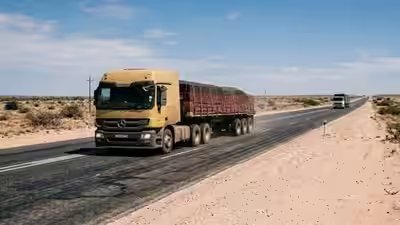
Southern African road builders have long struggled with an uncomfortable issue. The wide Kalahari region lacks the crushed rock and high-quality gravel typically used for road bases, and hauling those materials hundreds of kilometres can consume a large share of the project’s budget. The region has an abundant supply of fine, pale sand, often dismissed as too loose to carry heavy traffic. In 1962, engineers in South Africa’s Free State province tested that belief on a real road. After more than six decades, the experiment remains a strong argument for using the land’s own resources.The trial is located on the R700 between Hoopstad and Bultfontein. Several experimental base sections were built using a fine-grained, Kalahari-type sand. Some sections were treated with cement, lignosulfonate, tar or bitumen, while one section was left as plain sand. Control sections alongside them used graded crushed stone, the customary choice. In his final report, AFCAP researcher F. Netterberg wrote that by June 2017, 55 years after the road opened, all sections were still carrying traffic. None had been rehabilitated, and none appeared ever to have shown a structural failure.Why sand was worth testingThe sand near Hoopstad is a Kalahari-type sand and aeolian, meaning it was deposited by wind over thousands of years. It also isn’t plastic, so it doesn’t act like clay and get sticky or soft when it gets wet. That made it a logical contender, but no one in 1962 could say how it would behave after years of trucks, sun and rain.That is why the experiment was designed the way it was. Cement, tar, bitumen and lignosulfonate, a by-product of the paper industry, were all tested as stabilisers to see whether they could help the sand perform better. But the most revealing section was the plainest. A 90-metre stretch of untreated sand was used as the base course with nothing added to it at all. It was there to answer a direct question: could sand alone do the job? Its performance was then compared with that of the adjacent cement-stabilised and crushed-stone sections.What the traffic showedRoad engineers measure wear in standard axle loads, which convert the mix of vehicles, including buses and large lorries, into an equivalent number of passes by a single reference axle. By June 2017, Netterberg’s report said, the road had carried some 1.5 million standard axle loads per lane, and every section was still in service. The record has limits: traffic and performance data from the early decades are patchy.Further trials pointed the same way. Researchers compared untreated fine red sand, sand stabilised with bitumen emulsion, and standard gravel on Botswana’s Serowe-to-Orapa road, which was built in 1989. After 19 years, two reseals and no patching, all the sand and gravel sections were in excellent to very good condition.
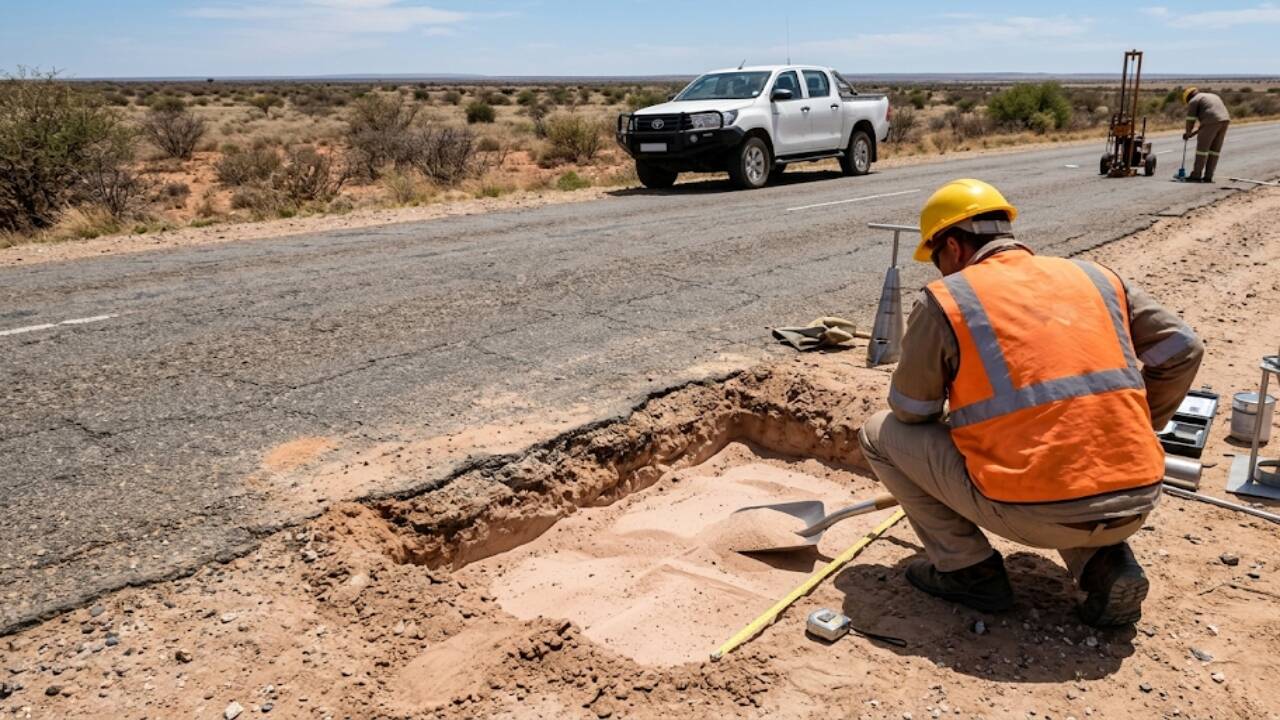
AI-generated representative image showing engineers inspecting compacted sand beneath an established rural road pavement. Credits – Gemini
When sand-based roads make senseThat is not to suggest motorways should be built across dunes. Traffic on the Hoopstad and Orapa roads is light, and the researchers say the findings apply to low-volume, sealed roads. They also attached conditions. The surface seal must be wide enough to accommodate the traffic, and building and surfacing must be done with great care since sand is unforgiving of shortcuts.Other work in the region supports cautious optimism. On Botswana’s Kanye-to-Jwaneng route, a separate experiment followed sand, asphalt and calcrete bases for 13 years and found both base types viable for at least 1.0 million standard axle loads, despite construction flaws in some sections.A sealed, all-weather road made mainly of local sand can cost far less than one built with imported stone. The Hoopstad experiment suggests such roads can also last for generations, using material found beside the carriageway. It is a good argument for checking the ground at hand before ordering gravel from far away.