From Suez to Russia’s Arctic: Why India, China are betting on Northern Sea Route & why it matters

Donald Trump’s trade and tariff policies, sanctions risks, and the ongoing Middle East route disruptions have led economies like India to reassess their supply chain strategies. The US-Iran war and the Houthi attacks in the Red Sea have exposed trade route vulnerabilities like never before. And some of the world’s largest economies like China, India and Japan are reassessing their trade route dependencies.With the Strait of Hormuz, Red Sea and Suez Canal routes facing disruptions, the Northern Sea Route is in focus for Asia’s trade with Russia and Europe.The Northern Sea Route (NSR), a frozen area route cutting through the Arctic along Russia’s northern coast, is now being used by China, and soon India will join the club.The attraction is clear: The trade route cuts distance and travel time significantly. But the NSR is not without its challenges.
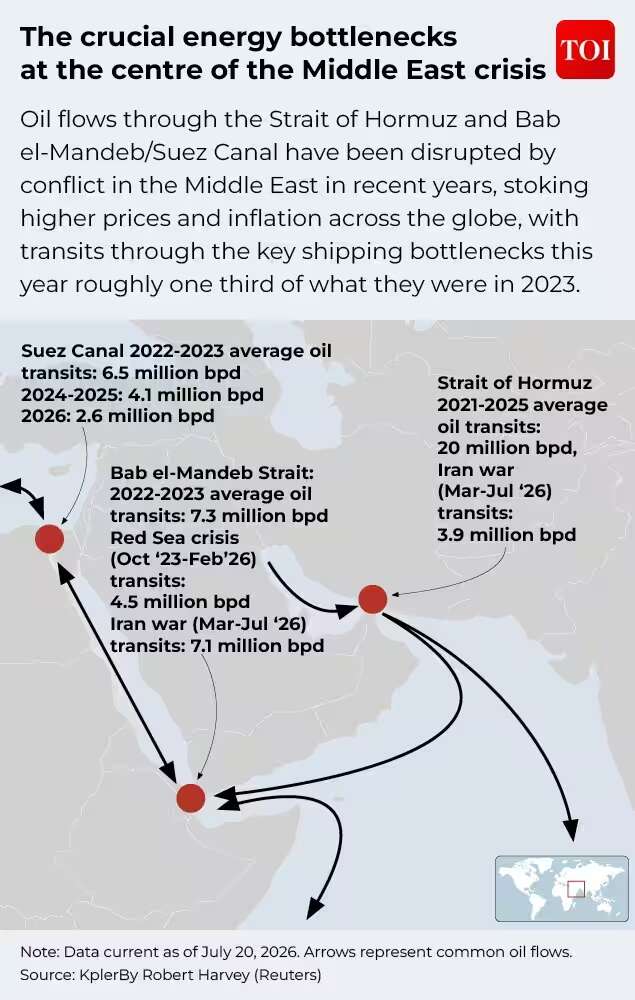
Crucial Energy Bottlenecks at the centre of Middle East crisis
India’s interest in the Northern Sea Route is being shaped by two factors: its commercial potential and the need to broaden trade connectivity. The NSR also offers a clear geographical advantage on certain Asia-Europe trade lanes, especially routes linking Asian ports with northern Europe.However, the economic potential of the route has to be weighed against the added challenges of operating in the Arctic. Can NSR replace Suez Canal as a meaningful alternative trade route? Let’s take a look:
What is the Northern Sea Route?
The Northern Sea Route is a link between Russia’s western ports with Asian markets via the Arctic waters. It’s a seasonal route that usually remains open through July-September every year.It’s over 5,500 km long shipping passage along Russia’s Arctic coast and the reason it has been gaining importance is due to the disruption of traditional trade routes like the Strait of Hormuz and Suez canal.Russia is investing in the infrastructure needed to turn the NSR into a major international trade corridor.It’s important because it allows Russia to ship cargo to China and other parts of Asia without any possible inspections and detentions related to Ukraine-related sanctions.Reports suggest that Russia’s crude oil shipping via the Arctic Sea has picked up pace this year. Reuters recently reported that seven cargoes with around 6 million barrels of crude were dispatched for Asia.
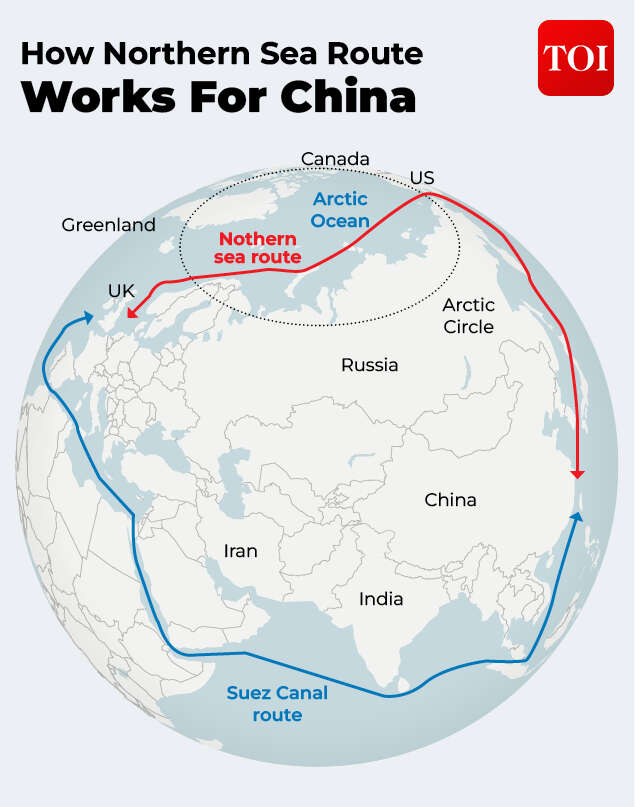
How Northern Sea Route Works For China
China already using NSR
While India, Japan and South Korea have expressed interest in the Northern Sea Route, China has moved fast and is already receiving shipments through it.In fact, traders are already anticipating that China will step up shipments through the route if Iranian oil supplies remain disrupted due to the Middle East conflict.The NSR helps reduce the travel time to China by about two weeks if one were to compare it to the usual route. Traders have said that China is the biggest beneficiary from this particular route since its ports are closer to the Far Eastern export terminals of Russia.For China the route is reduced from 40 days via the Suez canal to just 18 days to the United Kingdom.Experts say China is emerging as an early commercial beneficiary, building on its long-standing “Polar Silk Road” ambitions with Russia.Rosatom, which operates the NSR and provides nuclear-powered icebreakers, has issued permits for seven Chinese vessels travelling to Europe, with ships planned to sail weekly during the 2026 navigation season.
What India is planning on NSR
India is planning to send its first cargo ship through the Northern Sea Route in 2027.Discussions with Russia’s Arkhangelsk region are being held for the use of ports for Indian exports and imports, shipbuilding and potentially locating production near ports.There are added benefits as well: the region offers access to hydrocarbons, LNG, nickel, copper, platinum, palladium and rare earths.
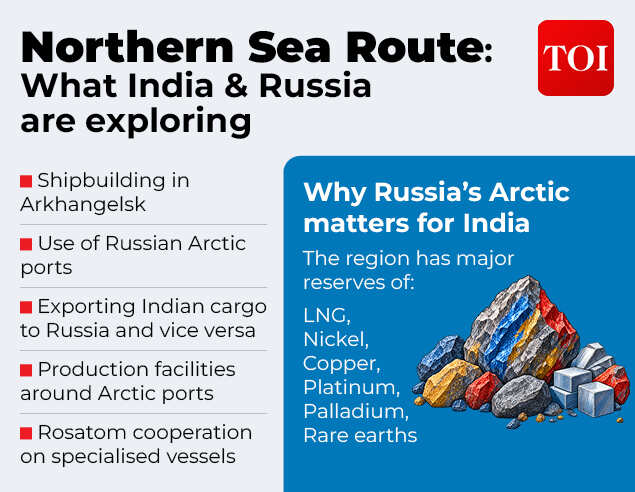
Northern Sea Route- What India & Russia are exploring
From India’s perspective, the NSR would complement the trade relationship with Moscow, while also providing an alternative to the Chennai-Vladivostok Eastern Maritime Corridor, which has seen cargo movement rise 70%.“India’s approach appears to be moving from strategic assessment towards practical evaluation. The government is planning India’s first pilot cargo voyage through the NSR in 2027,” Bhavik Vora, Partner and Transport and Logistics industry leader, Grant Thornton Bharat tells TOI.“This is significant because the commercial viability of the route will ultimately depend on actual operating economics rather than the theoretical distance advantage. The pilot should provide an opportunity to assess transit times, vessel requirements, insurance, navigation support, port infrastructure, and the economics of different cargo categories,” he says.
What changes for India?
The NSR is distinct from the Chennai-Vladivostok Eastern Maritime Corridor which directly connects India’s east coast with Russia’s Far East and has already demonstrated how to cut the India-Far East Russia journey from around 40 days to about 24 days.Estimates suggest that for India the Northern Sea Route would lead to the number of days for travel to Europe reducing by about 40% or two weeks.Experts believe that both geopolitical concerns and economics will drive India’s strategy with regards to the route. Also, even though geopolitical events-led disruptions may result in the shift, economics is what will decide whether India walks through it.According to Kpler data, Russian crude exports to India are dominated by Black Sea (Novorossiysk) and Baltic (Primorsk, Ust Luga) loadings, which together made up around 88% of Russia-India crude volumes in July 2026, compared with under 8% from the Arctic port of Murmansk.Matthew Wright, Senior Manager – Freight, Kpler tells TOI that even as India is interested in the NSR, it can only ever be relevant to a small slice of the trade.“For that slice, the NSR isn’t faster or shorter than Suez, it’s about 3.5 days slower and 1,100 nmi longer, so the appeal isn’t economic. What it does offer is reduced risk around the Bab-el Mandeb and avoided SECA compliance costs. That points to interest being driven by risk diversification rather than genuine cost or time advantage, and even then only for a minority of the cargo,” he says.Red Sea disruptions, since late 2023, have already forced re-routing of shipping around the Cape of Good Hope, adding cost and time to India-Europe trade.From a crude oil perspective, very little would change for India, says Kpler’s Matthew Wright.“The overwhelming majority of Russian crude reaching India loads from Black Sea and Baltic ports, and that cargo is naturally routed via Suez or around Europe regardless of what the NSR offers, since it isn’t anywhere near the Arctic route,” he says.
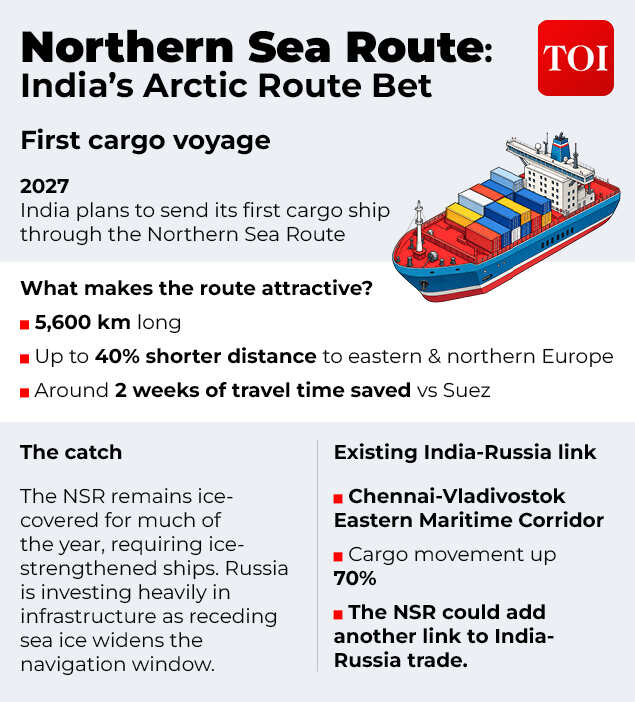
Northern Sea Route: India’s Bet on Arctic Route
Agneshwar Sen, Trade Policy Leader, EY India says India is interested in any route that reduces dependence on chokepoints such as Suez, Hormuz, Malacca.“Thus, it is really a combination of economics and the need for supply chain resilience. The NSR, for selected Asia-Europe trade, can reduce sailing distance by roughly 30-40% compared with the Suez route,” he explains.But distance is not the only factor, the biggest constraint will be the cost of shipping and associated risks.Ice-class vessels, icebreaker support, insurance, navigation constraints and seasonality can offset a significant part of the savings, Sen tells TOI.Bhavik Vora of Grant Thornton Bharat is of the view that the NSR could alter the economics and resilience of India’s trade with Russia and selected European markets by providing a shorter maritime connection for certain origin-destination pairs.However, he notes that its relevance will differ considerably between India-Russia and India-Europe trade.“For India-Russia trade, the NSR complements rather than replaces India’s other connectivity initiatives, including the Chennai-Vladivostok Eastern Maritime Corridor and the International North-South Transport Corridor. The route could improve access to Russia’s northern and Arctic regions and support the movement of energy, minerals, and other bulk commodities,” Bhavik Vora says.This is particularly relevant given the scale and composition of bilateral trade: India–Russia trade was $59.9 billion in FY2025–26, of which Indian imports were $55.4 billion.
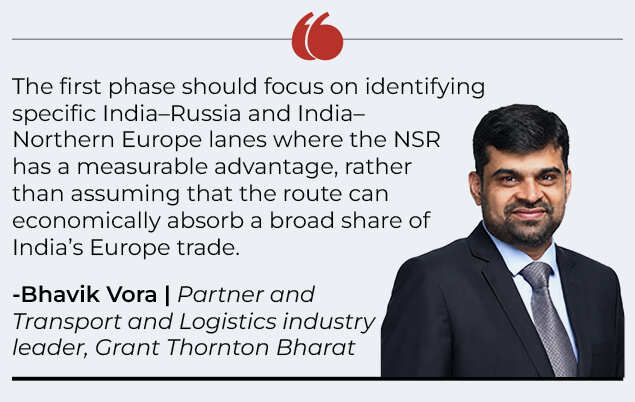
What Bhavik Vora from Grant Thornton Bharat said
Russian supplies to India include petroleum products, fertilisers, coking coal, and vegetable oils, while Indian exports include pharmaceuticals, chemicals, iron and steel and marine products.According to Vora, for Europe, the opportunity is more selective.“The NSR is naturally better suited to northern European destinations than to the whole of Europe, and its distance advantage is therefore highly dependent on the specific port pair,” he tells TOI.Commercial activity in 2026 is beginning to demonstrate this potential. A Chinese operator has launched a scheduled Arctic container service from Ningbo to Felixstowe, with eight sailings planned for the 2026 season and an expected transit of around 20 days. The service is scheduled to operate from August through October.“The strategic implication for India is that the NSR could eventually form part of a multi-corridor trade architecture, where shippers select between Suez, the Cape route, the NSR and land-based corridors depending on cost, time, security, and cargo characteristics. It should not, however, be treated as a risk-free alternative. The NSR introduces its own dependencies, particularly on Russian infrastructure and regulatory arrangements,” he cautions.
Why it’s important
The biggest factor and benefit is route diversification for trade, which has become important in today’s uncertain geopolitical and trade environment. It is key to supply chain resilience.“This is also consistent with the broader India-Russia approach to connectivity. The two countries have explicitly identified the Chennai-Vladivostok Eastern Maritime Corridor, the INSTC (where India has Chabahar port included as an alternative to Bandar Abbas) and the potential of the Northern Sea Route as complementary elements of a more diversified Eurasian transportation architecture,” EY’s Sen says.According to Agneshwar Sen, NSR can have a significant impact on the energy and bulk cargo side since it shortens the route between Russian Arctic/ Far East ports and India, complementing the Chennai-Vladivostok Eastern Maritime Corridor and the INSTC, and gives India a third artery for crude, LNG, coal and fertiliser.For India-Europe trade, the benefits may be more long-term. While the NSR would in principle cut sailing distance to northern Europe by up to 40% and transit time by about two weeks versus Suez, it isn’t as yet a corridor for the India-Europe container or general cargo trade, which needs reliable, high-frequency, container-ready service, he says.For India, therefore, the immediate strategic value of the NSR is not a cheaper route but that it can provide an additional routing option for specific trade flows.“Building that option has value in itself as global trade becomes more exposed to geopolitical and infrastructure-related disruptions,” says Bhavik Vora.
NSR Constraints & What They Mean For India
But, what prevents the Northern Sea Route from becoming a full-time substitute is its seasonality. So, its role as a substitute for the Suez Canal is limited, feel experts.The thick ice in the Arctic region means that specialised ice-strengthened vessels and nuclear-powered icebreakers are required for navigation through it.
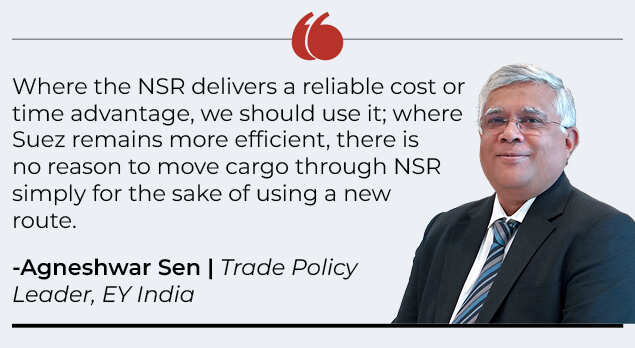
What EY’s Agneshwar Sen said
High operating costs, safety concerns, sanctions, limited infrastructure and environmental risks remain significant constraints. Shrinking summer sea ice is widening the navigation window, but experts caution that the NSR cannot currently substitute for Suez or Hormuz.Three structural constraints keep the role limited according to the EY expert:(i) navigability is still limited to a few ice-free months without heavy icebreaker escort, versus Suez’s year-round, weather-independent service;(ii) the NSR is used for bulk and tanker cargo, not the container liner traffic that dominates India-Europe trade, and container infrastructure/ ports along the route are thin;(iii) sanctions risk, which limits the pool of vessels and underwriters willing to service it.“Nonetheless, it can become a meaningful supplementary corridor for specific bulk commodities and a hedge against Suez/Red Sea disruption, but “Suez alternative” implies scale and reliability the NSR currently doesn’t offer,” Agneshwar Sen says.As Bhavik Vora concludes: The NSR is moving beyond the stage of being purely experimental, but it is still too early to consider it a substitute for Suez. The more credible scenario is that it develops into a complementary corridor for selected trade lanes and cargo categories, especially from the Asian part of Russia.Scale remains the principal constraint. Major shipping companies are beginning to selectively restore Suez services as security conditions improve. This means the NSR cannot rely indefinitely on disruption to Suez to generate demand.“For the route to become structurally relevant to India, it will need to demonstrate competitive economics and sufficient reliability even when conventional routes are operating normally. Its likely role over the medium term is therefore a seasonal and strategically valuable alternative rather than a replacement for Suez,” he says.