
Dutch scientists built a tiny robotic arm using living algae and two layers of gel; controlled by light, the two-centimetre strip grasped a metal ball and lifted a rubber ring underwater without a conventional motor

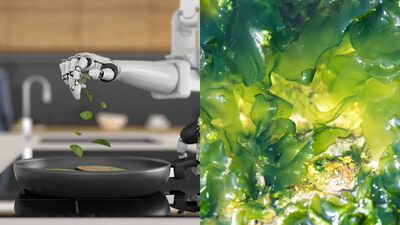
Think of a robot without battery, without traditional motor and without complicated mechanical joints and only living microalgae, soft gels and source of light. That’s the unusual premise of a new experiment by researchers at Delft University of Technology in the Netherlands, who have constructed a miniature actuator that can bend, grasp and lift objects underwater. The work offers a glimpse of such a future, where living organisms could become an active part of the robotic systems. Scroll down for more.
Living cell robot
Phys Org reports that the soft robotic strip is tiny, about two centimeters long and one millimeter thick, but its movement is surprisingly sophisticated. The actuator consists of two layers of hydrogel that respond differently when the chemical environment changes and microalgae grow over the surface of the actuator, the research report says.The report, published by Nature Communications, states the device utilizes the biological activity of the algae to generate movement rather than a traditional motor. They photosynthesize in the presence of light, converting light and carbon dioxide into energy. They also use nitrogen to grow their cells. This activity changes the chemical environment inside the hydrogel. The result is a change of pH which causes different degrees of swelling of the two gel layers. That imbalance makes the strip bend and curve.
The control system is lightweight
By simply changing the lighting conditions, the researchers can control the movement, the study report from Phys Org and Nature Communications says. When the light is turned off, the biological processes inside the algae change the pH in the opposite direction and the actuator starts bending back.This is quite a quick response, the strip beginning to move back in the opposite direction in about 10 seconds. This gives the little device a kind of biological control system. Instead of sending electrical signals to a motor, researchers can use light to induce a physical response generated through the metabolism of living organisms.
From bending to taking
The researchers wanted to see if this movement could do more than just demonstrate an unusual biological response, according to Nature Communications. For the underwater experiments the actuator was designed for simple manipulation tasks, such as hooking and lifting a rubber ring and grasping a small metal ball.Such motions could eventually be useful in situations where gentle handling is important. Soft robotic structures could more flexibly interact with fragile objects and changing environment than rigid mechanical systems.The technology could also result in devices that imitate movements found in nature. Light responsive mechanisms could someday be used for things like blinds that can change their orientation automatically or agricultural systems that can change their position based on environmental conditions.
Building robots using biology
The experiment’s importance is beyond its tiny scale. The researchers are investigating a wider region where living cells are incorporated directly into functional materials, enabling biological processes to yield useful mechanical behavior.Microalgae are of particular interest since they can use light as an energy source by photosynthesis. This opens the way to soft robotic systems that need less conventional external energy, but practical applications are a longer-term prospect.The research, published in Nature Communications, is an early proof of concept, not a ready-to-use robotic technology. But it points to an interesting direction in engineering: machines that don’t just copy biology, but actually collaborate with living things to move.Inside this tiny underwater arm, light does more than illuminate; it is the signal that converts biological activity into motion.Images Courtesy: istock


