
Delhi Gig Workers: High-risk delivery: Why 1 in 3 gig workers feels unsafe on Delhi roads | Delhi News


NEW DELHI: The delivery rider rushing past a red light, the bike weaving between cars, the cab driver stuck in traffic with another trip waiting on the app. For Delhi’s gig workers, the city’s roads are not just the route to work; they are the workplace. And very often, a hazardous one.The “Occupational Safety and Health of Platform-based Gig Workers in India: Report on a Nationwide Survey”, conducted by Janpahal NGO and Gig Workers Association of India and released Thursday, examined the working conditions of food and grocery delivery workers, ride-hailing drivers, e-commerce delivery personnel and workers engaged in household and personal care services.
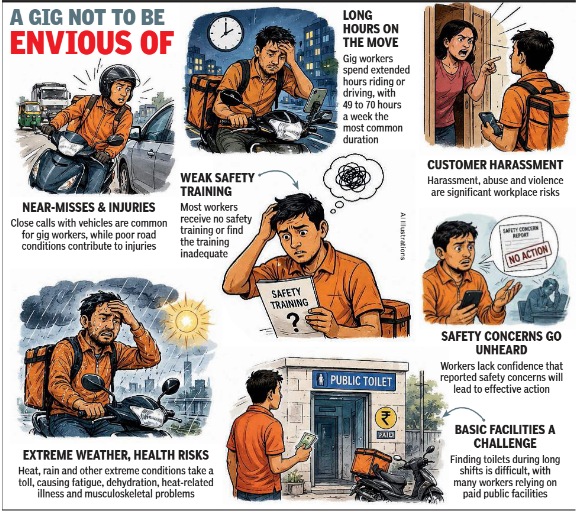
A gig not to be envious
Dharmendra Kumar, secretary of Janpahal, said the survey is important because it examines issues that are often overlooked: “Protecting workers must go beyond accident prevention. Extreme heat and lightning also need to be recognised as occupational safety and health risks.”While the study covers 10 cities, Delhi-specific data shows how exposed workers who spend much of their working day on the road are to occupational risks. Nearly three-fourths of respondents said they felt unsafe while travelling on the roads for work, while only 5% said they felt safe.The risks went well beyond a close call at a traffic signal. More than four in five respondents said they had experienced a near-miss with another vehicle, making it the most commonly reported incident. More than half said they had suffered an injury due to road conditions, while over a third reported having been involved in a traffic accident.For workers who spend hours riding or driving through the city, potholes, speeding vehicles and chaotic traffic are not occasional inconveniences, but occupational hazards. The survey found 76% frequently or very frequently encountered unsafe conditions while working.The pressure is compounded by long working hours. The most common working duration reported was 49 to 70 hours a week.The risks do not end on the road. Customer harassment or behaviour accounted for 30% of reported incidents. More than half of the respondents said they had personally experienced harassment, abuse or violence while working, while another 16% had witnessed it happening to another worker.Yet the safety net for workers appears thin. About 97% said they either received no safety training or found it insufficient. Only 1% said their platform provided comprehensive safety training or resources.When something does go wrong, workers are also unsure where to turn. As many as 81% were not confident their platforms had effective channels to report safety concerns and ensure follow-up. More than half said they received no health support, while 92% reported having no health insurance or not having claimed it.Delhi’s weather adds another layer to the risks. When the temperature soars, the orders don’t stop. While 98% of respondents said they had worked in extreme heat, nine in 10 had worked in extreme cold, and 64% had worked during heavy rain or thunderstorms.For 86%, extreme weather had a moderate to major impact on their ability to work safely. Nearly 89% said their platforms provided no policy for working during extreme weather. Workers reported changing routes, wearing weather-appropriate gear and cutting down their working hours to cope. For those paid according to trips or deliveries, however, spending fewer hours on the road can also mean fewer rupees at the end of the day.The weather left a mark on health too. Almost all respondents reported musculoskeletal problems such as back or neck pain, while 97% reported fatigue or sleep disruption. Dehydration was reported by nearly 89%, heat exhaustion by almost 79% and heat stroke or severe overheating by about 76%.Even basic workplace needs, such as finding a toilet during a long shift, can be a challenge. One-third of respondents said they rarely or never used toilet facilities during working hours. Among those who had access, 75% said they used paid public toilets.The report seeks stronger rights and safety protections for gig workers, including basic facilities, climate safeguards, worker participation, safety training, grievance redressal and insurance, while urging greater accountability from digital platforms.


