
China moved 64 rare Milu deer to a reserve in 1993 and 1994, but a 1998 flood sent 36 into the wild, where their population topped 500 | World News
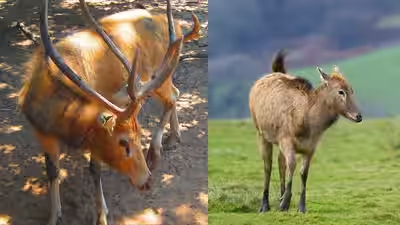
The Père David’s deer, or Milu, had disappeared from the wild in China by the early 20th century, making its later return an unusual conservation story. In 1993 and 1994, 64 Milu were transferred to the Hubei Shishou Milu National Nature Reserve, an island reserve along the Yangtze River. Then, during a severe flood in May 1998, 36 animals escaped and crossed the swollen river. What followed was an unexpected experiment in natural re-wilding, as the deer found new habitats, bred and gradually established populations beyond the reserve.
Why 64 rare Milu were returned to the Chinese reserve
The Milu, scientifically known as Elaphurus davidianus, is native to China and is particularly adapted to wetland environments. The species had once been widely distributed around the middle and lower reaches of the Yangtze River, but habitat loss, hunting and climate change contributed to its disappearance from the country around the beginning of the 20th century. According to the study titled ‘Stepping-stones and dispersal flow: establishment of a meta-population of Milu (Elaphurus davidianus) through natural re-wilding’ conducted by Institute of Zoology, Chinese Academy of Sciences, China, the reintroduction efforts began with animals brought from England to Beijing Milu Park in 1985. In 1991, Hubei Shishou Milu National Nature Reserve was established on an island in the Yangtze. A total of 64 Milu were subsequently transferred there from Beijing Milu Park during 1993 and 1994.
A 1998 flood changed the course of the reintroduction
For several years, the Milu remained within and around the reserve, occasionally attempting short movements into surrounding areas. That changed dramatically in May 1998, when the Yangtze experienced heavy flooding. A herd of 36 Milu escaped from the reserve and swam across the flooded river. Researchers later recorded that the animals could not simply be driven back because they had moved into swampy areas. Instead, the escape became the starting point for a naturally developing population outside the protected reserve. The researchers monitored the animals through regular surveys, recording their movements, numbers, habitats and subsequent dispersal between suitable areas.
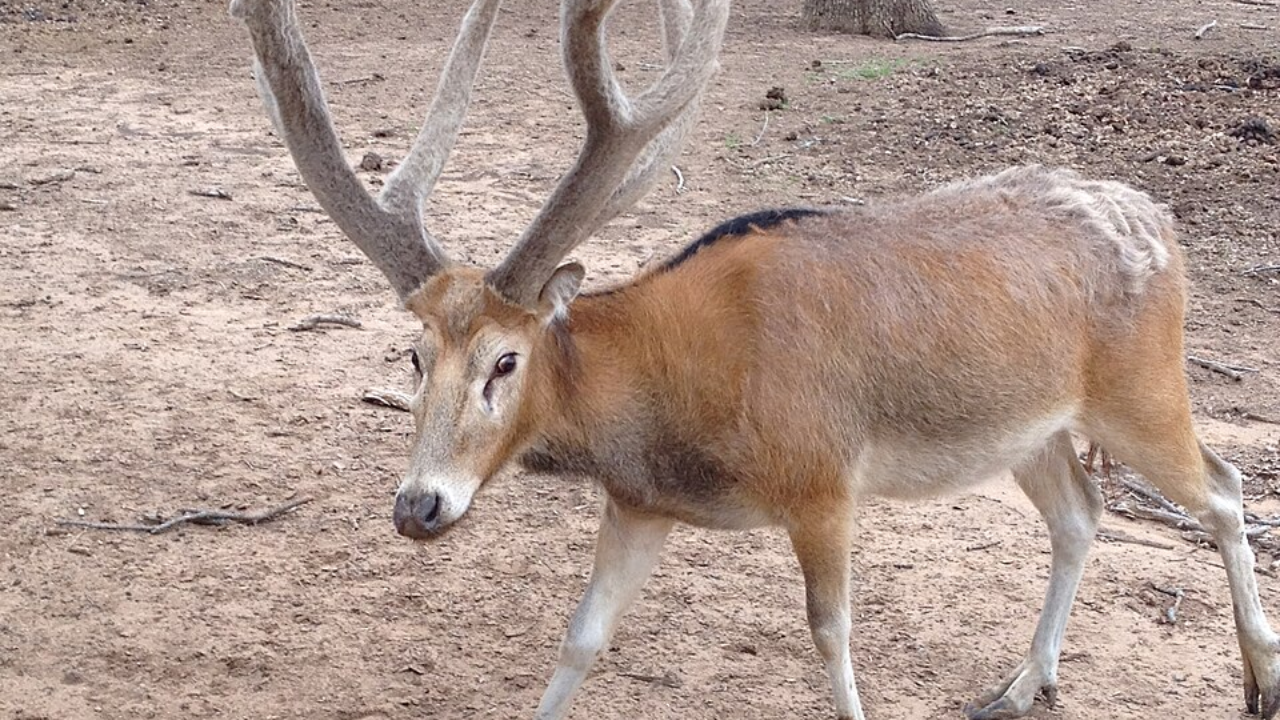
Père David’s deer (male) at Sharkarosa Ranch, 2014 (Image: Carrotsnmysox)
The escaped deer found ‘stepping stones’ across the landscape
The escaped Milu did not simply remain in one location. They moved between suitable patches of habitat, using what the researchers described as “stepping stones,” areas that provided food and shelter within a landscape otherwise unsuitable for continuous movement. Some of these places became refuges where the deer stayed and reproduced. Between 1995 and 2012, researchers recorded 122 dispersal events involving the escaped Milu. Most dispersal events occurred in 1998, 2003, 2006 and 2010, while the average dispersal distance was about 14.08 kilometres. More than 91% of recorded movements were shorter than 25 kilometres.
The population eventually exceeded 500 via natural re-wilding
The accidental escape ultimately produced a notable example of natural re-wilding. The researchers found that the escaped Milu successfully established populations and reproduced in the wild. By the end of 2009, the number of naturally re-wilded Milu and their descendants had exceeded 500. The population later declined during a disease outbreak in February and March 2010, while by the end of 2012 around 300 wild Milu were scattered across refuge populations on the eastern and southern edges of Dongting Lake. The study concluded that floods and human disturbance helped trigger dispersal, while population density was an important underlying driver.