
CEO’s exit to end uncertainty at HDFC
MUMBAI: Sashidhar Jagdishan’s decision to step down as HDFC Bank’s MD & CEO is set to remove a layer of uncertainty around the leadership of the country’s second-largest bank, giving the board and the incoming chief executive a clear runway to execute an ambitious plan to build a bank of global scale.Jagdishan will retire from the bank on Oct 26 after deciding not to seek reappointment. The decision comes at a point when HDFC Bank is emerging from one of the most consequential periods in its history, having completed its merger with HDFC and begun recalibrating its business and growth strategy for the post-merger phase.His departure allows the board to make a clean leadership transition without the possibility of an unresolved succession question continuing to hang over the institution. The new chief executive, whether chosen from within the bank or brought in from outside, will inherit a platform that has already undergone the disruption and integration associated with the merger and can focus on execution rather than managing a prolonged transition. Kaizad Bharucha, deputy MD, who has been on the board for 12 years, is seen as an internal frontrunner.
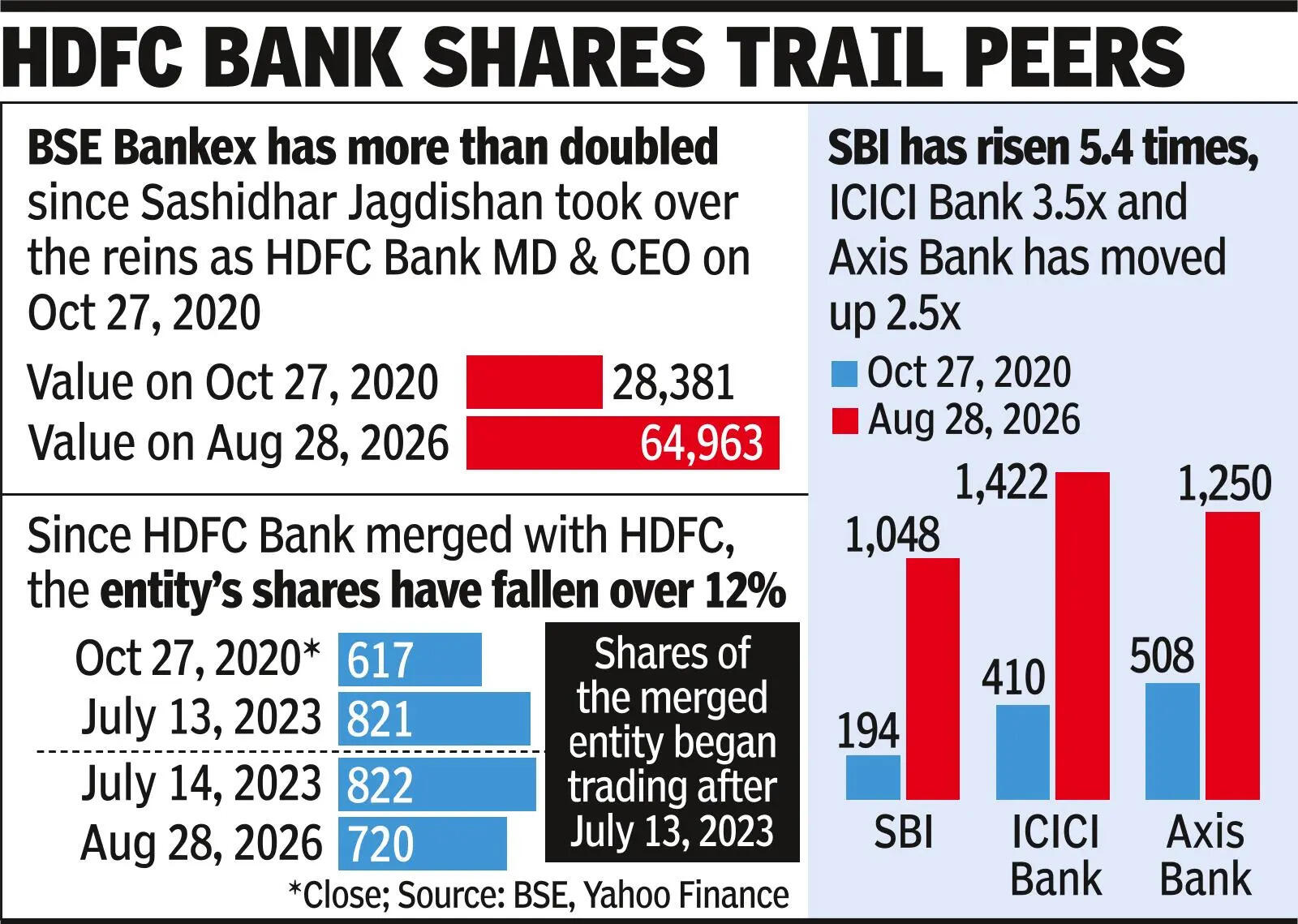
Over the last few weeks, several issues have been resolved: from the appointment of a new chairman in Rajeev Kumar to acting against the problems with “mis-selling” in Dubai, as well as penalties on executives, including Jagdishan, in the Maharashtra PSU case, where irregularities in raising deposits were brought to the fore.The timing is particularly important because HDFC Bank is now a substantially larger and more systemically important institution. With a balance sheet of about half a trillion dollars and around 100 million customers, the bank has become an increasingly important part of the Indian financial system. Its scale also means that scrutiny of its operations, governance and performance is unlikely to diminish.The challenge for the incoming chief, therefore, will be more about converting its scale into sustained growth and improving performance. The bank has a large distribution network, a massive customer base and a technology architecture that provides the foundation for the next phase of expansion.The post-merger recalibration had also created a period in which growth, margins and the business mix came under greater scrutiny. As the effects of the merger and the associated base effects fade, the focus is likely to shift towards how effectively the bank can use its distribution advantage, technology investments and changing business mix to accelerate growth and improve returns.This gives the succession process an unusual character. The incoming CEO does not necessarily need to rebuild the bank or undertake another fundamental transformation. The task is to run the existing platform more effectively, sharpen execution and pursue the board’s larger ambition of making HDFC Bank one of the world’s top banks.According to board-level sources, the bank has considerable management depth to draw upon, leaving open the possibility of an internal candidate taking over or the appointment of an external executive who can bring a fresh perspective. Either route would benefit from the clarity created by Jagdishan’s decision not to seek another term.For investors, the transition could therefore mark the end of one chapter rather than the beginning of another period of uncertainty. Jagdishan’s tenure was dominated by the challenge of integrating HDFC Ltd with HDFC Bank, while the next phase is likely to be judged increasingly on growth, profitability, technology and the ability to translate the combined institution’s scale into a globally competitive banking franchise.