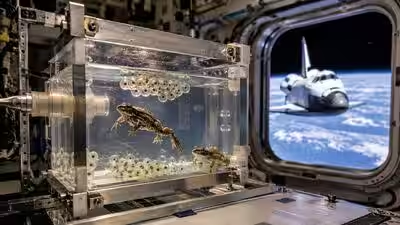
Japan’s abandoned rice fields are being restored into year-round wetlands to replenish groundwater and bring back frogs, dragonflies and endangered aquatic wildlife

A restored wetland area surrounded by our Natural Water Sanctuary. (Picture source: Suntory) For years, many rice fields in Japan have been left unused as fewer people continued farming and rural communities grew older. Without regular care, many of these fields became covered with weeds. The frogs, dragonflies and other small animals that once lived…

Read More

Chicago-sized iceberg A-84 breaks away from Antarctica: Scientists warn melting ice could raise sea level and threaten coastal cities from New York to Mumbai |

Image Credit: Alex Ingle/Schmidt Ocean Institute. In January 2025, a massive event occurred at the Antarctic that changed what we know about life in the extreme cold. An iceberg the size of Chicago, named ‘A-84,’ broke away from Antarctica’s George VI Ice Shelf. As this massive block of ice, roughly 19 miles long and 11…

Read More

Dutch cities are replacing solid concrete surfaces with grass-filled paving blocks that absorb rainwater and help keep urban areas cooler |

Cities in the Netherlands are experimenting with a greener approach to urban surfaces by using grass-filled permeable paving blocks in places where conventional sealed concrete or asphalt might otherwise be used. These specially designed blocks contain open spaces where grass can grow, while gaps in the surface allow rainwater to pass through rather than immediately…

Read More

Scientists discovered a plastic-eating fungus in the Amazon rainforest that survives without oxygen and could one day help tackle landfill waste worldwide |

Deep within the Ecuadorian Amazon rainforest, scientists discovered a fungus with an extraordinary ability that could offer new clues in the fight against plastic pollution. Known as Pestalotiopsis microspora, the fungus can break down polyester polyurethane, a widely used type of plastic, and use it as a source of carbon. Even more remarkably, laboratory research…

Read More

American scientists created a flexible solar ‘skin’ that stretches like fabric and follows the Sun to capture more energy |

Traditional solar panels have transformed renewable energy, but they come with one major limitation, they are rigid, heavy and designed to sit on flat surfaces such as rooftops or solar farms. That makes them difficult to install on curved buildings, lightweight structures or unconventional designs. Researchers in the United States are now working on a…

Read More

Japan scientists developed a fabric that blocks heat-producing infrared light while letting crops receive the sunlight they need for photosynthesis |

As climate change drives temperatures higher, farmers are facing a growing challenge: protecting crops from extreme heat without reducing the sunlight they need to grow. Conventional shade nets can lower temperatures, but they also block visible light, limiting photosynthesis and potentially affecting yields. Researchers and engineers in Japan believe they have found a better solution….

Read More

Scientists are turning air filters into DNA collectors that can detect traces of wildlife, viruses and human activity from particles floating in the air

Air filters trap biological particles along with ordinary dust and pollution, allowing laboratory sequencing to reveal environmental DNA Every breath you take carries an invisible record of the living world, and scientists have discovered a way to read it using ordinary air filters.By studying the tiny particles trapped inside standard air-quality monitoring equipment, researchers can…

Read More