
In 1977, a Saudi prince towed an Alaskan iceberg to Iowa to pitch shipping icebergs to Arabia for drinking water; now engineers are exploring the idea as freshwater scarcity worsens

The royals across the world are known to pull numerous extravagant moves with an aim to impress. While Cleopatra made guests dine on gold plates, King Henry VIII of England and King Francis I of France built temporary palaces of brick and glass for a meeting. But in modern times, such grand gestures have been…

Read More

In 1868, a solar eclipse in India revealed a mysterious element in the Sun that would not be found on Earth for 27 years |

In August 1868, the Sun briefly became a laboratory for astronomers gathered in India to watch a total solar eclipse. Among them was the French astronomer Pierre Jules Janssen, who turned a spectroscope towards the bright prominences rising around the eclipsed solar disc. Their light contained a yellow spectral line that seemed to sit close…

Read More

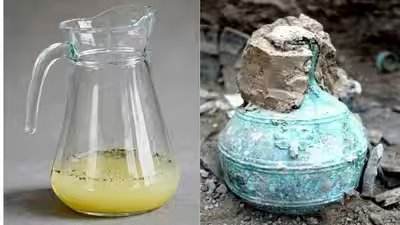
2,300-year-old beer, well preserved inside an ancient bronze bottle containing nearly a gallon of liquid with more than 2,400 chemical compounds, was discovered by archaeologists |

Archaeologists in China have uncovered an extraordinary alcoholic drink that remained remarkably well preserved for more than 2,000 years inside an ancient bronze bottle. The vessel, recovered from a Qin-period tomb at the Shanjiabao cemetery in the Ningxia Hui Autonomous Region, contained about 3.74 litres of pale blue-green liquid, equivalent to nearly a gallon. Scientific…

Read More

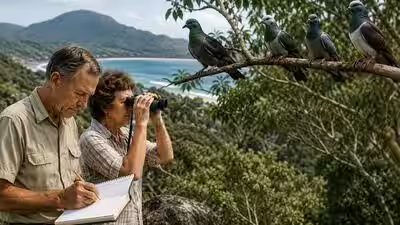
In 1965, a couple began counting pigeons in Queensland. Three years later, numbers fell from 4,692 to 1,451, beginning a 60-year conservation story |

A couple, Margaret and Arthur Thorsborne, travelled north from Queensland’s Gold Coast to Hinchinbrook Island, a place they knew largely through photographs. They would return many times, eventually making the Cardwell area their home and becoming closely associated with its forests, wetlands and wildlife. Among the animals that caught their attention were pied imperial-pigeons, which…

Read More

Meet Sirish Subash: The 14-year-old who invented an AI-powered pesticide detector for fruits and vegetables and won $25,000 |

A 14-year-old Georgia student has turned a common kitchen concern into an award-winning science project. Sirish Subash, a ninth grader from Snellville, built PestiSCAND, a handheld device designed to detect pesticide residues on fruits and vegetables. As reported by USA Today, his invention earned him the title of America’s Top Young Scientist in October 2024,…

Read More

German scientists made a sponge-like material that pulls drinking water from air as dry as 18% humidity, producing up to 1.8 litres per kg each day |

Representative Image of water harvesting technology collecting and storing water (AI-generated image) Researchers at Kiel University in Germany have developed a highly porous material that can pull drinking water directly out of dry air, offering a possible lifeline for regions where rainfall is becoming less reliable. The material, known as CAU-10-H, behaves like a sponge,…

Read More

Quote of the day by Benjamin Franklin: “What is more valuable than gold? Diamonds. Than diamonds? Virtue.” |

Benjamin Franklin (Image: Wikipedia) Two people can spend a lifetime accumulating whatever they consider valuable and end up with completely different kinds of wealth to show for it. One collects money, property, and possessions, each one clearly priced, each one able to be counted. The other spends that same effort building something that resists being…

Read More

America is turning decades-old radioactive waste into strontium-90 power systems that could keep underwater sensors running for decades |

America is quietly building a network of nuclear-powered nodes on the ocean floor that could charge drone submarines for close to three decades without a cable, a support ship or a single resupply run. The fuel behind this project is strontium-90, a radioactive by-product that has sat in government storage for decades, and the Pentagon…

Read More

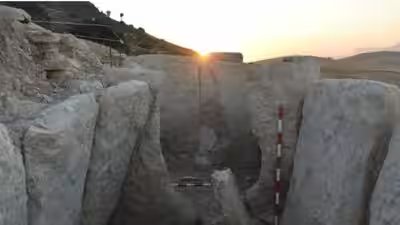
Archaeologists in Málaga uncovered a 13-metre megalithic tomb more than 5,000 years old; ivory, amber and seashells point to long-distance exchange networks

Photo credit: University of Cádiz Archaeologists working near Teba in Málaga, southern Spain, have uncovered a remarkably well-preserved megalithic tomb that is more than 5,000 years old. Announced by the University of Cádiz, the structure, known as Dolmen I of the La Lentejuela necropolis stretches about 13 metres, or roughly 42 feet, and contains multiple…

Read More