Why has Britain’s grass turned yellow? Scientists warn about the future of the island after ‘driest month ever’

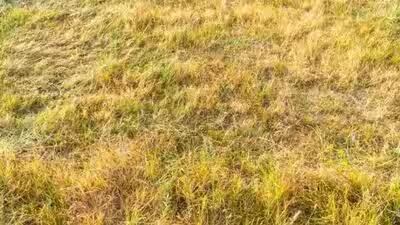
Britain’s fields, parks and lawns were thriving areas of fresh greenery, just before summer arrived. Then, everything was burnt to a crisp, with a yellow and golden hue and now landscapes as old as thousands of years have been revealed as green outlines against yellow backgrounds.July was the driest month ever recorded in England and…

Read More

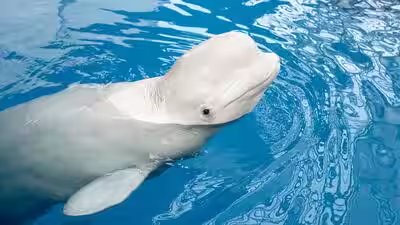
In 2001, scientists tested 4 beluga whales at a New York aquarium; 98 sessions later, it was found the Arctic whales may recognise themselves

In the quiet pools of the New York Aquarium, a groundbreaking experiment was unfolding. It was 2001, and a team of scientists was about to test a question that had long fascinated researchers: could beluga whales, the white Arctic cetaceans known for their expressive faces and complex social lives, recognise themselves in a mirror?Over the…

Read More

A stark warning for today’s climate

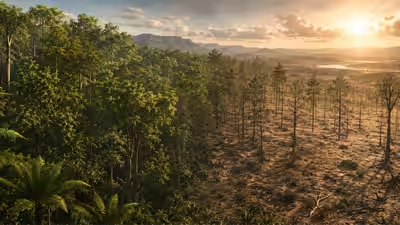
Fossils from Wyoming are revealing how forests responded when Earth experienced one of its most intense episodes of global warming around 56 million years ago. A new study, published in the journal Science on August 13, 2026, reconstructs the structure of forests during the Paleocene-Eocene Thermal Maximum, or PETM, and finds that their canopies became…

Read More

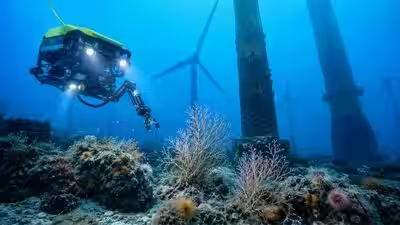
A robot explored the waters beneath 5 Scottish wind turbines and found 121 types of marine life, including possible young deep-water corals

A robotic submersible descended beneath 5 giant floating wind turbines off Scotland, moving around steel structures, cables and anchors that sit as much as 80 metres below the surface. Its high-definition camera recorded a surprisingly busy underwater community at the Hywind Scotland Pilot Park, about 25 kilometres east of Peterhead. Across 41 structures and associated…

Read More

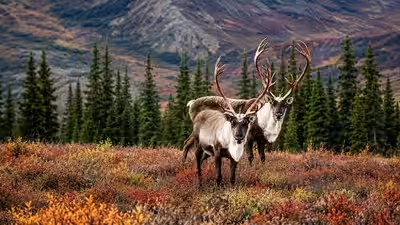
Alaska’s tundra looks like frozen ground, but beneath it lies ancient carbon a climate warning worth $43 trillion

Inside Alaska’s tundra (Image: Alaska Organisation) From above, Alaska’s tundra can look like an ordinary expanse of soil, moss and low vegetation. Beneath that surface, however, lies permafrost, ground that has remained frozen for long periods and contains vast quantities of ancient organic material. As temperatures rise, that frozen material can thaw and begin decomposing,…

Read More

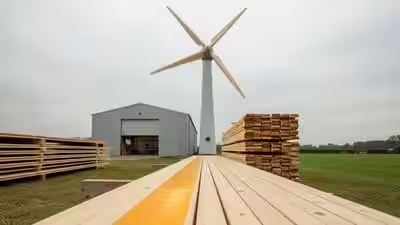
German startup Voodin replaced fibreglass with laminated veneer lumber in 19.3-metre turbine blades; its new EU-backed factory targets fully recyclable blades at commercial scale

When you look at wind turbines the blades look larger than life. Like permanent, monumental objects that will turn forever above the same field, long after you are gone and someone else is looking up at them similarly. In reality, most wind turbine blades last only 20 to 25 years and when they stop spinning,…

Read More

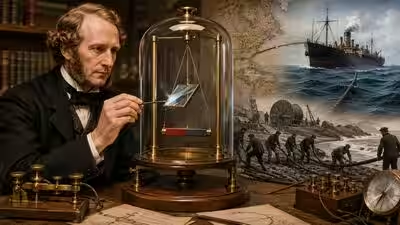
In 1854, William Thomson used a tiny mirror on a suspended magnet to help solve the problem of sending telegraph signals across the Atlantic

In the middle of the 19th century, sending a message across the Atlantic was still a distant ambition. Telegraph lines had already begun shrinking distances on land, but an ocean presented a different problem. A signal travelling through thousands of miles of cable could arrive so weak that ordinary instruments struggled to detect it. William…

Read More