
A 1,700-year-old inscription found at a Mithras temple mentions Jesus Christ and may show how Christianity overtook a mysterious Roman cult

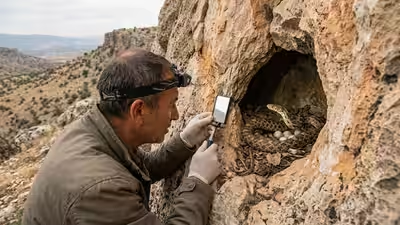
Archaeologists have deciphered a 1,700-year-old inscription at an ancient Roman temple in Turkey that offers rare written evidence of the shift from Mithraism to Christianity during the Roman period.The inscription was found at an underground Temple of Mithras inside Zerzevan Castle, a Roman fortification about 40 miles from the Syrian border. It was written in…

Read More

Scientists tried to thicken Arctic ice by pumping seawater onto it. The ice did become thicker and brighter, but there is a big catch

Sea ice melts on the Franklin Starait (AP file photo) Scientists have tested an idea that could help reduce the melting of Arctic sea ice, and the initial results are promising. The method involves spraying of seawater onto existing sea ice in winter and letting it freeze into a new layer.The on-site experiment took place…

Read More

NASA’s Voyager 1 left Earth in 1977; now its signal takes over 22 hours to reach us and it is still sending data

Representational photo of Voyager When NASA launched Voyager 1 in September 1977, it was expected to explore the outer planets before continuing its journey into deep space. Nearly 49 years later, the spacecraft is still continues to send information back to Earth from about 25 billion kilometres away, making it the most distant human-made object…

Read More

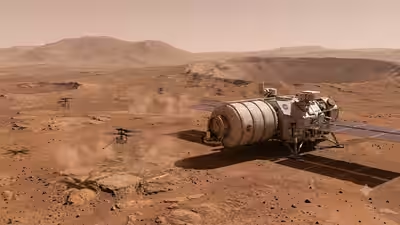
AI’s cooling crisis: Why future data centres in space may not need a single drop of water |

Artificial intelligence is driving an unprecedented surge in demand for computing power. Still, the data centres behind today’s most advanced AI models face a growing challenge: keeping millions of processors cool without consuming vast amounts of energy and water. On Earth, cooling systems can account for a significant share of a facility’s electricity use while…

Read More

A new island rose from the sea in Iceland in 1963, but everyone except scientists is banned from setting foot on it: Here’s why |

A barren stretch of volcanic rock rising from the Atlantic Ocean may not sound like one of the world’s most protected places, yet almost nobody is allowed to set foot on Iceland’s Surtsey island. There are no permanent residents, hotels or tourist attractions, and even scientists need special permission to visit. The reason lies in…

Read More