
Ancient Footprints Suggest Gender-Based Labor Division in Early Human Society |
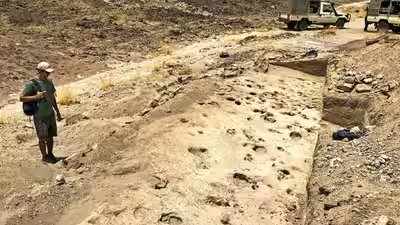
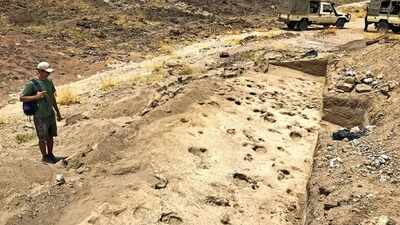
Once in a while, a simple discovery in the dirt changes everything. That’s what happened when scientists found a string of ancient footprints locked into what used to be a muddy lakeshore in Kenya. Per a study published in the Proceedings of the National Academy of Sciences, these tracks, some even going back 1.5 million years, offer a rare snapshot of everyday life among our early human relatives. And what stands out is something unexpected: it looks like adult men and women walked and worked in different groups, hinting at a division of labor way before anyone thought it existed.
What does the study say
Bones and stone tools tell you a lot about who our ancestors were, but footprints show what they were doing, right in the middle of it. You can almost picture it: who walked with whom, how fast they moved, and where they were headed that day. At Koobi Fora, on the shores of prehistoric Lake Turkana, researchers found hundreds of well-preserved tracks, mostly made by Homo erectus, one of our earliest ancestors.For the unversed, the site was first discovered in 1978 but was substantially expanded in 2016 and again in 2023, revealing far more tracks than previously known. The tracks record at least eight individuals who crossed a shallow lakeshore, leaving behind evidence of their anatomy, walking style, and possible behavior.In their research, Dr. Kevin Hatala, a researcher at Chatham University and the Max Planck Institute for Evolutionary Anthropology, and his colleagues analyzed 21 hominin tracks uncovered at the site of GaJi10 in the Koobi Fora Formation in the Turkana Basin.“The sizes of the footprints indicate human-like body sizes — up to 1.8 m (5.9 feet) tall and around 75 kg,” said Dr. Hatala.“One trackway is oriented to the east while all other tracks and trackways are oriented toward the west,” the researchers noted. “It is possible that the east-bound individual is also sampled in the west-bound tracks, but evidence to make that determination is lacking.”
What do the footprints reveal?
Now, the fascinating thing about footprints is how quickly they capture a moment. Unlike bones, which pile up over eons, these prints were probably made within the span of a few hours or days. So instead of a collection of scattered remains, you get an instant photograph of who was there, almost like a freeze-frame out of time.The footprints preserve the internal architecture of ancient feet in enough detail to compare them with tracks already attributed to two hominin species known to have lived in the region at the time: Homo erectus and Paranthropus boisei.Studying the size, spacing, and direction of these prints, scientists noticed something odd. Bigger footprints, likely from adult males, bunched together heading the same way. Smaller ones (probably women and young people) clustered off in other groups, sometimes going in different directions. It wasn’t just a random mess of tracks; there seemed to be an order. The idea is that men may have traveled together, maybe searching for food or keeping watch over territory, while women and kids took on different jobs: perhaps gathering, tending to each other, or moving at their own pace.Now, it’s not always easy to tell who left which print. Researchers estimated the sex and age by the size of the footprints, since Homo erectus males were noticeably bigger than females. There’s always some wiggle room with these guesses, but the pattern is pretty clear.“The fact that eight, mostly adult male, Paranthropus boisei individuals seemingly traveled together as a group, without females or children, hints at a complex social structure in this species,” said Dr. Neil Roach, researcher at Harvard University. “They may have lived in large groups, where males competed for mates, but also tolerated each other at times for safety in a dangerous environment.”
Why does it matter
If this interpretation holds, it could mean that the idea of splitting jobs by sex is much, much older than we thought. Anthropologists have long debated when humans first divided up hunting, gathering, and childcare. Most clues have been indirect (think tools, leftovers from meals), but here, the prints actually show the group in action.“The discovery of these fossil footprints along the margins of Lake Turkana reinforces the region’s global importance in understanding human evolution, preserving remarkable evidence of how our ancient relatives lived 1.4 million years ago,” said Dr. Purity Kiura, a researcher at the National Museums of Kenya.What’s next?To be fair, not everyone’s sold on this idea. Some scientists point out that it’s tricky to know for sure if these groupings were really about gender, or if the groups formed for some other reason. Weather, the opportunities of the day, or even just chance could play a part. Plus, guessing someone’s sex based just on footprint size isn’t perfect; there’s always overlap.Even so, the discovery’s a game-changer. Just by analyzing where ancient feet landed in the mud, researchers can see not only what our ancestors looked like, but also how they lived: who stuck together, who wandered off, and how they might’ve divided up the day’s tasks.What’s more? Koobi Fora also turned up footprints from Paranthropus boisei, another ancient human relative, which means these early humans weren’t alone; they were sharing space with other species. Every footprint has a story, often richer than what you find in bone.