
A signal from beyond: Astronomers detect radio waves from planet 63 light-years away for first time
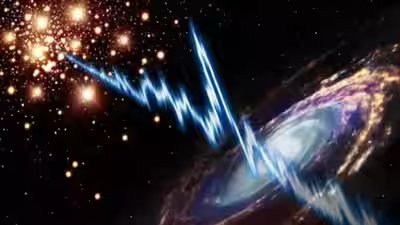
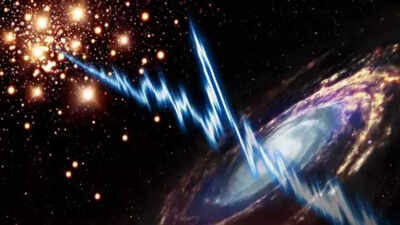
A mysterious radio signal from deep space has astronomers asking a big question: is someone out there trying to say hello?The answer, however, is far less sci-fi and much more magnetic.Astronomers have detected radio emission directly from an exoplanet for the first time, with the signal from Beta Pictoris b pointing to an exceptionally powerful magnetic field, not intelligent life.“I know radio signals are associated with searches for extraterrestrial intelligence,” said Edo Berger, a professor of astronomy at Harvard University. “But this is something very different,” the expert told CNN.
So where is the signal coming from?
The repeating bursts appear to originate from Beta Pictoris b, a gas giant 63 light-years from Earth and roughly 12 times the mass of Jupiter. It is one of three planets orbiting Beta Pictoris, a young star which is 1.75 times as massive as the sun.According to Berger, the radio waves are produced by processes associated with the planet’s magnetic field, specifically auroras similar to Earth’s northern lights.“In order to see radio waves that extend all the way to the frequencies that we observed, you need an incredibly strong magnetic field,” Berger said.
How powerful is Beta Pictoris b’s magnetic field?
The strength of Beta Pictoris b’s magnetic field is striking. “The magnetic field on this planet is at least 200 times stronger than the magnetic field of Jupiter,” Berger said.Jupiter’s magnetic field is powerful enough to generate a magnetosphere stretching up to 2 million miles (3 million kilometres) towards the sun. Earth’s magnetic field, meanwhile, helps protect its atmosphere from solar wind, a continuous outflow of plasma containing charged particles such as protons and electrons that can affect planetary atmospheres directly.Jupiter’s field also produces auroras. Electrically charged particles released by volcanoes on its moon Io become trapped around the planet’s magnetic poles. Astronomers call this type of signal an auroral radio emission.The phenomenon has already been observed from Jupiter, Saturn and the sun, besides stars outside the solar system and brown dwarfs. “Radio observations can give us a completely new view on planets beyond our system,” Berger said.Earlier reports had suggested possible radio emissions from exoplanets, but they remained unconfirmed because the host star could not be excluded as the source. Joseph Callingham, an associate professor at the Anton Pannekoek Institute for Astronomy at the University of Amsterdam, said the new study distinguishes itself by locating the emission on the planet.
A young and well-studied planetary system
Beta Pictoris is about 23 million years old. Beta Pictoris b was discovered in 2008, followed by Beta Pictoris c in 2019 and Beta Pictoris d in 2026. The system also contains 30 orbiting comets and a large disk of dust and debris photographed by NASA’s Hubble Space Telescope in 2015.The signal was detected using MeerKAT, an array of 64 radio telescope dishes in South Africa.“My graduate student Kevin was going through the data. He came into my office one day with the detection and he said, ‘I don’t think you’re going to believe this,’” Berger recalled, referring to lead author Kevin Ortiz Ceballos.Researchers said the finding challenged the expectation that exoplanet magnetic fields would resemble Jupiter’s and produce lower-frequency radio emissions. Berger described it as “going against the perceived wisdom in the field”.The research is still under peer review. Berger said the team detected the signal repeatedly and at multiple frequencies, while ruling out the star as its source. Callingham said confirmation would show that exoplanets can possess much stronger magnetic fields than expected.