A brightly striped wasp spider has been recorded in Cheshire for the first time; Chester Zoo says the harmless species is moving north as warming reshapes where British wildlife can survive
A striking yellow-and-black spider has turned up in Cheshire for the first time, giving conservationists another glimpse of how Britain’s wildlife is responding to a changing climate. The discovery was made during a biodiversity survey on the Chester Zoo estate, with the finding confirmed by an expert from the British Arachnological Society. According to Chester Zoo, the primary source for the discovery, the spider, nicknamed “Wendy”, is part of a species whose range has been moving northwards as warmer conditions become more common.
A first record for Cheshire
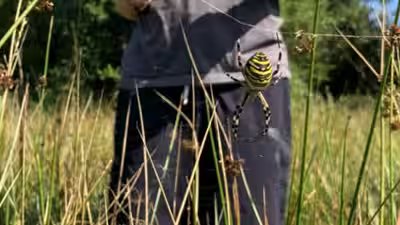
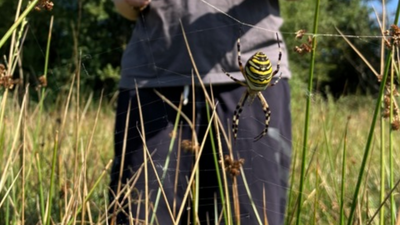
The spider is a wasp spider, Argiope bruennichi, an orb-weaving species recognised for the bold yellow, white and black pattern across the female’s abdomen. Its appearance can make it look more like a wasp than a spider, but the resemblance is only visual. The species is harmless to people and is not considered a threat to humans. Wendy was spotted by Rosie Cooper, an estate biodiversity assistant at Chester Zoo, while she was carrying out fieldwork. The discovery happened during a wider survey of plants and wildlife on the zoo’s estate.Chester Zoo conservationists made the discovery while working with RECORD, Cheshire’s local environmental records centre. The identification was then confirmed by a British Arachnological Society expert, establishing the sighting as the first recorded wasp spider in Cheshire. The spider itself is relatively large compared with many species commonly seen in Britain. Chester Zoo said wasp spiders can measure around 2-3cm across the body and build ornate webs among vegetation. Their webs can also feature a conspicuous vertical band of white silk, a characteristic associated with the species.
Why the spider is moving north
Although the wasp spider is new to Cheshire records, it is not new to Britain. The species was first recorded in the UK in 1922 at Rye in East Sussex and has since become widespread in southern England. According to the British Arachnological Society, it is now spreading northwards. The species needs a prolonged period of warm weather to reproduce successfully, along with relatively mild winters. As Britain’s climate changes, conditions suitable for the spider are becoming more common in areas farther north than its traditional range. That makes the Cheshire sighting more than an unusual wildlife encounter. It is also an example of how changing environmental conditions can influence where species are able to live.Ruby Merriman, Chester Zoo’s estate biodiversity manager, said the species is slowly moving north because parts of its southern European range are warming too quickly for the spiders to remain there in the same way. Chester Zoo described animals shifting their ranges in response to climate change as “climate refugees”. The movement does not mean that every individual spider has suddenly travelled hundreds of miles north. Instead, species can gradually expand their range over generations as suitable habitat and climate conditions appear in new places.
What makes the wasp spider distinctive
The female wasp spider is particularly easy to recognise. Its abdomen carries the vivid yellow, black and white markings that give the species its common name, while its legs are also striped. Males are considerably smaller and have much less striking colouring. The spider hunts from the centre of its orb web, where it waits for insects to become trapped. Grasshoppers and crickets are among its preferred prey, although flies and other insects can also form part of its diet.Its life cycle is also closely connected to the seasons. Adults mature around August and September. After mating, the female produces an egg sac that is attached to vegetation, with the young remaining protected inside until the following spring. Adult females die during autumn. Despite its dramatic appearance, there is little reason for people to be concerned if they encounter one. Chester Zoo specifically describes the species as completely harmless to humans.
A small spider with a bigger climate message
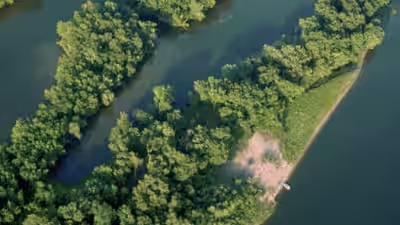
The discovery comes from an unusually diverse area of habitat. Chester Zoo’s estate covers about 205 hectares, including wet meadows, ponds, reedbeds, grasslands, woodlands, orchards and hedgerows. The area supports species including harvest mice, great crested newts and badgers, while barn owls also nest there. For conservationists, the arrival of the wasp spider therefore fits into a much wider picture. Some wildlife species are expanding into areas where conditions have become more suitable, while others face increasing pressure as their established habitats become warmer, drier or otherwise less suitable.Scott Wilson, Chester Zoo’s head of field programmes, said the arrival of Wendy was exciting but also part of a broader trend linked to climate change. He pointed to changes being observed in ecosystems around the world and said European spiders are among the wildlife groups experiencing difficulty as climates shift. The Cheshire sighting does not, on its own, prove that climate change caused this individual spider to appear there. However, the species’ established northward expansion, combined with its dependence on warm conditions and milder winters, makes the discovery part of a broader pattern already documented by British arachnologists.For now, “Wendy” is simply an eye-catching new record for Cheshire. But her presence also offers a visible reminder that the map of British wildlife is not fixed. As temperatures and seasons change, the places where different plants and animals can survive may change with them.