
The greatest traitor and the biggest lie part 12
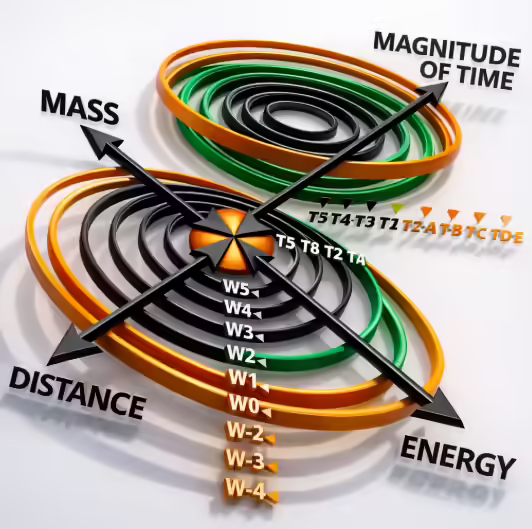
Once Time is perceived from its smallest unit—where nothing else exists (the Adwaita state)—the correlation between action and consequence is immediate. However, Time is experienced within the body and then projected outward. The moment it is projected outward (i.e., when “otherness” arises), it becomes staggered. A gap between cause and consequence is thus created. At this point, the theory of Karma becomes intelligible.
We must understand that the Soul and the body are entangled. The body, being a projection of the soul, receives the consequences—but with delay. These consequences manifest according to the condition of the body as a whole. The body is constituted of Tatwas, and these Tatwas exist in all individuals and in matter itself. Therefore, one body is entangled with all other bodies through the Tatwas. This universal entanglement is what Indian seers refer to as “Eak hi Bramha, ditiya nasti”—only Brahman exists, nothing else.
This entanglement is instantaneous (without time lag), yet consequences appear delayed. All actions—physical, mental, and emotional—accumulate, and their results manifest depending on the state of the body. The more outward the projection, the greater the staggering of consequences.
The double-slit experiment deepens this understanding. It suggests that a particle behaves differently when observed. In a similar way, observation introduces the role of the Soul. When I am unobserved, I exist in one state; the moment I realise I am being observed, I change. My physical, mental, and emotional states shift instantly. Particles reflect this intrinsic principle of behaviour.
Consider a simple example. When a person knows he is being observed—say, by a traffic camera—his behaviour changes immediately. Once he passes the camera, the behaviour reverts. The duration of observation matters, as does awareness of being observed. Particles register observation instantly; humans, however, process it through mind and emotion. It is the Tatwas that detect observation. Highly activated Tatwas recognise it quickly; less activated Tatwas recognise it with delay. Activation here simply refers to the level of responsiveness within the Tatwas.
When a person is already inclined to violate traffic rules, he becomes more alert to spotting cameras. His internal energy aligns with that possibility, making behavioural correction more immediate. This subtle mechanism has far-reaching implications.
Indian seers therefore emphasise: meditate. Observe the mind, the breath, the body, the feelings. Then go further—become a Witness, without entangling with what is observed. This is essentially an attempt to decouple action from consequence.
Entanglement creates the conditions for the fructification of actions. In complete disentanglement, consequences pursue the doer but fail to catch up. These consequences—physical, mental, emotional—exist within what we have called a “Time Capsule.” When consequences cannot catch up, it means Time itself cannot find and bind the individual. This state is referred to as Maheswara. Time trails behind and can’t reach. Actions performed here are free of consequence—completely independent. This is what the seers call Mukti (freedom): freedom even from one’s own actions, thoughts, and emotions.
The moment one assumes the stance of a Witness, material behaviour changes—it becomes indeterminate. Time, which contains this material, also becomes fluid, unable to identify the doer. Entanglement arises from Ego—the faculty of distinction. The lesser the Ego, the weaker the hold of past Karmas. The weaker their hold, the less they interfere with the present. Independence increases accordingly.
Consider another example. If my wife is unaware of a place called Honolulu, then for her, it effectively does not exist. She has no basis to distinguish herself from someone living there; hence, no entanglement. The moment she comes to know of Honolulu, exactly at that moment, ego appears. The moment awareness arises; distinction follows. Comparison begins, and entanglement becomes inevitable. The challenge is to know without becoming entangled—to remain a Witness. This, the seers insist, is possible only through meditation.
This is why Indian symbolism portrays Shiva or Maheswara in meditation. Even Mahakala (Real Time) cannot infuence him. He remains ahead of Time, though Time continues its pursuit. Time still exists—but as reality, not as projection. He remains untouched by Time.
A soul completely devoid of materiality, ego, and time is termed Paramatma. Nothing else exists in that state. This differs from Adwaita, where Time still exists in its most subtle unit as discussed in Part 11.
Between Adwaita and Paramatma unfolds a cosmic play: Time attempting to catch up—sometimes succeeding, sometimes failing. This eternal interplay is called Raas Leela. Its essence lies in observation and entanglement—the same principle reflected in the double-slit experiment.
To extend this idea (as Osho often suggests): sex represents the highest form of physical entanglement. When combined with awareness, it transforms into meditation. When emotions are added, it becomes Raas Leela. Throughout, Time records everything, storing it within its capsule, only to return it as present in the form of consequence. Every dimension of life follows this same pattern.
Thus, Time again appears as a traitor—delivering unintended consequences we experience as suffering. The task is to transform this suffering into bliss. The instruction is simple but demanding: do not attach, do not entangle—observe.
Indeed, Time is both the greatest traitor and the greatest teacher.
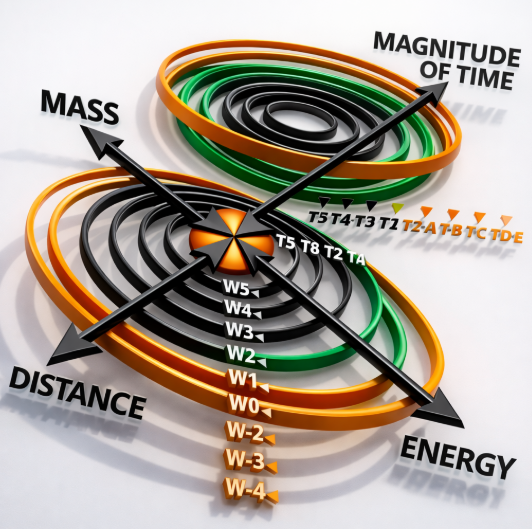

Different worlds are dancing in cosmic rhythm, our soul at the centre manifesting in different worlds, Time playing the music. The love or averseness for time creates the vibration. The staggering time creates friction leading to vibration. This vibration is put into a rhythm.
Many romantics say that the flute of Krishna is Mahadev or Mahakal and this initiates the Raas Leela.
Time reveals itself not as a fundamental reality but as a shadow cast by entanglement. In the state of bhokta, where one is fully identified with body, mind, and the surrounding field, actions solidify into consequences that return with delay, giving rise to the lived experience of Time and Karma. As awareness shifts into drashta and upadrasta, the seer and the witness, this entanglement loosens; behaviour subtly transforms under observation, and the distance between cause and consequence begins to contract. With deeper realisation as anumanta and bharta, one stands as the silent ground that permits and sustains all movement, where consequences are no longer merely suffered but quietly shaped. In Maheswara, action flows without residue—Time follows but cannot bind. And beyond even this, in Paramatma, where no distinction remains, the very basis for Time dissolves. A quiet parallel may be seen in Quantum Decoherence within Quantum Mechanics, where interaction—not awareness—renders possibilities into fixed outcomes. So too, the deeper the entanglement, the firmer the grip of Time; and as witnessing deepens, that grip loosens, until Time, once the great pursuer, is revealed to have been only a condition of involvement.
Time’s journey starts from becoming and not Being. It’s not an entity to start with. It moves or vibrates (Dimention or call it direction) and manifests as a being or a presence. Material, body or soul start by being a Being or an entity. Gradually, becoming becomes a habit and subsequently transcend to something I call ‘Becoming to Nothing – No presence only permeance’. Scientifically this would mean ‘Absence of any Tatwa’.
We will explore subsequently sticking centrally to the concept of Time and see possibilities with respect to different kind of souls, worlds and how they are entangled.
Disclaimer
Views expressed above are the author’s own.
END OF ARTICLE